
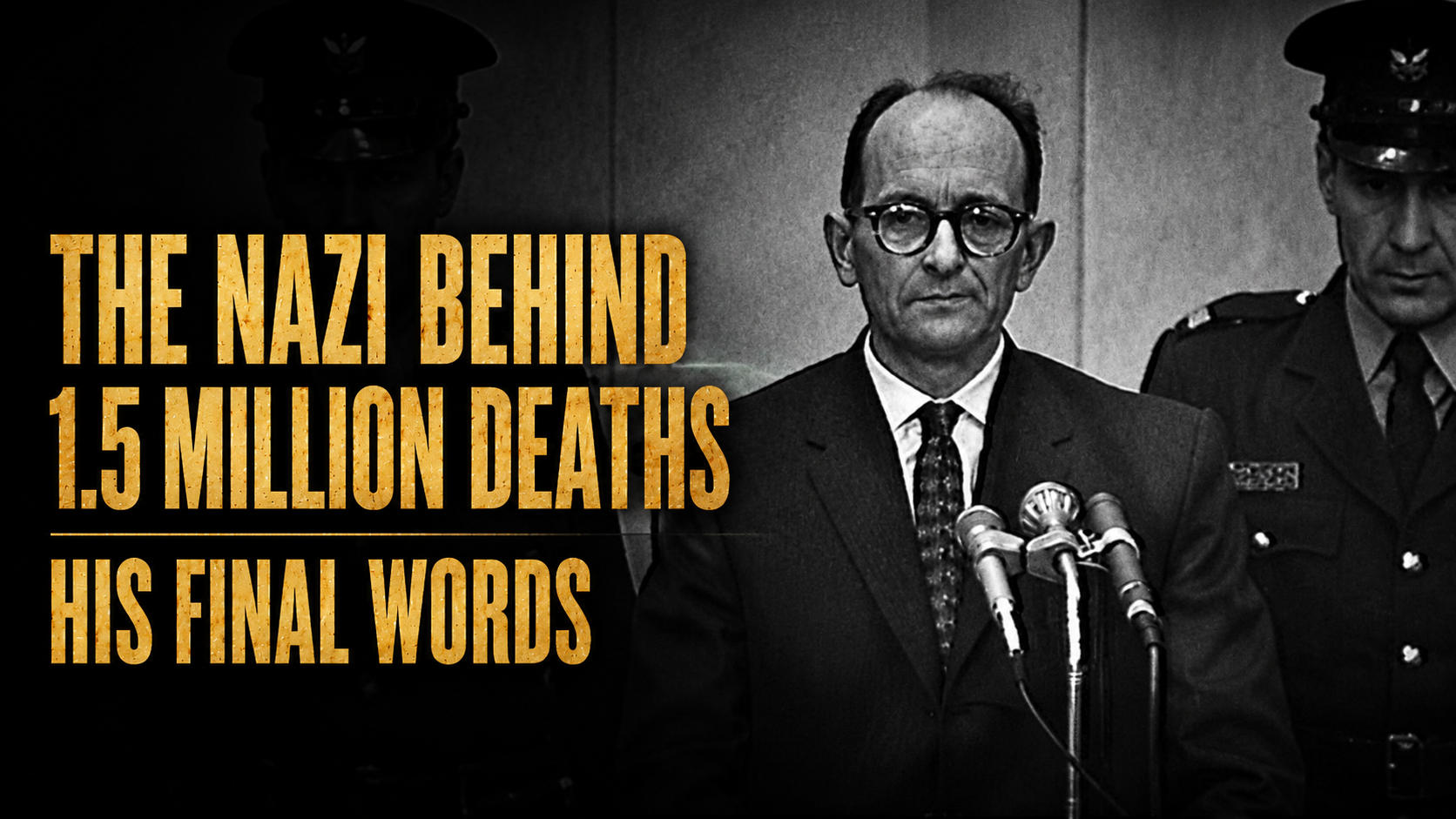

Adolf Eichmann’s final words before execution remain one of the most disturbing moments in the history of postwar justice. He was not remembered as a battlefield commander, nor as a dictator giving orders from the top of the Nazi hierarchy. Eichmann became infamous for something colder and, in many ways, more terrifying: the bureaucratic organization of mass deportation.
He was the man who helped turn murder into paperwork, train schedules, lists, signatures, and transport orders.
During the Holocaust, Eichmann played a central role in the Nazi system that deported Jews from across Europe to ghettos, concentration camps, and killing centers. His work was not accidental. It was not passive. It was administrative violence on a continental scale.
And in 1962, after years of hiding in Argentina, he stood in an Israeli prison waiting for the only civilian execution ever carried out by the State of Israel.
The Man Behind the Deportations
Adolf Eichmann was born in Germany in 1906. In the early 1930s, he joined the Nazi Party and the SS, entering a political movement built on antisemitism, racial ideology, and totalitarian control. Over time, he became attached to the section of the Nazi security apparatus responsible for “Jewish affairs.”
Eichmann was not the original author of Nazi antisemitism. He was not the only man responsible for the Holocaust. But his role was crucial because he helped transform Nazi ideology into a functioning system of deportation and death.
His office coordinated with ministries, railway authorities, police units, local collaborators, and occupation governments. The language was bureaucratic: transports, resettlement, evacuation, quotas. But behind those words were human beings forced into cattle cars, separated from their homes, and sent toward ghettos, forced labor camps, and extermination centers.
This is what made Eichmann so chilling. His crimes were not carried out in a moment of rage. They were organized through routine. He represented the desk-bound machinery of genocide.
A Bureaucrat of the “Final Solution”
Eichmann’s name became permanently connected to the “Final Solution,” the Nazi plan to annihilate Europe’s Jews. His department helped manage the forced movement of Jewish communities from occupied territories into the Nazi killing system.
In many cases, deportations followed a similar pattern. Jewish families were first identified, stripped of rights, robbed of property, concentrated in ghettos or assembly points, then loaded onto trains. The transports were often presented in official language as relocation. In reality, many were sent directly to killing centers such as Auschwitz-Birkenau.
One of the most devastating examples came in Hungary in 1944. Even as Nazi Germany was losing the war, the deportation machinery accelerated. Within weeks, hundreds of thousands of Hungarian Jews were deported, most of them to Auschwitz. Eichmann was deeply involved in this late-stage operation, proving that even near the collapse of the Third Reich, he remained committed to the genocidal mission.
For Eichmann, murder did not require him to pull a trigger. He helped build the system that delivered victims to those who did.
Escape After the War
When Nazi Germany collapsed in 1945, many of its officials disappeared into the chaos of postwar Europe. Eichmann was captured by American forces, but he concealed his identity and eventually escaped.
For years, he lived under false names. Like many Nazi fugitives, he benefited from escape networks and the confusion of the immediate postwar period. Eventually, he made his way to Argentina, where he lived under the name Ricardo Klement.
In Argentina, Eichmann tried to disappear into an ordinary life. He worked, lived with his family, and avoided public attention. But his past did not vanish. Survivors, investigators, and Israeli intelligence continued to search for Nazi war criminals who had escaped justice.
In May 1960, Israeli agents located Eichmann near Buenos Aires. He was captured and secretly taken to Israel. The operation was controversial internationally, but for many Holocaust survivors, it represented something far greater than the arrest of one man. It was the return of a major Nazi criminal to a courtroom where the world would finally hear the voices of his victims.
The Trial in Jerusalem
Adolf Eichmann’s trial opened in Jerusalem in 1961. It became one of the most important trials of the twentieth century.
Unlike the earlier Nuremberg Trials, which had focused heavily on documents and the Nazi leadership as a whole, the Eichmann Trial placed survivor testimony at the center. Witness after witness described ghettos, deportations, selections, shootings, camps, hunger, loss, and the destruction of entire communities.
Eichmann sat behind a glass booth, wearing headphones, listening as the story of the Holocaust was presented not only as a legal case but as a human catastrophe.
His defense followed a familiar pattern used by many perpetrators after the war. He claimed that he had only followed orders. He portrayed himself as a subordinate, a man trapped inside a chain of command. He denied being one of the true decision-makers.
But the court rejected this image. Eichmann had not been a powerless clerk. He had been an active organizer within the Nazi system of persecution and murder. He had shown initiative. He had coordinated deportations. He had understood what the system was doing.
The trial exposed a terrifying truth: genocide does not depend only on fanatics with weapons. It also depends on administrators, schedules, offices, and men who convince themselves that obedience is innocence.
No Remorse
One of the most disturbing aspects of Eichmann’s case was his refusal to express genuine remorse.
He did not speak like a man overwhelmed by guilt. Instead, he hid behind procedure, hierarchy, and obedience. He suggested that his conscience was clear because he had acted according to the rules of the regime he served.
This was one reason his trial became so influential. Eichmann forced the world to confront a difficult question: What happens when ordinary administrative language is used to carry out extraordinary evil?
He did not appear as a monster in the theatrical sense. He appeared as a bureaucrat — calm, precise, and evasive. That made him even more frightening.
Sentenced to Death
In December 1961, Adolf Eichmann was found guilty of crimes against the Jewish people, crimes against humanity, war crimes, and membership in criminal organizations. He was sentenced to death.
His appeals failed. His request for clemency was rejected.
In the final hours before his execution, Eichmann remained defiant. Accounts of his last words differ in exact wording, but they share the same essential meaning: he did not offer repentance. He expressed loyalty to Germany, Argentina, and Austria, and according to later recollections, he left behind a final bitter remark to those present.
Shortly after midnight, on June 1, 1962, Adolf Eichmann was hanged at Ramla Prison in Israel. His body was cremated, and his ashes were scattered at sea outside Israeli territorial waters, so that no grave could become a site of pilgrimage for Nazi sympathizers.
Why Eichmann’s Final Words Still Matter
Eichmann’s final words are remembered not because they were profound, but because they were empty of remorse.
They revealed the same moral absence that had defined his defense. Even at the end, he did not truly face the victims. He did not ask forgiveness. He did not acknowledge the full human weight of what he had helped organize.
That is why Eichmann remains such an important figure in the study of the Holocaust. He represents the danger of obedience without conscience, administration without morality, and ideology turned into logistics.
The photograph of Eichmann in custody, surrounded by guards or sitting alone before judgment, is powerful because it shows no battlefield. No ruins. No dramatic collapse. Just a man in a suit.
And yet behind that image lies one of the most devastating systems of organized murder in human history.
Adolf Eichmann’s execution did not bring back the millions who were murdered. It did not heal the survivors. It did not erase the crimes of the Nazi regime.
But it forced the world to look directly at a man who had helped make genocide function — not through chaos, but through order.
His final words were not a confession.
They were a warning about what happens when a man gives his loyalty to a system and abandons his humanity.