

The sudden death of a Royal Navy giant
On November 25, 1941, in the eastern Mediterranean, one of Britain’s most powerful battleships vanished in one of the most dramatic naval disasters ever captured on film.
HMS Barham was not a small escort ship, nor a forgotten vessel on the edge of war. She was a Queen Elizabeth-class battleship, a veteran of the Royal Navy, and a symbol of British sea power. By the time of the Second World War, she had already served for more than two decades and had survived the brutal naval battles of the First World War.
But her final moments lasted only minutes.
The footage of her destruction remains one of the most haunting images of the Second World War: a massive battleship rolling helplessly onto her side, sailors scrambling across the exposed hull, and then, without warning, a catastrophic explosion tearing the ship apart.
It was not just the sinking of a warship. It was the instant transformation of steel, fire, water, and human life into history.
A battleship from another era
HMS Barham was launched in 1914 and commissioned into the Royal Navy in 1915. She belonged to the Queen Elizabeth class, a group of fast battleships that represented some of the most advanced naval thinking of their time.
These ships were built around heavy firepower, thick armor, and speed. Their main guns were designed to fight enemy battleships at long range, while their armor was meant to absorb the punishment of a major fleet engagement.
During the First World War, Barham fought at the Battle of Jutland in 1916, the largest naval battle of that conflict. She survived that war and remained in service through the interwar years.
By 1941, however, naval warfare had changed. Battleships were still powerful, but they were no longer untouchable. Aircraft, submarines, torpedoes, and mines had made even the largest warships vulnerable. The age of the battleship was beginning to fade, and the Mediterranean was one of the places where that truth became brutally clear.
The Mediterranean war
In 1941, the Mediterranean was one of the most important naval theaters of the Second World War. Britain needed to protect supply routes to Egypt, Malta, and the wider Middle East. Axis forces, especially Italy and Germany, tried to cut those routes and weaken British control of the region.
HMS Barham was part of the British Mediterranean Fleet. Her presence mattered. A battleship like Barham could support operations, escort convoys, and project power across the sea.
But the Mediterranean was dangerous. German U-boats were operating in the region, and one of them, U-331, would soon become part of Barham’s story.
U-331 was commanded by Hans-Diedrich Freiherr von Tiesenhausen. On November 25, 1941, the submarine found itself in position to attack a powerful British force.
For a submarine commander, this was an extraordinary opportunity. For HMS Barham, it was the beginning of the end.
The attack by U-331
Barham was sailing with other Royal Navy ships when U-331 launched its torpedoes.
Three torpedoes struck the battleship in close succession.
The impacts were devastating. Barham began to list heavily to port. Within minutes, the great ship was rolling over. Her crew fought for survival as the vessel lost stability and the sea began to claim her.
In the surviving footage, the viewer can see the terrible speed of the disaster. Sailors appear on the exposed side of the hull, trying to escape as the battleship turns over. Some slide down the metal surface. Others are trapped by the chaos around them.
Then came the explosion.
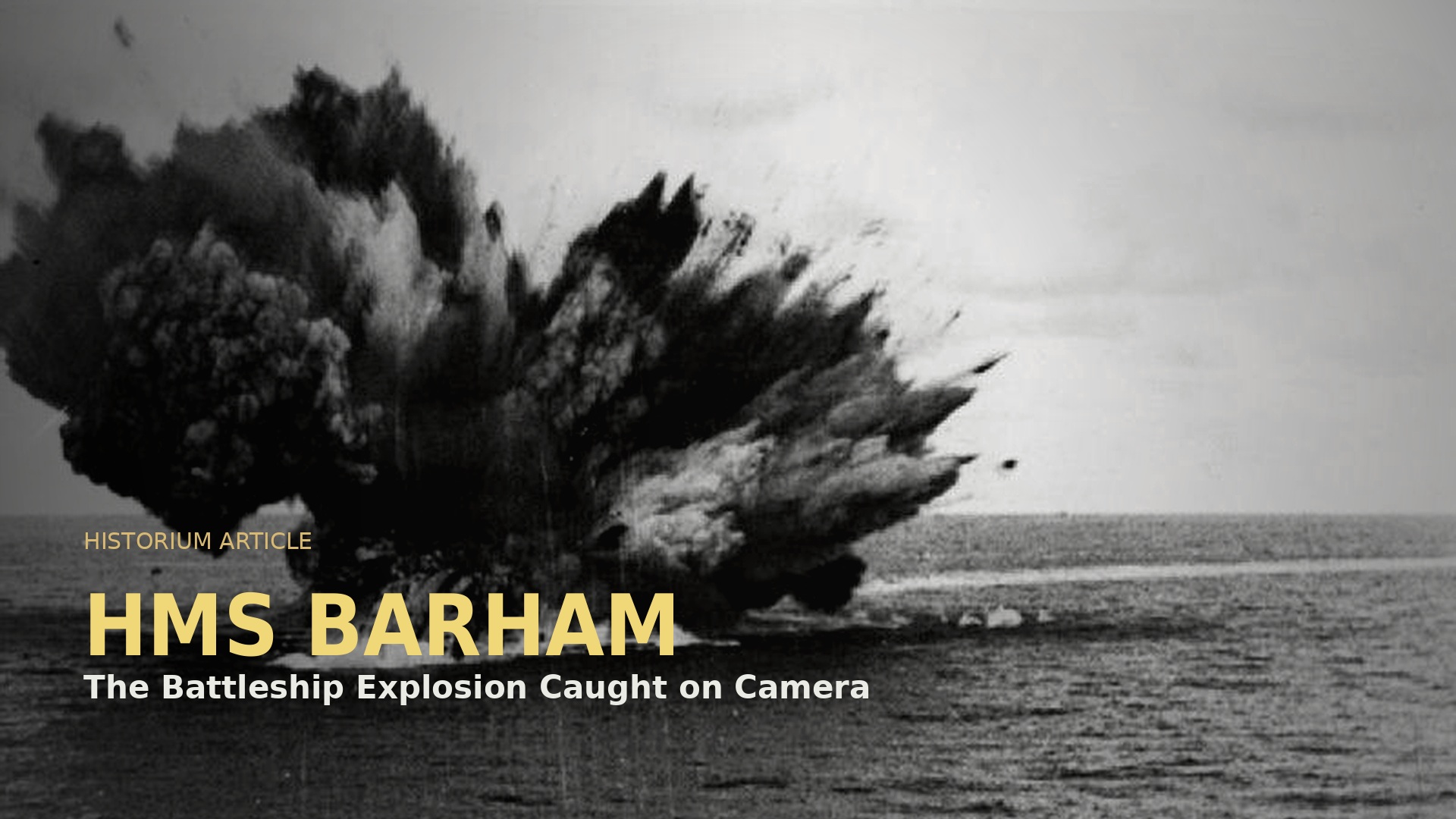
As Barham capsized, one of her magazines detonated. The result was a massive blast that erupted from the ship with terrifying force. A giant cloud of smoke, fire, and debris consumed the frame. The battleship disappeared into the sea.
The entire disaster unfolded in only a few minutes.
Why the explosion was so powerful
The explosion that destroyed HMS Barham was caused by the detonation of her ammunition magazines.
A battleship carried enormous quantities of explosive shells and propellant for its main guns. These magazines were usually protected deep within the ship, surrounded by armor and safety systems. But once a warship was fatally damaged, capsizing, flooding, and internal fires could turn those magazines into a catastrophic threat.
When Barham rolled over, the conditions inside the ship became uncontrollable. The detonation was not a normal explosion on the surface of the vessel. It was the violent destruction of the ship’s own stored firepower.
That is why the blast was so enormous.
The ship did not simply sink. She blew herself apart.
The human cost
The loss of HMS Barham was catastrophic.
A total of 862 men died: 56 officers and 806 ratings. Many were killed in the explosion itself. Others were trapped inside the ship or lost in the sea.
Hundreds survived, rescued by nearby ships. But for those who witnessed the disaster, the sight must have been almost impossible to forget. One moment, Barham was a battleship sailing in formation. Minutes later, she was gone.
The footage makes the tragedy feel immediate even today. It is not an abstract naval loss or a number in a wartime report. It shows the final seconds of a ship and the desperate struggle of the men aboard her.
That is what makes the sinking of HMS Barham so disturbing. We are not only reading about a disaster. We are watching it happen.
A disaster captured on film
One of the most remarkable aspects of Barham’s sinking is that it was filmed.
The footage was captured from another British ship nearby. It later became one of the most famous pieces of naval footage from the Second World War.
But the film was not immediately shown to the public.
During wartime, governments often controlled information about major losses. The destruction of a battleship was not only a military event; it was also a matter of morale. News of such a dramatic loss could shock the public and encourage the enemy.
For a time, the sinking of HMS Barham was kept secret. Families of the dead were eventually informed, but the full visual horror of the disaster was not immediately released to the wider public.
When the footage became widely known, it turned Barham’s final moments into one of the most iconic and tragic naval images of the war.
The vulnerability of battleships
The sinking of HMS Barham was part of a larger lesson in twentieth-century warfare.
Battleships had once been considered the ultimate expression of naval power. They were massive, heavily armored, and armed with giant guns. For decades, nations measured their strength by the size and number of their battleships.
But the Second World War showed that size alone could not guarantee survival.
Aircraft sank powerful ships from the air. Submarines struck from beneath the waves. Torpedoes could disable or destroy vessels that had taken years to build and thousands of men to operate.
Barham’s destruction was a reminder that even the strongest ships could be vulnerable when hit in the right place at the wrong moment.
Only a few weeks after Barham’s sinking, Britain would suffer another major naval shock: the loss of HMS Prince of Wales and HMS Repulse to Japanese aircraft in December 1941.
The message was becoming impossible to ignore. Naval warfare had entered a new era.
Remembering HMS Barham
Today, HMS Barham is remembered not only as a Royal Navy battleship, but as the subject of one of the most haunting visual records of the Second World War.
Her sinking combines several elements that make it unforgettable: the scale of the ship, the speed of the disaster, the violence of the explosion, and the knowledge that hundreds of men were dying in the same moment the camera continued to roll.
For historians, the footage is an important record of naval warfare. For viewers, it is something more emotional: a direct encounter with the reality of war at sea.
The destruction of HMS Barham was not cinematic fiction. It was not a staged scene. It was a real disaster, captured by chance, preserved by history, and remembered because it shows the terrifying vulnerability of even the mightiest machines.
In less than five minutes, a battleship that had served through two world wars was gone.
And the camera kept filming.