
Shinano: The Secret Supercarrier That Sank Before It Could Fight
In the final year of World War II, Japan launched one of the largest and most secretive warships ever built. Her name was Shinano. She was meant to represent power, endurance, and survival at a moment when the Japanese Empire was already collapsing. Instead, she became one of the most tragic symbols of that collapse: a giant aircraft carrier sunk on her first voyage, before she ever launched a combat aircraft.
Shinano did not begin life as an aircraft carrier. She was laid down at Yokosuka Naval Arsenal on May 4, 1940, as the third ship of the legendary Yamato-class battleships, the same family that produced Yamato and Musashi. Yokosuka’s massive Dry Dock No. 6 had been built specifically for constructing ships of this scale, and Shinano’s hull was already well advanced when Japan’s naval priorities began to change.
The turning point came after the disasters of 1942, especially the Battle of Midway, where Japan lost four fleet carriers. The age of battleship dominance was ending. Aircraft carriers, not giant gunships, had become the decisive weapons of the Pacific War. Shinano’s future was therefore rewritten: instead of becoming another Yamato-class battleship armed with massive guns, she would be converted into an aircraft carrier.
But Shinano was never a clean carrier design. She was an emergency conversion built on a battleship hull. That made her enormous, heavily armored, and visually intimidating, but also complicated. She carried the legacy of a battleship beneath the flight deck of a carrier. In theory, this made her a floating fortress. In practice, it made her a rushed and unfinished compromise.
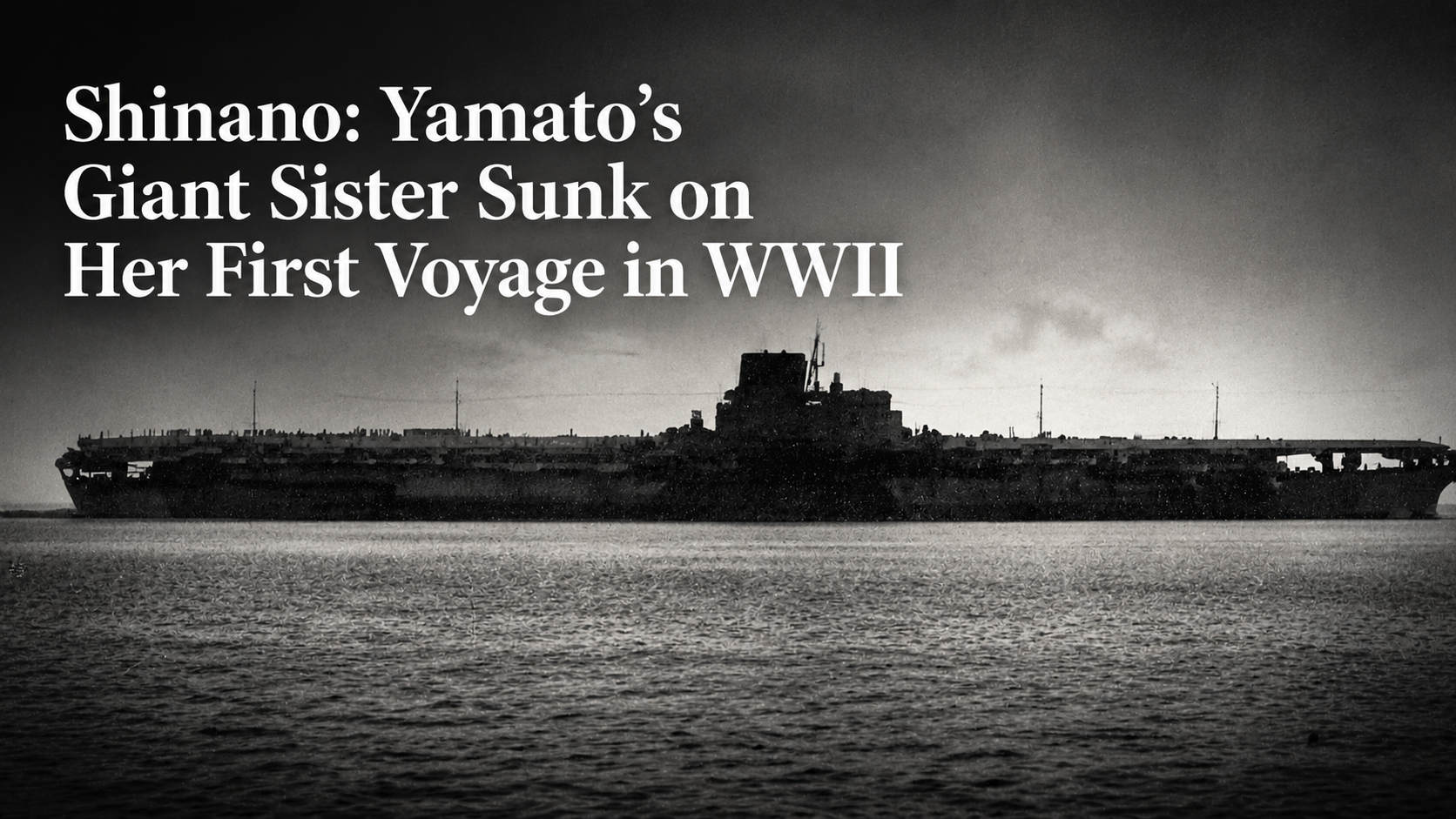
Even her secrecy was extreme. Very few photographs of Shinano survive today. The U.S. Naval History and Heritage Command notes that its page features only the available views concerning the ship, while the famous sea-trials photograph preserved through Wikimedia Commons identifies Shinano underway in Tokyo Bay on November 11, 1944, photographed by marine engineer Hiroshi Arakawa and held in the Kure Maritime History Science Museum collection.
By November 1944, Shinano was officially commissioned, but she was not truly ready for war. She was still incomplete. Important watertight doors had not been fully installed, internal compartments were not fully tested, and the crew had not received the level of damage-control training needed for a ship of her size. This was not a minor weakness. For a carrier expected to survive battle damage, internal compartmentalization could mean the difference between staying afloat and dying slowly.
On November 28, 1944, Shinano left Yokosuka for Kure, where final fitting-out work was supposed to continue. She sailed with the destroyers Isokaze, Yukikaze, and Hamakaze as escorts. According to U.S. Navy Region Japan’s historical account, she had been underway only about four hours when she was detected by the American Balao-class submarine USS Archerfish.
Archerfish was commanded by Commander Joseph F. Enright. At first, the American crew did not fully understand what they had found. Shinano was so secret that Allied intelligence did not have a clear picture of her existence as an operational carrier. To the men aboard Archerfish, the silhouette that appeared before them was almost unreal: a massive carrier, moving through the night with escorts, where no such ship was expected. The U.S. Submarine Force Library and Museum account describes Archerfish tracking the target for hours before moving into attack position.
Then came the moment that sealed Shinano’s fate. Archerfish fired a spread of six torpedoes. Four struck home. The attack did not instantly destroy Shinano, and that is part of what makes the story so haunting. For several hours, the giant carrier remained afloat. But the damage spread through an unfinished ship whose systems and crew were not prepared for a crisis of that scale.
The tragedy of Shinano was not simply that she was hit. Warships were designed to take damage. The tragedy was that her size and armor created a dangerous illusion of safety. Her builders had produced one of the largest carriers the world had ever seen, but size alone could not save her from flooding, poor readiness, and rushed construction. Once water began moving through vulnerable spaces, the carrier’s immense mass became a burden rather than a protection.
By the morning of November 29, 1944, Shinano was lost. She capsized and sank south of Japan, taking more than 1,400 men with her. Many accounts give the death toll as 1,435, with about 1,080 survivors rescued by the escorting destroyers. Captain Toshio Abe was among those who did not survive.
The Americans did not immediately know what Archerfish had sunk. The target was initially believed to be a smaller carrier. Only after the war was the true identity confirmed: USS Archerfish had destroyed Shinano, the largest warship ever sunk by a submarine. The Naval History and Heritage Command later noted that Archerfish received the Presidential Unit Citation for the action.
Shinano’s loss was more than a naval disaster. It was a perfect image of Japan’s late-war crisis. The empire still possessed engineers capable of building enormous machines, but it no longer had the time, resources, fuel, trained crews, or strategic freedom to use them properly. Yamato, Musashi, and Shinano were all born from the same dream of overwhelming naval power. All three were lost.
That is why Shinano remains such a powerful historical story. She was not destroyed in a grand carrier battle. She did not fall after launching waves of aircraft against an enemy fleet. She never fulfilled the role for which she had been converted. She was built in secrecy, rushed into service, forced out of port before she was ready, and sunk in darkness by a single submarine.
In the end, Shinano was not just a shipwreck. She was the last breath of an idea: that steel, armor, and size could still decide the future of naval warfare. Her sinking proved the opposite. In the Pacific War, the age of the giant battleship had already passed — and even the largest aircraft carrier in the world could disappear beneath the waves before history had the chance to see her fight.