
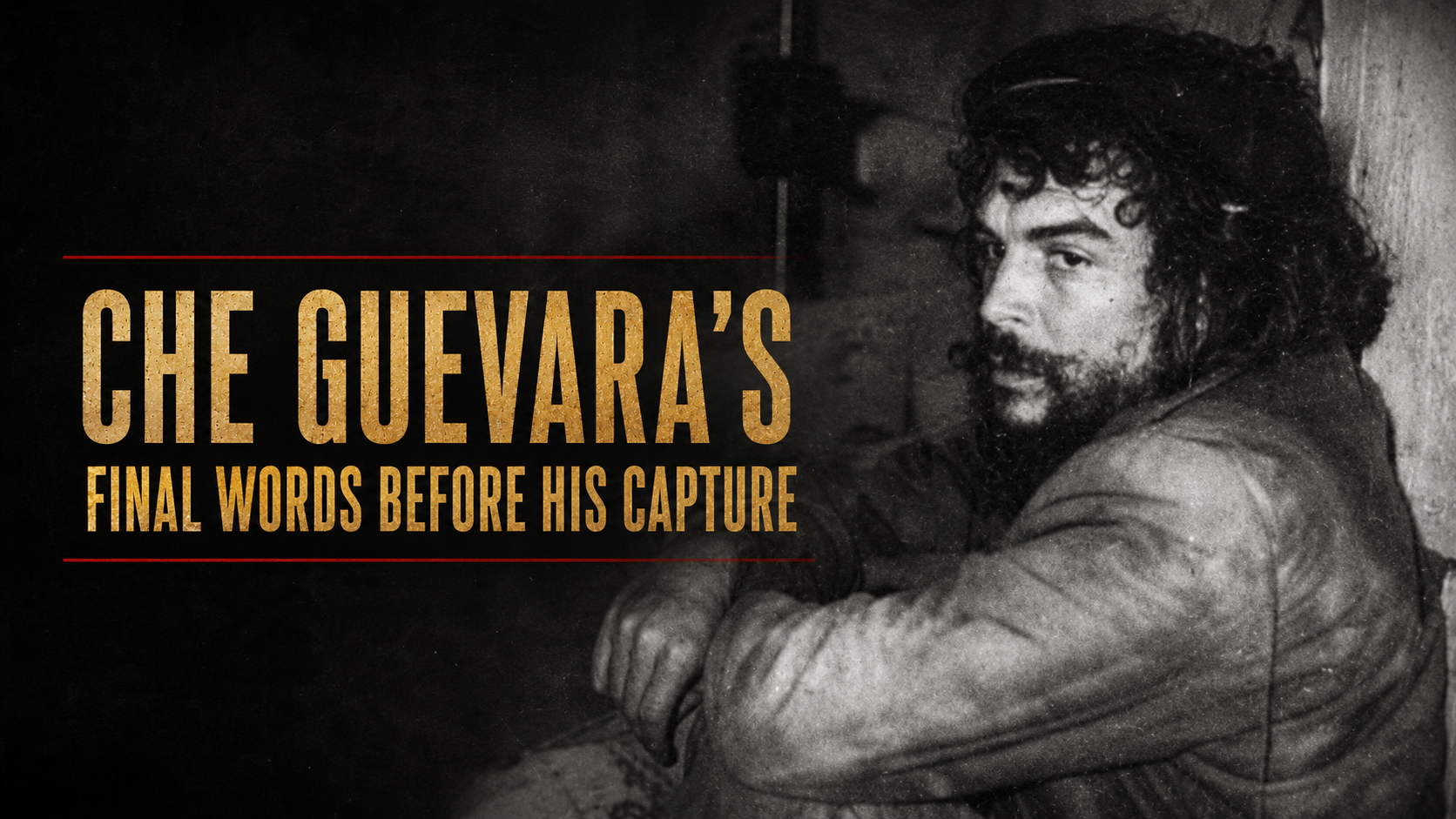

The failed last campaign of the world’s most famous guerrilla
By the time Che Guevara reached Bolivia in 1966, he was no longer the celebrated revolutionary commander who had helped bring Fidel Castro to power in Cuba. He was a fugitive from public life, a man who had walked away from government, diplomacy, and the symbolic safety of Havana to chase one final, impossible dream: a revolution that would spread across Latin America.
That dream ended in a narrow Bolivian ravine on October 8, 1967.
Wounded, exhausted, starving, and surrounded by soldiers, Che Guevara was finally captured. According to the most widely repeated account of that moment, he shouted:
“Don’t shoot. I am Che Guevara. I am worth more to you alive than dead.”
Those words were not his final words before death. They were something different: the last words of Che Guevara as a free man.
The next day, inside a small village schoolhouse in La Higuera, the final hours of his life would begin.
From Algiers to disappearance
Che’s road to Bolivia did not begin in Bolivia. It began, in many ways, with a speech.
In February 1965, while still serving as Cuba’s Minister of Industries, Che Guevara spoke in Algiers at an international Afro-Asian gathering. The speech shocked many of Cuba’s allies because Che did not limit his criticism to the United States and Western imperialism. He also criticized the socialist bloc, accusing wealthy socialist countries of trading with poorer nations in ways that resembled the capitalist system they claimed to oppose.
For a man whose country depended heavily on Soviet support, this was a dangerous position.
Cuba’s economy, military strength, and survival after the revolution were deeply tied to Soviet assistance. Che’s words placed Fidel Castro in a difficult position. Che was still one of the most famous faces of the Cuban Revolution, but his vision of permanent global revolution no longer matched the diplomatic caution Cuba needed in order to survive.
Soon after, Che disappeared from public view.
He resigned from his official posts, gave up his Cuban citizenship, and left behind the life of a statesman. The man who had once appeared in military fatigues beside Castro now moved under false identities, hidden from the world.
His next battlefield was Congo.
The Congo failure
Che arrived in Congo in 1965 hoping to support a revolutionary movement against a Western-backed government. He believed Africa could become another front in the global struggle against imperialism.
But the campaign quickly collapsed.
The fighters he expected to train and lead were poorly organized. Rebel leadership was divided. Local conditions were far more complex than Che had imagined. Language barriers isolated him from the men he wanted to command. Disease and asthma weakened him. Instead of creating a disciplined revolutionary army, Che found chaos, mistrust, and defeat.
After months of frustration, he was secretly evacuated.
His own diary later described the Congo mission with brutal honesty: “This is the history of a failure.”
For many men, that would have been the end. For Che Guevara, it became only a pause before the final act.
Why Bolivia?
After Congo, Che eventually turned his attention to Bolivia.
To Che, Bolivia seemed strategically important. It sat near the heart of South America, bordered by several countries, and could theoretically serve as the center of a larger revolutionary wave. If a guerrilla war could begin there, Che believed it might spread into Argentina, Peru, Chile, Paraguay, and beyond.
His dream was not simply to overthrow the Bolivian government. His goal was continental revolution.
But Bolivia was not Cuba.
The Cuban Revolution had succeeded in part because Castro’s rebels developed support networks, local sympathy, and political momentum. In Bolivia, Che lacked nearly all of those advantages.
He entered the country under a false identity and began organizing a guerrilla foco, a small revolutionary nucleus meant to ignite a broader uprising. But the spark never became a fire.
A revolution without the people
From the beginning, Che’s Bolivian campaign was plagued by isolation.
The Bolivian Communist Party did not provide the support he expected. Its leadership was cautious, divided, and unwilling to fully submit to Che’s command. Without that local political infrastructure, the guerrillas were left dangerously exposed.
Even worse for Che, the local peasants did not rally to his cause.
He believed he was fighting for them. But many of the people living in the rural areas where his group operated saw him differently. To them, Che and his men were armed foreigners moving through their land, bringing danger, army patrols, and the threat of violence.
Some locals began passing information to the Bolivian military about guerrilla movements and hiding places.
This was one of the most fatal miscalculations of Che’s final campaign. A guerrilla war cannot survive on ideology alone. It needs food, shelter, information, and silence from the surrounding population. In Bolivia, Che’s group was slowly deprived of all four.
The net closes
By 1967, Che’s situation had become desperate.
His guerrilla column was shrinking. Supplies were scarce. Food was limited. Medicine was running out. Communication with outside supporters had broken down. Che’s asthma, which had troubled him since childhood, became a severe burden in the harsh terrain.
The Bolivian army, meanwhile, was improving.
Bolivian Ranger units had received American training, and U.S. intelligence was deeply interested in tracking Che’s movements. Washington had been watching Guevara since his disappearance from public view in Cuba. His presence in Bolivia turned a local counterinsurgency campaign into an international Cold War operation.
Che had once imagined Bolivia as the beginning of a continental revolution.
Instead, it became a trap.
The ambush at Quebrada del Yuro
On October 8, 1967, Che Guevara and the remaining members of his guerrilla group were caught near the Quebrada del Yuro ravine, close to the village of La Higuera.
The battle was short but devastating.
Bolivian soldiers moved against the guerrillas in rough terrain. Che was wounded in the leg. His rifle was reportedly damaged, leaving him unable to continue fighting effectively. The group around him was broken apart. Some were killed, others scattered.
By the time Bolivian soldiers closed in, Che was no longer in a position to resist.
The most famous account says he identified himself and warned the soldiers not to kill him:
“Don’t shoot. I am Che Guevara. I am worth more to you alive than dead.”
The sentence was practical, not poetic.
Che understood his value. Alive, he was an intelligence prize, a political trophy, and a figure whose capture would echo across the world. Dead, he would become something else entirely: a martyr.
The Bolivian soldiers captured him alive.
For the first time in years, Che Guevara was no longer moving, hiding, or fighting.
He was a prisoner.
The prisoner of La Higuera
After his capture, Che was taken to the small village of La Higuera and held inside a schoolhouse.
The image is almost surreal: one of the most recognizable revolutionaries of the twentieth century, wounded and exhausted, held in a tiny rural classroom in the mountains of Bolivia.
There, his fate was debated.
A public trial would have turned Che into a global spectacle. It could have embarrassed the Bolivian government, drawn international attention, and given Che a final platform. Imprisonment would have kept him alive as a symbol. Execution would end the immediate problem, but risk creating an even more powerful legend.
On October 9, 1967, the decision was made.
Che Guevara was executed inside the schoolhouse.
His body was later taken to Vallegrande and displayed to the press. The images of his corpse, eyes open, surrounded by soldiers and reporters, became some of the most haunting photographs of the Cold War era.
The Bolivian campaign had failed completely.
But in death, Che became more famous than ever.
Why his capture still matters
Che Guevara’s capture is often remembered as the dramatic fall of a revolutionary icon, but it also reveals the limits of his strategy.
He believed that a small, determined guerrilla force could ignite revolution across an entire continent. In Cuba, under very specific conditions, armed struggle had helped topple a dictatorship. In Bolivia, the same model collapsed.
The reasons were clear.
He lacked strong local support. He underestimated the political complexity of Bolivia. He failed to secure the loyalty of the rural population. He was cut off from reliable supply lines. His health deteriorated. And he faced a Bolivian military increasingly supported by American intelligence and counterinsurgency training.
Che’s final campaign was not simply a military defeat. It was the collapse of an idea: that revolution could be exported by willpower alone.
And yet, the words he shouted before his capture helped shape the legend that followed.
“I am worth more to you alive than dead.”
In the short term, he was right. Alive, he had intelligence value.
In the long term, history proved something darker.
Dead, Che Guevara became immortal.