
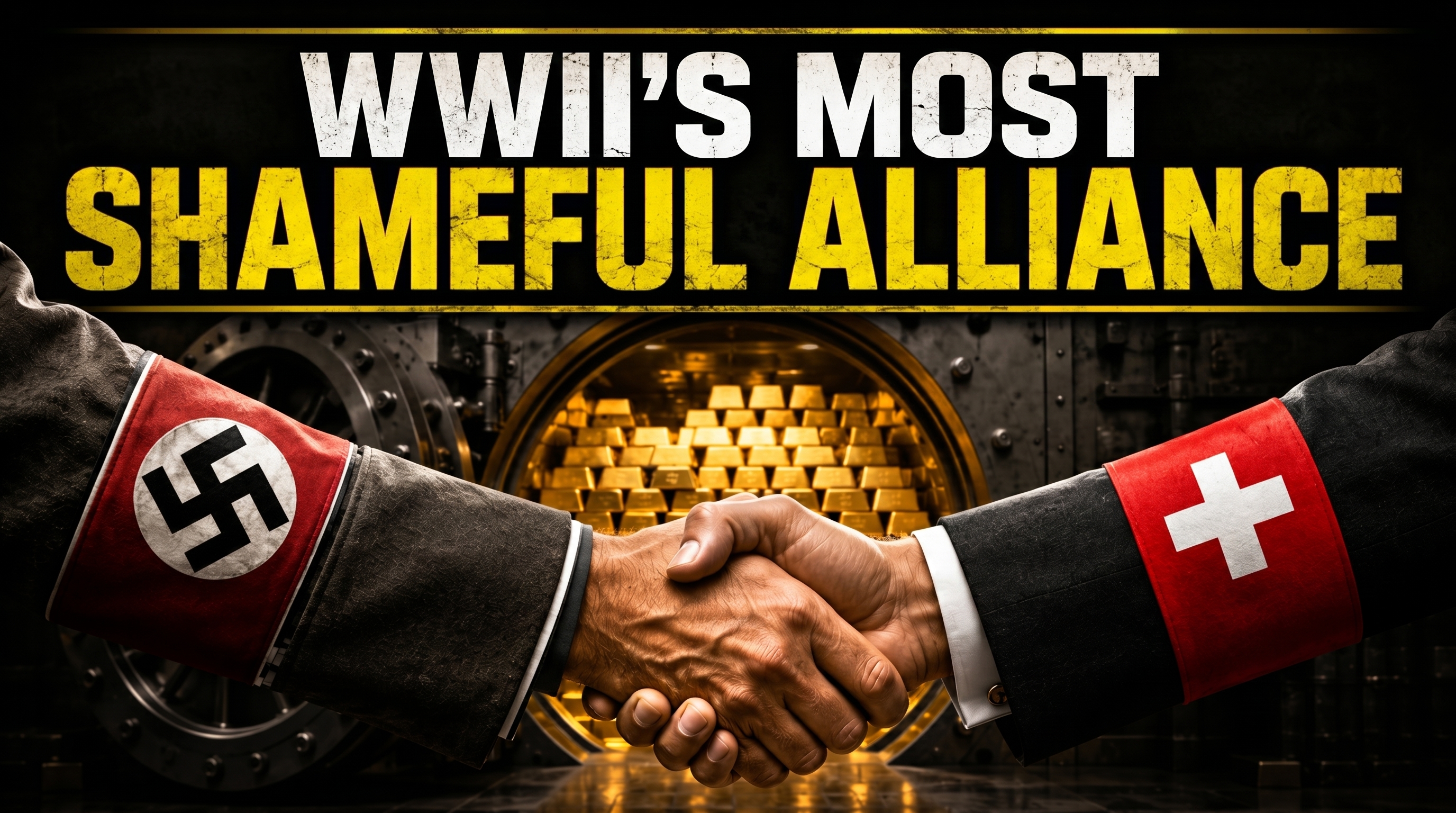

During the Second World War, Switzerland stood at the center of a paradox.
It was a small Alpine nation surrounded by violence, invasion, occupation, and collapse. Its cities were not reduced to rubble. Its government did not fall. Its territory was not occupied by Nazi Germany. To many observers, Switzerland appeared to be an island of peace in a continent consumed by war.
For decades, this image became part of Switzerland’s national identity: a neutral country, armed but peaceful, independent but restrained, protected from the madness of the age by its refusal to take sides.
But history is rarely so simple.
Behind the image of neutrality was a far more uncomfortable reality. Switzerland’s wartime survival was not only the result of geography, military preparedness, or diplomatic tradition. It also depended on a series of political, financial, and moral compromises with Nazi Germany. Some of those compromises were made under genuine fear of invasion. Others brought economic advantage. And some came at a devastating human cost.
The story of Switzerland during World War II is not the story of a country that became Nazi. Nor is it the story of a country that simply stood outside history. It is the story of a neutral state forced — and sometimes willing — to negotiate with evil, while thousands of desperate people stood at its borders, begging for safety.
A Neutrality Older Than the War
Switzerland’s neutrality did not begin with Adolf Hitler. It was a central part of the country’s identity long before the Second World War.
Swiss neutrality was formally recognized by the international community in 1815, at the Congress of Vienna. From that point onward, neutrality became more than a diplomatic posture. It became a national myth, a political shield, and a defining part of how Switzerland understood itself.
By the time Germany invaded Poland in September 1939, Switzerland immediately reaffirmed its neutral status. This was not surprising. For the Swiss government, neutrality was both a survival strategy and a statement of sovereignty. Surrounded by larger powers, Switzerland’s independence depended on remaining useful, cautious, and difficult to invade.
But neutrality is not simply declared. It is tested.
That test became far more severe in 1940. After Nazi Germany conquered France, Switzerland found itself almost entirely surrounded by Axis-controlled territory. To the north and east stood Nazi Germany. To the south stood Fascist Italy. To the west, after the fall of France, lay territory controlled by the Vichy regime, under German influence.
Switzerland was now a small, landlocked country inside a continent dominated by Hitler.
The threat was real. Nazi Germany had military plans for a possible invasion of Switzerland. The Swiss army prepared for resistance in the mountains, developing the “National Redoubt” strategy, which would have allowed parts of the country to continue resisting from Alpine fortresses even if the lowlands were overrun.
But military planning alone could not guarantee survival. Switzerland also had to negotiate, trade, and maintain channels with the regimes around it. This is where neutrality became morally complicated.
The Vaults of Bern
At the center of Switzerland’s controversial wartime role was gold.
During the war, Nazi Germany needed foreign currency. The Reich could seize territory, loot treasuries, and confiscate private property, but much of what it stole was not easily usable in international trade. Gold, however, could be converted. It could be exchanged. It could be used to obtain the foreign currency needed to buy strategic materials from neutral countries.
Switzerland became one of the most important financial centers for these transactions.
The Swiss National Bank purchased large quantities of gold from the German Reichsbank during the war. Some of this gold came from the reserves of central banks in countries occupied by Nazi Germany. When the Nazis conquered states such as Belgium and the Netherlands, they gained access to national gold reserves and other financial assets. These reserves were then moved, transformed, and used to support the German war economy.
Even darker was the issue of gold taken from individuals.
Across Nazi-occupied Europe, Jewish families and other victims of persecution had their property confiscated. Jewelry, coins, wedding rings, watches, and personal valuables were seized. In the machinery of genocide, even the possessions of murdered people could be converted into state assets.
Not every bar of gold that passed through Switzerland had the same origin. Historians have debated the exact proportions and documentation. But the central moral issue remains clear: Switzerland became a major financial channel for gold coming from Nazi-controlled Europe, and Swiss officials either knew, suspected, or had reason to suspect that some of it was looted.
The problem was not only financial. It was moral.
By converting German gold into Swiss francs and other currencies, Switzerland helped provide Nazi Germany with access to the international economy. Those transactions made it easier for the Reich to purchase goods abroad, maintain trade relationships, and sustain parts of its war machine.
For Switzerland, these dealings were often defended as necessary. The country needed food, fuel, and raw materials. It was surrounded by hostile powers. It had to preserve the Swiss franc and maintain international solvency. In the eyes of Swiss officials at the time, economic survival and national security were inseparable.
But survival came with a price.
Trade With the Reich
Switzerland’s relationship with Nazi Germany was not limited to gold.
During the war, Swiss companies continued to trade with Germany. Some Swiss industries exported precision machinery, tools, optical instruments, electrical equipment, and other goods that could be useful to the German economy and military production. Swiss factories were not the engine of Hitler’s war machine, but they were part of a wider network of wartime commerce that helped Germany function under pressure.
Switzerland also occupied a crucial geographic position between Germany and Italy. The Alpine rail routes connecting the two Axis powers were strategically important. Transit through Switzerland allowed movement between northern and southern Europe, making the country’s railways a sensitive part of wartime logistics.
The Swiss government was under pressure from both sides. The Axis powers wanted continued access to Swiss trade and transit. The Allies wanted Switzerland to reduce or stop economic cooperation with Germany. As the war turned against Hitler, Allied pressure increased. By 1944 and 1945, Switzerland began cutting back trade with Germany and restricting some forms of transit.
But for much of the war, economic relations remained significant.
This is where the moral line becomes difficult to draw. A neutral country may trade with belligerents under international law. But what happens when one of those belligerents is committing genocide? What happens when legal neutrality becomes a practical benefit to a criminal regime?
Switzerland’s defenders have often argued that the country had very little room for maneuver. A small state surrounded by the Axis could not behave like a great power. If it had provoked Hitler too openly, it might have been invaded, occupied, and destroyed.
That argument cannot be dismissed.
But it does not erase the consequences of Swiss policy. The question is not whether Switzerland faced danger. It did. The question is how far a neutral country can go in accommodating a murderous regime before neutrality becomes complicity.
The Refugees at the Border
The most tragic part of Switzerland’s wartime record was not hidden in bank vaults. It happened at the borders.
As Nazi persecution intensified, thousands of Jewish refugees tried to escape into Switzerland. For many, the Swiss mountains represented the last possible sanctuary. Behind them were deportations, ghettos, camps, and death. Ahead of them was a country known for neutrality, humanitarian tradition, and the Red Cross.
But many found the gates closed.
Swiss refugee policy became increasingly restrictive during the war. Officials feared that the country would be overwhelmed by refugees. They worried about food shortages, unemployment, social tension, and German reaction. There were also deeper prejudices at work: xenophobia and antisemitism existed inside Switzerland, as they did elsewhere in Europe.
One of the darkest episodes came before the war, in 1938, when Switzerland and Nazi Germany reached an arrangement that helped identify Jewish passport holders. German Jews were required to carry passports marked with a large “J”, making it easier for border officials to distinguish them from other German nationals. This measure had devastating consequences. It transformed identity documents into instruments of exclusion.
By 1942, when the mass murder of European Jews was already underway, Swiss refugee policy hardened even further. The phrase often associated with this period was “the boat is full.” It captured the official argument that Switzerland had reached its limit.
For those fleeing extermination, this could mean death.
Some refugees were admitted. Some Swiss citizens, police officers, diplomats, religious figures, and humanitarian workers risked careers and reputations to help people escape. Figures such as Carl Lutz, the Swiss vice-consul in Budapest, helped save tens of thousands of Hungarian Jews through protective documents and diplomatic action.
But the existence of individual courage does not erase the reality of official policy. Thousands of desperate people were turned away, and many of them were sent back into the hands of the Nazi system.
This remains the deepest wound in Switzerland’s wartime memory. Gold can be counted. Bank accounts can be investigated. Trade records can be analyzed. But the people turned away at the border represent a moral failure that cannot be reduced to numbers.
The Postwar Silence
When the war ended in 1945, Switzerland was physically intact. Unlike much of Europe, it did not have to rebuild bombed-out cities or mourn a defeated army. Its institutions survived. Its financial sector remained strong. Its image as a neutral humanitarian country endured.
But the unresolved questions did not disappear.
After the war, Allied governments pressed Switzerland over looted assets and Nazi gold. There were negotiations and agreements, but much of the deeper public reckoning was delayed. For decades, Switzerland maintained a largely positive memory of its wartime role: armed neutrality, resistance, humanitarianism, and survival.
The darker chapters were known in fragments, but they were not central to the national story.
That began to change in the 1990s.
The issue that reopened the debate was not only Nazi gold. It was the dormant bank accounts of Holocaust victims. Families of murdered Jews had deposited money and valuables in Swiss banks before or during the war. After the Holocaust, many heirs faced enormous difficulty accessing those accounts. Banks demanded documentation that victims and their families often could not provide — precisely because the Holocaust had destroyed families, records, and entire communities.
International pressure grew. Lawsuits were filed. Journalists investigated. Jewish organizations demanded accountability. The image of Swiss neutrality collided with evidence of secrecy, obstruction, and moral evasion.
In 1998, major Swiss banks reached a $1.25 billion settlement with Holocaust victims and their heirs. The settlement did not answer every question, but it marked a turning point. Switzerland could no longer rely on silence.
The Bergier Commission
In the late 1990s, Switzerland established the Independent Commission of Experts Switzerland – Second World War, chaired by historian Jean-François Bergier. It became widely known as the Bergier Commission.
Its task was to investigate Switzerland’s wartime conduct in areas including gold transactions, refugee policy, banking, trade, insurance, industrial relations, looted assets, and postwar restitution.
The commission’s findings were painful. They showed that Switzerland’s wartime history could not be reduced to heroic neutrality. Swiss decision-makers had made concessions to Nazi Germany. Swiss financial institutions had played a significant role in gold transactions. Swiss refugee policy had failed many people fleeing persecution. After the war, restitution was often inadequate, slow, and defensive.
The commission did not claim that Switzerland was the same as Nazi Germany. It did not deny the real dangers Switzerland faced. It did not ignore the country’s humanitarian actions or the courage of individuals who helped refugees.
But it challenged the comforting myth that neutrality automatically meant innocence.
That was the core of the reckoning.
Neutrality and Moral Responsibility
Switzerland’s wartime story raises one of the most difficult questions in modern history: what does neutrality mean in the face of mass murder?
In ordinary conflicts, neutrality can be a legitimate and stabilizing position. A neutral state can mediate, protect civilians, and avoid widening a war. But the Second World War was not an ordinary conflict. Nazi Germany was not merely another belligerent state. It was a regime built on conquest, racial ideology, enslavement, and genocide.
In that context, neutrality became morally unstable.
Switzerland did not invade its neighbors. It did not build extermination camps. It did not participate directly in the Holocaust. But its banks, borders, railways, companies, and officials interacted with a regime that was carrying out one of history’s greatest crimes.
Some of those interactions were made under pressure. Some were motivated by fear. Some were justified as national necessity. But others were shaped by profit, prejudice, bureaucracy, and a desire to preserve comfort while others suffered.
This is why the Swiss case remains so important. It shows that moral failure in history does not always appear as open violence. Sometimes it appears as paperwork. A border order. A financial transaction. A passport stamp. A polite refusal. A closed file. A bank account left dormant for decades.
A Legacy Still Worth Studying
Today, Switzerland is a democratic state with a strong humanitarian reputation. It is home to international organizations, diplomatic negotiations, and institutions associated with peace. But its World War II history remains a warning about the limits of national myths.
The point is not to reduce Switzerland to its darkest wartime choices. The point is to understand that even stable, civilized, neutral societies can become entangled in systems of violence when survival, profit, fear, and prejudice converge.
History is not only made by armies and dictators. It is also made by bankers, border guards, railway officials, diplomats, factory owners, and politicians who tell themselves they are simply being practical.
Switzerland survived the Second World War. But survival is not the same as innocence.
Its story forces us to ask a question that still matters today: when a state chooses silence in the face of mass suffering, is it truly neutral — or has it simply chosen a quieter side?
The answer is uncomfortable.
And that is exactly why this history must be remembered.