
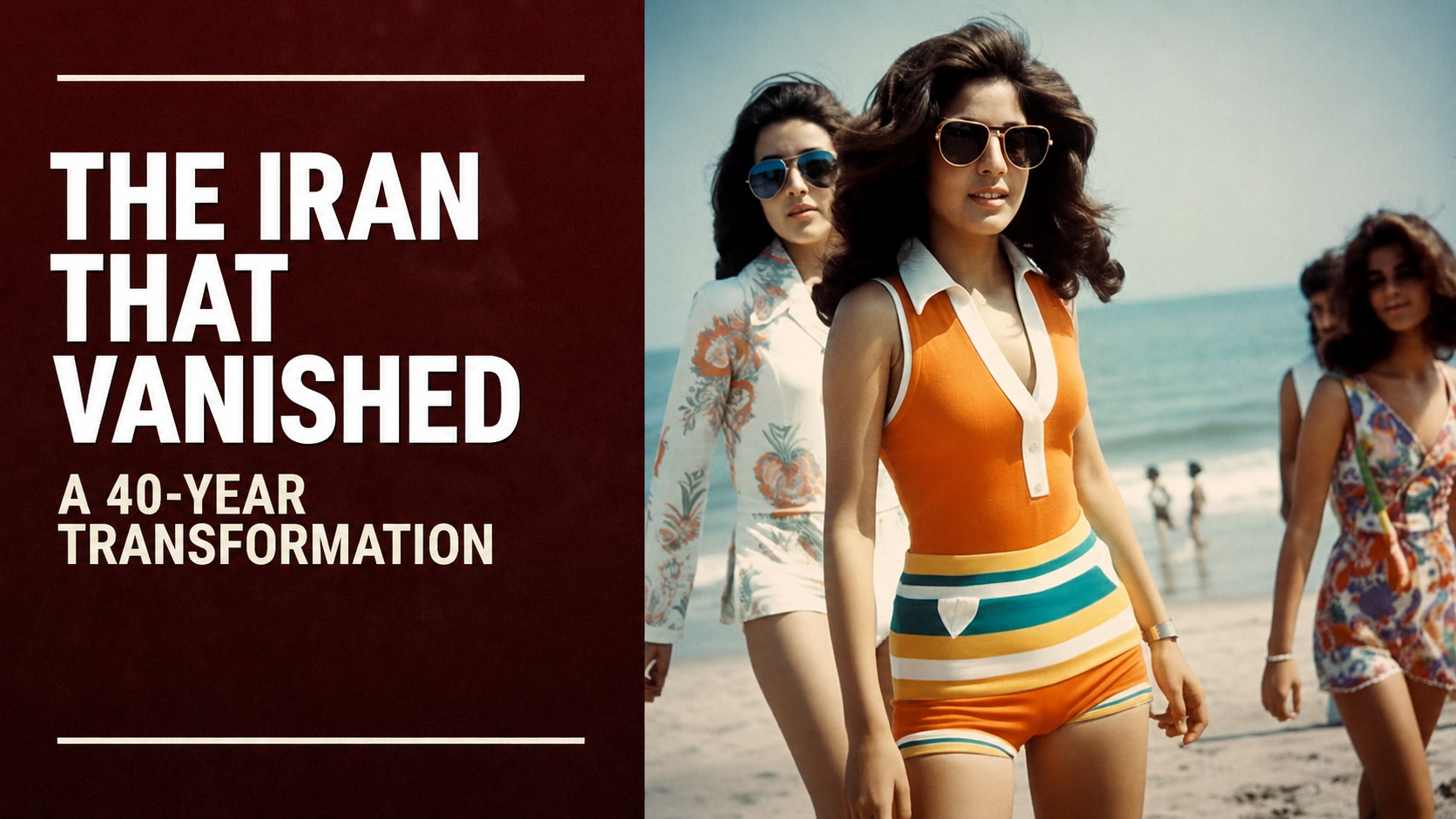

The human memory is notoriously short, often forgetting that the geopolitical fault lines of today were once the cultural hubs of yesterday. Five decades ago, the Middle East held a starkly different reality. Tehran, the capital of Iran, was affectionately dubbed the "Paris of the Middle East." It was not a city defined by strict religious enforcement, morality police, or international isolation. Instead, it was a sprawling, cosmopolitan metropolis that, in many aspects of lifestyle, art, and industrial ambition, outpaced several capitals of Western Europe.
To look at archival footage of 1970s Tehran is to witness a historical paradox. Women walked down tree-lined boulevards in miniskirts, jazz clubs and cinemas thrived in the neon-lit nightlife, and the nation hosted cutting-edge international art festivals like the Shiraz Arts Festival. Iran was a major economic power, manufacturing its own automobiles (like the iconic Paykan) and developing an advanced aviation infrastructure.
Yet, beneath this glossy, modernized exterior lay deep structural flaws. The foundations of this society were built on a precarious balance of rapid westernization and severe political repression—a combination that would eventually trigger one of the most drastic societal U-turns in modern human history.
The Flawed Foundations: Reza Shah’s Divided Vision
The roots of Iran’s 20th-century modernization can be traced back to the founder of the Pahlavi dynasty, Reza Shah Pahlavi. Rising to power via a military coup in the 1920s, he looked westward for inspiration, deeply admiring the radical, secular reforms implemented by Mustafa Kemal Atatürk in neighboring Turkey. Reza Shah envisioned a secular, industrialized, and Westernized Iran, aiming to break the country free from feudal constraints and the deep-rooted influence of the Shiite clergy. He built the Trans-Iranian Railway and controversially banned the traditional Islamic veil (the chador) in 1936.
However, his execution of this vision carried a fatal contradiction. While he idolized Atatürk's secular modernization, he was also deeply fascinated by the authoritarian efficiency of European fascist leaders, including Adolf Hitler. In an effort to counter British and Soviet influence in the region, Reza Shah forged strong economic and technical ties with Nazi Germany.
This inclination toward rigid totalitarian control created an aggressive state apparatus. Instead of fostering organic societal progress, modernization was imposed by force. Ultimately, his fascist leanings and refusal to expel German nationals during World War II prompted a joint Anglo-Soviet invasion of Iran in 1941, leading to his forced abdication and exile.
The Peak of the Pahlavi Era: Wealth and Repression
The mantle passed to his young son, Mohammad Reza Shah, who would oversee Iran’s transition into a global economic powerhouse. Fueled by skyrocketing oil revenues in the 1960s and 1970s, the Shah accelerated his father's vision to its absolute peak.
He launched the "White Revolution," a massive series of reforms aimed at modernizing the country without shedding blood. This included breaking up traditional estates for land reform, heavily investing in education through a "Literacy Corps," and granting women the right to vote in 1963. During this era, women achieved significant legal rights, occupying high-ranking positions in universities, the judiciary, and parliament.
But the Shah inherited more than his father's vision; he inherited his flawed, authoritarian methods, amplified by foreign interference. After a CIA and MI6-backed coup in 1953 overthrew the democratically elected Prime Minister Mohammad Mosaddegh (who had nationalized Iran's oil), the Shah’s paranoia grew.
The economic prosperity of the 70s was heavily centralized, widening the wealth gap between the urban elite in northern Tehran and the deeply conservative, impoverished rural populations. Political dissent was systematically crushed by SAVAK, the Shah's brutal secret police force. While total freedom of lifestyle was granted—allowing citizens to drink, dance, and dress as they pleased—freedom of speech and political thought were strictly prohibited. The Shah had created a golden cage.
The 1979 Revolution: How Everything Changed Overnight
By the late 1970s, the pressure cooker of political repression, economic inequality, and religious backlash boiled over. It is a common misconception that the 1979 revolution was purely Islamic from the start. In reality, it was a massive, diverse coalition of secular intellectuals, Marxist students, trade unionists, bazaar merchants, and traditional Islamists who united under a single, desperate goal: overthrowing the absolute monarchy.
The Shah, weakened by cancer and losing the support of his Western allies, fled into exile in January 1979. However, in the chaotic power vacuum that followed, the secular and leftist groups were outmaneuvered. The highly organized religious faction, led by the charismatic Ayatollah Ruhollah Khomeini returning from exile in Paris, seized absolute control.
What followed is history's ultimate warning about the fragility of freedom. Almost overnight, the entire cultural landscape was dismantled to forge the new Islamic Republic:
Cultural Eradication: Jazz clubs, cabarets, and cinemas were burned down, closed, or repurposed. Western music and broadcasting were banned.
Legal U-Turn: The secular judiciary was entirely replaced by strict Sharia (religious) law.
Women's Rights Decimated: Societal autonomy vanished. The Family Protection Law was dismantled, and mandatory hijab laws were violently enforced on the very streets where women had exercised complete bodily autonomy just weeks prior.
The Shadow of the Present
Today, the vibrant, self-sustaining Iran of the 1970s exists only in faded photographs, archival reels, and the nostalgic memories of the diaspora. The Iran-Iraq War of the 1980s further solidified the theocratic regime's grip on power, allowing them to eliminate remaining domestic opposition under the guise of national security.
Decades of strict theological rule, combined with severe international sanctions, economic embargoes, and the perpetual shadow of regional warfare, have suffocated a nation that once held limitless potential. The stark contrast between the vibrant, secret private lives of Iranian citizens today and the bleak, enforced public sphere is a tragic continuation of the country's dual identity.
The story of Iran serves as a stark reminder to the modern world: progress is never linear, and liberties are never permanent. When a society trades political pluralism and organic growth for authoritarian stability—whether imposed by a secular dictator in a suit or a religious supreme leader in a cleric's robe—it lays the groundwork for its own demise.
For a visual dive into this historical transformation, including rare archival footage of 1970s Tehran, watch our full documentary short, available now on the Historium platform.