
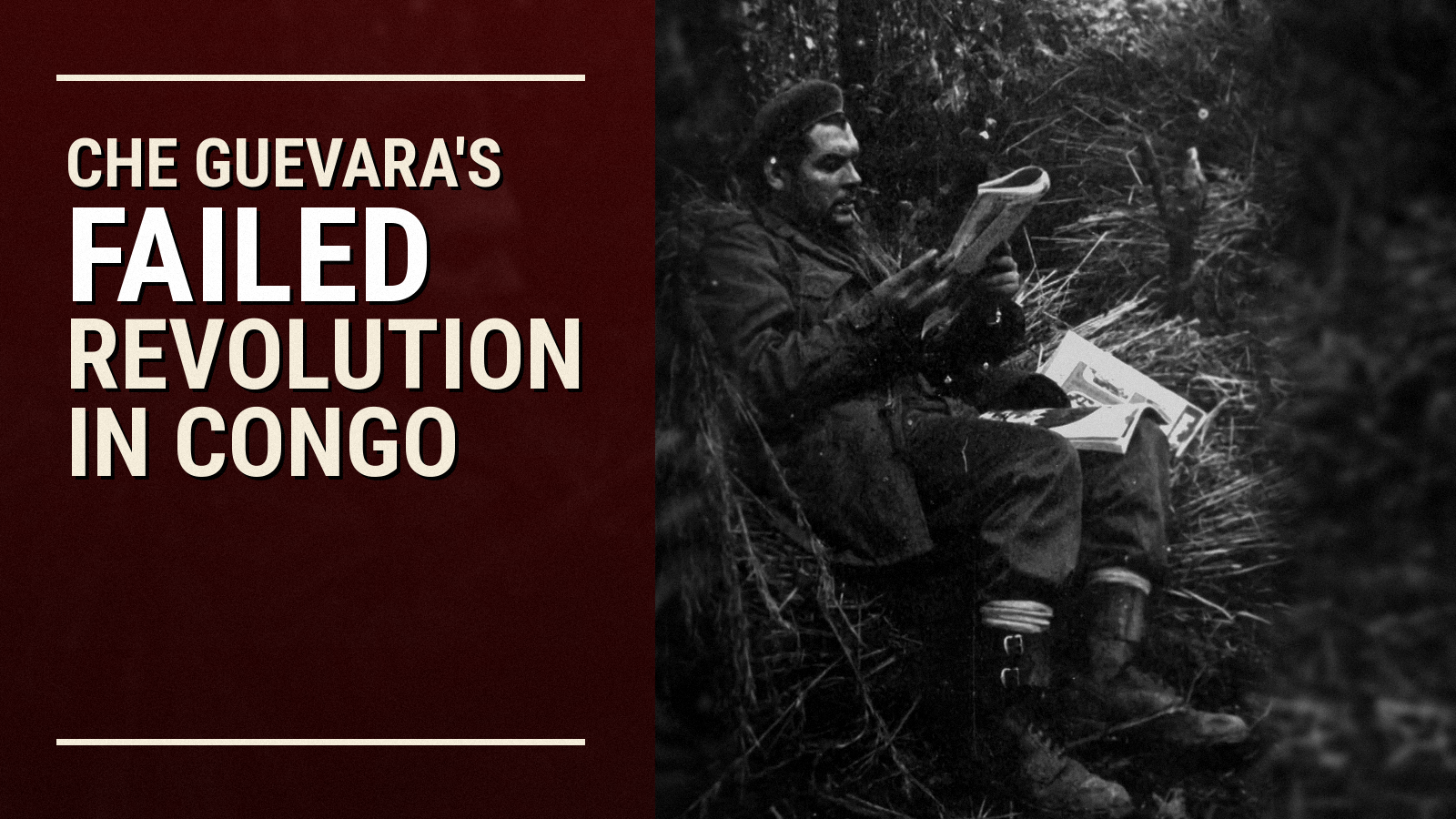
Ernesto “Che” Guevara is usually remembered through the grand images of revolution: the Cuban guerrilla fighter in the Sierra Maestra, the defiant Marxist at the United Nations, the martyr of Bolivia whose face became one of the most reproduced political symbols of the 20th century. Yet between the triumph of the Cuban Revolution and his death in Bolivia lies a lesser-known chapter that reveals a very different Che: exhausted, isolated, disillusioned, and forced to confront the limits of exporting revolution.
That chapter unfolded in 1965, deep in the jungles of the Congo.
Che went there hoping to open a new front in the global anti-imperialist struggle. Instead, he left after seven months of disease, military setbacks, political confusion, and bitter disappointment. He later introduced his Congo diary with a devastating sentence: “This is the history of a failure.”
The Algeria Speech That Marked a Turning Point
By early 1965, Che Guevara was no longer just a guerrilla commander. After the Cuban Revolution, he had become one of the most visible figures of the new Cuban state. He had served in major government roles, including as Minister of Industries, and he represented Cuba abroad as one of its most recognizable revolutionary voices.
But Che was never fully comfortable as a bureaucrat. His political imagination was international. He believed the Cuban Revolution could not remain isolated on one island. To him, revolution had to spread across Latin America, Africa, and Asia, especially in countries struggling against colonialism, neo-colonialism, poverty, and foreign domination.
On February 24, 1965, Che delivered a major speech at the Second Economic Seminar of Afro-Asian Solidarity in Algiers. The conference brought together representatives from 63 African and Asian governments and 19 national liberation movements, with Cuba attending as an observer.
The speech was explosive because Che did not limit his criticism to Western imperialism. He also challenged the socialist countries, arguing that they had a moral duty to support poorer nations more radically and more fairly. In his view, newly independent countries should not remain trapped in unequal economic relationships, even with states that claimed to be socialist. This was widely understood as a criticism of the Soviet Union and its approach to trade with the developing world.
For Cuba, this was politically sensitive. The island depended heavily on Soviet economic and military support. Che, however, was increasingly impatient with what he saw as cautious diplomacy. He wanted revolutionary internationalism, not just state-to-state alliances.
Leaving Cuba Behind
Shortly after the Algeria speech, Che returned to Havana. Then, suddenly, he disappeared from public life.
In a farewell letter to Fidel Castro dated April 1, 1965, Che resigned from his official positions, gave up his rank of commander, stepped down from his ministerial role, and renounced his Cuban citizenship. He wrote that other nations were calling for his efforts and that he was leaving to fight imperialism on new fronts.
The letter was not immediately made public. For months, rumors spread. Had Che been killed? Had he fallen out with Fidel Castro? Had he gone to Vietnam, Latin America, or somewhere else entirely?
The truth was that Che had chosen Africa.
His destination was the Congo, a country that had become one of the most dramatic battlegrounds of the Cold War. After independence from Belgium in 1960, the Congo was thrown into crisis: army mutinies, regional secession, foreign intervention, the removal and murder of Patrice Lumumba, and repeated efforts by the United States to support a stable pro-Western government.
For anti-imperialist movements around the world, Lumumba’s murder had turned the Congo into a symbol of betrayed independence. Che believed the country could become the center of a new revolutionary struggle in Africa.
Why the Congo?
The rebellion Che hoped to support was connected to Lumumbaist and anti-government forces fighting against the pro-Western Congolese leadership. The United States viewed the Congo through the lens of Cold War competition and feared Soviet influence in the region. By 1964, rebel forces had captured Stanleyville, now Kisangani, prompting increased U.S. military assistance to the Congolese government.
Che saw the Congo as a place where the Cuban experience might be repeated. In Cuba, a relatively small guerrilla movement had helped overthrow Fulgencio Batista’s dictatorship. Che believed trained revolutionaries could help local fighters develop discipline, strategy, and political commitment.
Cuba prepared seriously for the mission. According to historical accounts, Cuban volunteers were trained for deployment, and Che traveled with a group of fighters through Dar es Salaam before crossing Lake Tanganyika into eastern Congo in April 1965.
Che used the code name “Tatu” during the mission. His aim was not simply to fight as a foreign volunteer. He wanted to train, organize, and strengthen Congolese rebel forces so that they could build a revolutionary army capable of challenging the central government.
The plan looked bold on paper. On the ground, it quickly began to collapse.
The Reality Che Found
Che expected to find a disciplined liberation movement. Instead, he found fragmentation, weak leadership, rival factions, poor morale, and a lack of military organization.
Key rebel leaders such as Laurent-Désiré Kabila and Gaston Soumialot did not provide the consistent leadership Che expected. While Cuba had prepared carefully, the Congolese rebel leadership paid relatively little attention to the Cuban mission at first. Kabila and Soumialot were occupied with political meetings elsewhere, leaving Che to deal mostly with lower-ranking figures.
This was a severe blow to Che’s expectations. He believed revolutionary leaders should live and fight alongside their soldiers. In the Congo, he found many leaders absent from the front, divided by personal rivalries, and disconnected from the fighters they claimed to command.
In extracts from his Congo writings, Che complained about rebel factions losing territory without serious resistance and criticized leaders who remained far from the fighting. He was especially harsh toward Soumialot, whom he accused of living comfortably in Dar es Salaam while the movement disintegrated in the field.
The contrast was painful: Cuban volunteers were risking their lives in unfamiliar terrain, while some of the local political leaders seemed more interested in status, diplomacy, or factional rivalry than in building an effective guerrilla force.
Language, Culture, and Isolation
Che’s difficulties were not only military. They were also cultural and linguistic.
In Cuba, Che had fought among Spanish-speaking comrades in a revolutionary movement rooted in local conditions. In the Congo, he was a foreign commander in a vast and complex country whose languages, local loyalties, regional tensions, and political divisions he did not fully understand.
His diary acknowledged the unusual nature of the mission: foreign revolutionaries had entered an unknown land where people spoke a different language and where the bond between them and the local fighters rested mainly on the abstract idea of proletarian internationalism.
This mattered deeply. Guerrilla warfare depends on trust. It depends on communication, shared sacrifice, local intelligence, and a strong relationship with the surrounding population. Che’s Cuban experience could not simply be transplanted into the Congo.
The Cuban fighters could provide training and tactical knowledge, but they could not manufacture political unity, local legitimacy, or social roots where those conditions were weak.
Disease and Physical Decline
The environment also worked against Che and his men.
The Congo campaign was fought in difficult terrain, under exhausting conditions, with limited medical support. Nearly all the Cuban fighters became ill at some point. Che himself suffered from asthma and malaria during the campaign.
This was especially dangerous because Che had suffered from asthma since childhood. In Cuba, he had endured harsh guerrilla conditions before, but the Congo presented a different kind of strain: tropical disease, humidity, isolation, and a movement that seemed to be losing coherence around him.
His health deteriorated alongside his confidence in the mission. The more he saw, the more he concluded that the problem was not simply a lack of weapons or training. The problem was political.
There were armed men in the Congo, but not necessarily a revolutionary army.
The Bendera Disaster
One of the clearest examples of the mission’s failure came with the attack on Bendera, a government-held garrison defending a hydroelectric plant.
Che did not agree with the plan, but he accepted it after instructions came from Kabila. On June 20, 1965, a combined force of Cubans, Congolese, and Tutsi fighters attacked Bendera. The result was disastrous: many fighters fled or refused to participate, four Cubans were killed, and the operation revealed Cuba’s direct involvement in the rebellion.
For Che, Bendera was more than a failed battle. It exposed the weakness of the entire enterprise. The Cuban fighters were disciplined, but they were too few. The Congolese rebels had manpower, but many lacked training, coordination, and commitment. The leadership was divided. The political environment was worsening.
Even when Cuban training improved some rebel tactics, it did not change the wider trajectory of the war. Small successes could not overcome strategic failure.
“The History of a Failure”
By the end of 1965, Che understood that the Congo mission had failed.
His diary opening is one of the most striking lines he ever wrote: “This is the history of a failure.” But the sentence was not merely an expression of despair. Che believed defeat could still be useful if it was studied honestly. He wanted future revolutionaries to learn from the mistakes of the Congo campaign.
The failure revealed a crucial lesson: revolution could not be imported from outside. Foreign fighters could assist a movement, but they could not replace local leadership, political organization, popular support, and a clear revolutionary program.
Che had learned in Cuba that a small guerrilla army could become historically powerful. In the Congo, he learned that the same model could fail when the local conditions were not present.
This was the central contradiction of Che’s internationalism. He believed deeply in global revolution, but each revolution had to be rooted in its own society. The Congo showed that courage and ideology were not enough.
Secret Evacuation
By November 1965, continuing the campaign no longer made sense. The Congolese rebel leadership was in retreat, the peasants had grown increasingly hostile, and the Cuban presence had become strategically pointless. On November 20, Che organized the crossing back across Lake Tanganyika into Tanzania.
The evacuation was carried out quietly. Most of the Cuban fighters eventually returned home, but Che did not simply resume his old life in Havana. After the Congo failure, he spent time in Tanzania and later in a safe house near Prague before returning secretly to Cuba. Britannica notes that after the Congo campaign failed, Che fled first to Tanzania and then to a safe house near Prague.
By then, Che had become a man between worlds. He had renounced his Cuban citizenship and left his official posts. He could not easily return to public life in Cuba. Yet he also refused to abandon the idea of international revolution.
So he began preparing for another front.
Bolivia: The Final Gamble
Che’s next target was Bolivia.
In the autumn of 1966, he entered Bolivia incognito, physically transformed to avoid detection. His aim was to create and lead a guerrilla movement in the region of Santa Cruz. He hoped Bolivia could become the starting point for a broader revolutionary struggle across South America.
But Bolivia repeated many of the problems of the Congo. The guerrillas remained isolated. Local support was limited. Relations with established left-wing forces were difficult. The Bolivian army, with U.S. assistance, intensified its pursuit.
On October 8, 1967, Che was wounded and captured by Bolivian forces. The next day, October 9, he was executed. The National Security Archive notes that he was captured by a U.S.-trained Bolivian military battalion and that CIA operative Félix Rodríguez was present at the scene. U.S. officials had been tracking Che’s movements since his disappearance from Cuba in 1965.
The Congo had been the rehearsal for defeat. Bolivia became the final act.
Why the Congo Campaign Matters
Che Guevara’s Congo mission is often overshadowed by the Cuban Revolution and his death in Bolivia. Yet it is one of the most revealing episodes of his life.
It shows Che not as an untouchable icon, but as a political actor facing confusion, bad intelligence, weak allies, illness, and strategic miscalculation. It also shows the limits of revolutionary voluntarism: the belief that determination, sacrifice, and armed struggle can overcome almost any obstacle.
The Congo proved otherwise.
A successful revolution requires more than brave fighters. It requires local legitimacy, effective leadership, social roots, political unity, and a population willing to support the struggle. Che had some of these conditions in Cuba. He did not find them in the Congo.
The tragedy is that Che recognized many of these problems, yet still moved on to Bolivia, where similar weaknesses would contribute to his capture and death.
Conclusion: The Failure Behind the Myth
Che Guevara’s journey to the Congo was born from one of his deepest convictions: that revolution should be international, that oppressed peoples across continents shared a common struggle, and that those who had won freedom in one place had a duty to fight for it elsewhere.
But the Congo campaign forced him to confront a hard reality. Revolutions cannot simply be exported. They must grow from the soil of the society in which they occur.
In the jungles of the Congo, Che found not the disciplined revolutionary army he had imagined, but disorder, rivalry, illness, mistrust, and defeat. He left secretly, weakened and disappointed, but not politically defeated in his own mind. Rather than return permanently to Cuba, he carried his revolutionary project to Bolivia.
That decision would make him a martyr. But the Congo made him human.
To understand Che Guevara fully, it is not enough to look at his victories in Cuba or his death in Bolivia. One must also look at his failure in the Congo — the place where the dream of global revolution collided with the reality of local politics, and where Che himself admitted that his mission had become “the history of a failure.”