
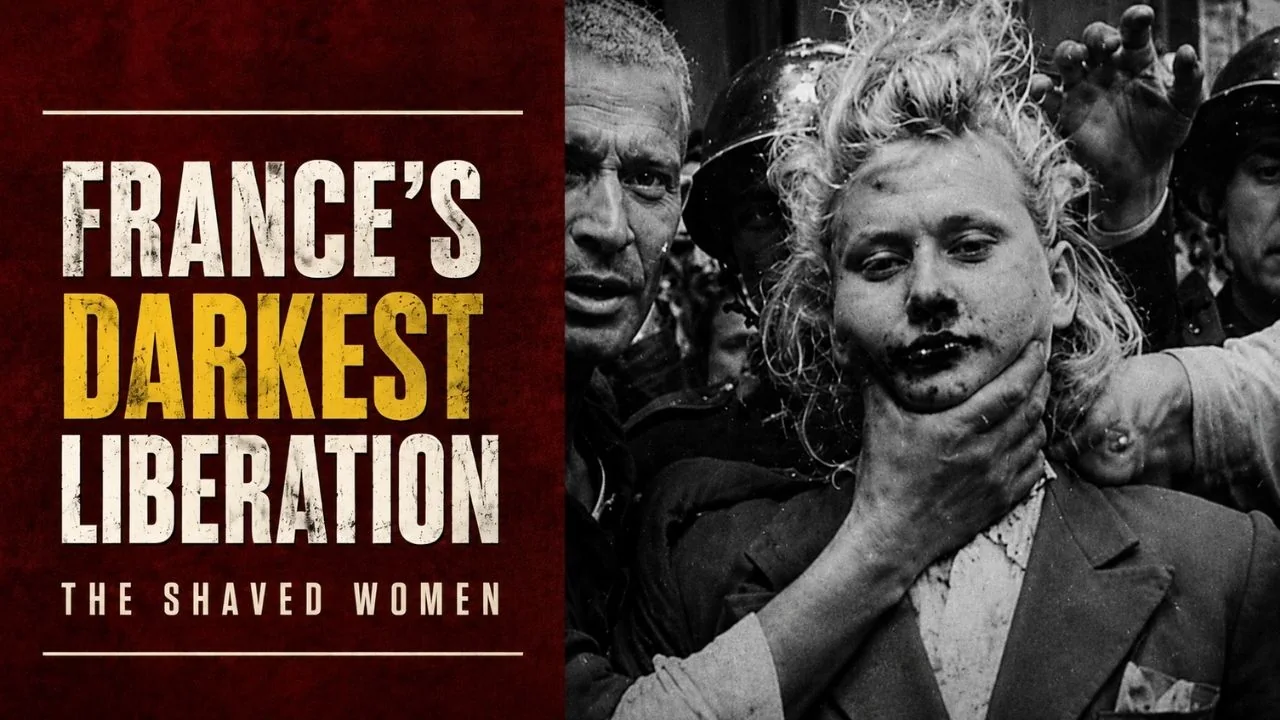

In 1944, as France celebrated liberation from Nazi occupation, thousands of women accused of collaboration with German soldiers were publicly humiliated, shaved, and paraded through the streets. This is the story of Les Tondues — the shaved women of France.
France’s Liberation Had a Dark Side
In the summer of 1944, France was finally emerging from one of the most humiliating chapters in its modern history. After four years of Nazi occupation, Allied forces were advancing across the country. Towns and villages filled with cheering crowds. Flags appeared in windows. Streets that had once echoed with the boots of German soldiers now welcomed tanks, resistance fighters, and the promise of freedom.
But liberation did not arrive only as a moment of joy.
As German power collapsed, France entered a chaotic and violent period of revenge. Suspected collaborators were hunted, beaten, arrested, or executed. Some were guilty of serious crimes: informing on neighbors, assisting the occupiers, joining collaborationist organizations, or profiting from the occupation. Others were caught in rumor, jealousy, local vendettas, or the need to survive under impossible conditions.
Among the most visible victims of this revenge were thousands of French women.
They became known as Les Tondues — “the shaved women.”
The Occupation of France
To understand what happened in 1944, we have to return to 1940.
On May 10, 1940, Nazi Germany launched its invasion of France and the Low Countries. Within only six weeks, France — one of Europe’s great military powers — had been defeated. The northern and western parts of the country fell under German occupation, while the collaborationist Vichy regime, led by Marshal Philippe Pétain, governed from the south and cooperated with Nazi Germany.
Occupation transformed daily life. Food shortages, curfews, surveillance, fear, propaganda, and repression became part of ordinary existence. The Vichy government did not simply wait passively under German pressure; it actively collaborated in many areas, including policing, labor policy, political repression, and the persecution of Jews.
For ordinary French people, survival often meant moral compromise. Some resisted. Some collaborated openly. Many tried to navigate a dangerous middle ground, doing what was necessary to feed families, keep jobs, or avoid suspicion.
Women were part of this world too. Some worked for German offices as secretaries, cleaners, translators, nurses, or domestic servants. Some had romantic or sexual relationships with German soldiers. Some were prostitutes. Some were informers. Some were politically committed collaborators. Others were simply poor, vulnerable, or trapped by circumstances that would later be judged harshly by their neighbors.
When liberation came, all of these different stories were often collapsed into one accusation: collaboration.
The Wild Purge
As the Germans retreated in 1944, France experienced what became known as the épuration sauvage, or “wild purge.” This was not the official legal purge that would later be organized through courts. It was immediate, local, emotional, and often violent.
The wild purge took place in a power vacuum. German authority was disappearing. The Vichy state was collapsing. The Provisional Government of France had not yet fully established control everywhere. In that unstable space, resistance groups, local committees, angry civilians, and opportunists began settling accounts.
Suspected collaborators were dragged from homes, questioned, beaten, imprisoned, or executed. Sometimes genuine criminals were punished. Sometimes the guilty escaped by accusing others. Sometimes old personal grudges were disguised as patriotism.
For women accused of “horizontal collaboration” — relationships with German soldiers — the punishment was often public humiliation.
Their heads were shaved.
Who Were Les Tondues?
The phrase Les Tondues refers to women whose heads were forcibly shaved during the liberation of France. The act was meant to mark them physically and socially. A shaved head made them instantly recognizable. It stripped them of privacy, femininity, dignity, and protection.
The accusation was often that they had slept with German soldiers. But history is far more complicated than that.
Not all of the shaved women had intimate relationships with Germans. Some were accused of economic collaboration, such as working for German authorities or selling goods to German soldiers. Others were accused of political collaboration, denunciation, or simply associating with the occupiers. In some cases, the accusation was based on rumor rather than evidence.
The punishment was usually extrajudicial. There was often no trial, no defense, and no attempt to separate different degrees of guilt. A woman who had denounced neighbors could be treated the same way as a woman who had worked as a cleaner in a German office. A woman who had a relationship with a German soldier could be treated the same way as a woman who had been coerced, exploited, or simply accused.
This is what makes the story so disturbing. Les Tondues were not a single group with one clear history. They were a symbol onto which a wounded society projected anger, shame, and guilt.
The Ritual of Humiliation
The shaving of women’s heads was rarely a private act. It was staged.
Women were often placed in public squares, streets, courtyards, or town centers. Crowds gathered. Men held them down. Barbers, resistance members, or civilians cut away their hair with scissors, clippers, or razors. Sometimes the women were beaten. Sometimes their bodies were marked with swastikas. Sometimes they were forced to walk through the streets while people shouted, laughed, spat, or threw objects.
The punishment had a theatrical quality. It was not simply about identifying alleged collaborators. It was about spectacle.
The crowd needed to see the punishment. The woman’s body became a public screen on which the community displayed its revenge. Her shaved head told everyone that she had been judged, even if no court had ever heard her case.
For the newly liberated nation, these scenes were presented as moral cleansing. France had been occupied, humiliated, and divided. Now the visible “traitor” could be exposed, marked, and expelled from the national body.
But the target was often not the most powerful collaborator. It was the most visible and vulnerable one.
Why Women?
Men collaborated with Nazi Germany on a far greater political, military, economic, and administrative scale. French officials, police officers, businessmen, journalists, and militia members played major roles in collaboration. Some participated in repression, deportation, and the persecution of Jews.
Yet in the streets of liberated France, women’s bodies became some of the most photographed symbols of betrayal.
This was not accidental.
The occupation had created a crisis of national masculinity. France had been defeated in 1940. Its army had collapsed. Its government had cooperated with the enemy. Many men had been prisoners of war, forced laborers, collaborators, or silent witnesses. Liberation brought pride, but also shame.
Punishing women became a way to restore a damaged image of national honor. The accusation that a French woman had given herself to a German soldier was treated not only as a personal act, but as a symbolic surrender of the nation itself.
In this logic, the female body became territory.
To shave a woman’s head was to reclaim that territory. It was a ritual of domination disguised as patriotism.
Collaboration, Survival, and Scapegoating
None of this means that all accused women were innocent. Some French women did collaborate knowingly and actively. Some denounced neighbors. Some joined collaborationist organizations. Some benefited from the occupation. Some relationships with German soldiers were based on political sympathy, social ambition, or genuine affection.
But the punishment of Les Tondues rarely depended on careful evidence.
The reality of occupation was morally complex. A woman might work for Germans because it was the only available job. A mother might accept help from a soldier to feed her child. A young woman might fall in love across enemy lines. Another might be coerced or sexually exploited. Another might be falsely accused by neighbors who wanted revenge, property, or public moral superiority.
After liberation, these distinctions often disappeared.
The shaved women became scapegoats for a much wider national trauma. France had to confront the reality that collaboration had not been limited to a few monsters. It had existed in offices, police stations, businesses, newspapers, villages, and families. By focusing public rage on women accused of sexual betrayal, society could transform a broad and uncomfortable history into a simpler image: the woman who betrayed France with the enemy.
That image was easier to punish.
The Power of the Images
The story of Les Tondues is so haunting partly because it was photographed and filmed.
Allied cameramen, war correspondents, soldiers, and civilians captured these scenes across France. Some images became famous, including photographs of women with shaved heads being marched through streets while carrying children or being surrounded by jeering crowds.
These images are difficult to look at because they blur categories that people often prefer to keep separate. They show liberation, but also cruelty. They show justice being claimed, but also revenge being performed. They show a nation freed from occupation, but also a society willing to humiliate vulnerable people in public.
The camera did not simply document the humiliation. In many cases, it intensified it.
The presence of photographers turned punishment into an image meant to survive beyond the moment. These women were not only shamed in front of their neighbors; they were turned into symbols for history.
For decades, those images helped shape the memory of female collaboration. They suggested that collaboration was feminine, sexual, and visible. Meanwhile, many forms of male collaboration — administrative, financial, police-based, ideological — were less easily reduced to one unforgettable photograph.
After the Shaving
What happened to the shaved women afterward varied.
Some were arrested. Some were imprisoned. Some were released. Some returned to their communities under lasting stigma. Some were ostracized for years. Some carried the trauma in silence. Their children, especially those born from relationships with German soldiers, often grew up marked by shame as well.
There were also broader consequences. In the aftermath of occupation, thousands of children were born to French women and German men. Some came from loving relationships. Some came from exploitation or sexual violence. Many grew up without fathers, carrying identities that postwar society did not want to acknowledge.
The mothers were often seen as traitors. The children were seen as reminders of defeat.
This silence lasted for decades.
Only much later did historians begin to examine Les Tondues not as a simple story of punishment, but as a story of gender, violence, memory, and national shame.
Justice or Revenge?
The central question raised by Les Tondues is not whether collaboration should have been ignored. Collaboration was real. Betrayal was real. Informers, fascists, profiteers, and collaborators caused enormous suffering.
The question is whether public humiliation without trial can ever be called justice.
The shaving of women’s heads did not rebuild the rule of law. It often replaced one form of domination with another. It allowed crowds to feel purified without necessarily confronting the deeper structures of collaboration. It punished bodies more than systems. It transformed women into symbols, then treated those symbols as proof that France had cleansed itself.
But a society cannot erase its guilt by placing it on the heads of the vulnerable.
Les Tondues reveal one of the most uncomfortable truths about liberation: freedom does not automatically produce justice. Sometimes, the collapse of oppression releases not only hope, but also vengeance.
The Legacy of Les Tondues
Today, the shaved women of France remain one of the darkest and most complex images of the liberation. Their story forces us to look beyond the heroic memory of 1944 and ask harder questions.
Who gets punished after a war?
Who escapes?
Who becomes a symbol?
And who is silenced because their suffering does not fit the national story?
The liberation of France was real, necessary, and historic. Nazi occupation had brought fear, repression, deportation, and death. The defeat of that occupation was a moment of immense importance.
But history is rarely pure.
In 1944, France celebrated freedom while thousands of women were dragged into the streets, stripped of dignity, and made to carry the shame of an entire society. Some had collaborated. Some had survived. Some had loved. Some had been coerced. Some had simply been accused.
Their shaved heads became a warning from history.
Without law, justice can become revenge.
Without truth, memory can become myth.
And without compassion, liberation can have a very dark side.