
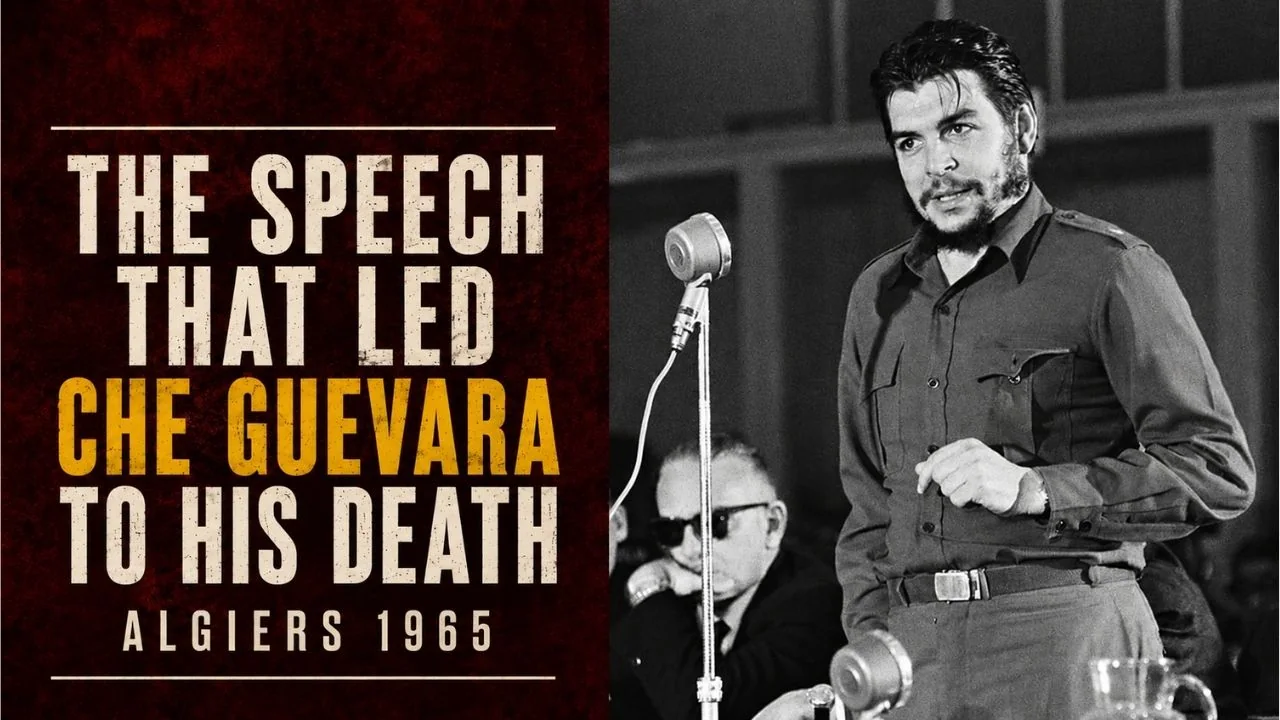

In February 1965, Che Guevara stood before an international audience in Algiers and delivered one of the most consequential speeches of his life. It was not his longest speech, nor his most famous among the general public. Yet, in many ways, it marked the beginning of the end.
At the Afro-Asian Solidarity Conference in Algeria, Che did something few revolutionary leaders would have dared to do. He criticized the United States, as expected. But then he turned his anger toward the socialist bloc itself, especially the Soviet Union — the very power Cuba depended on for survival.
For a man who had become one of the most recognizable symbols of the Cuban Revolution, this was more than a political statement. It was a declaration of ideological independence. And it would help push him away from government offices, away from Havana, and toward the jungles of Congo and Bolivia.
By the time Che Guevara was captured and executed in Bolivia in 1967, the road that led him there had already begun in Algiers.
Che Guevara Before Algiers
By 1965, Che Guevara was no longer only a guerrilla commander. After the Cuban Revolution, he had become one of the most important figures in the new Cuban state. He served as president of the National Bank of Cuba and later as Minister of Industries. He represented Cuba abroad, negotiated with foreign governments, and became the face of revolutionary internationalism.
But Che was never fully comfortable as a bureaucrat.
He believed that revolution could not stop at national borders. For him, Cuba was not the final destination, but the beginning of a global struggle. He wanted armed revolutions to spread across Latin America, Africa, and Asia. He believed oppressed nations could not truly be free as long as global economic systems continued to exploit them.
This belief brought him into tension not only with the capitalist West, but also with the Soviet Union.
Cuba’s survival depended heavily on Soviet aid, Soviet oil, Soviet machinery, and Soviet military protection. After the failed Bay of Pigs invasion and the Cuban Missile Crisis, Moscow had become Havana’s most important lifeline. Fidel Castro had to manage this relationship carefully.
Che, however, saw the world differently. He believed that socialist countries had a moral responsibility to support poorer revolutionary nations, not trade with them as if they were ordinary capitalist partners.
That disagreement exploded publicly in Algiers.
The Algiers Speech
On February 24, 1965, Che Guevara addressed the Second Economic Seminar of Afro-Asian Solidarity in Algiers. His speech focused on imperialism, economic dependency, and the struggles of newly independent nations.
At first, his message seemed familiar. Che condemned colonialism and Western imperialism. He spoke about the need for solidarity among the nations of Africa, Asia, and Latin America. He argued that political independence meant little if former colonies remained trapped in economic dependency.
But then his speech took a more dangerous turn.
Che argued that socialist countries could not claim moral superiority while trading with poor nations under the same logic as capitalist economies. In his view, if socialist states bought raw materials cheaply and sold manufactured goods at high prices, they were participating in the same unequal system they claimed to oppose.
He suggested that socialist countries had a duty to help underdeveloped nations without demanding profit in return. For Che, international socialism was not supposed to be a marketplace. It was supposed to be a sacrifice.
This was an attack on the Soviet Union without always naming it directly.
And everyone understood it.
Why the Speech Was So Dangerous
Che’s criticism came at an extremely sensitive moment. Cuba was economically dependent on the Soviet Union. The island had survived years of pressure from the United States, but that survival required Soviet trade, loans, military support, and political protection.
Fidel Castro knew this. The Cuban government knew this. Moscow knew it too.
Che’s speech placed Cuba in a deeply uncomfortable position. One of its most famous leaders had publicly accused socialist countries of failing the revolutionary world. He had challenged the moral authority of the Soviet Union at a time when Cuba could not afford to lose Soviet support.
For Che, this was a matter of principle. For Castro, it was a diplomatic crisis.
This did not mean that Che was immediately punished or that the speech alone caused his death. History is rarely that simple. But the speech revealed a widening gap between Che’s revolutionary idealism and the political realities of Cuba’s survival.
Che wanted permanent revolution. Cuba needed stability.
Che wanted sacrifice from the socialist world. The Soviet Union wanted strategic alliances and economic control.
Che wanted to return to the battlefield. The Cuban state needed him to remain a symbol, a minister, and a diplomat.
After Algiers, those contradictions became impossible to hide.
Che Vanishes From Public Life
After returning to Cuba in March 1965, Che Guevara gradually disappeared from public view. This sudden absence created speculation around the world. Where was Che? Had he fallen out with Fidel Castro? Had he been removed from power? Was he dead?
The truth was more complex.
Che had decided to leave Cuba and return to armed struggle. He resigned from his official positions, renounced his Cuban citizenship, and prepared to fight abroad under a false identity.
In a farewell letter later read publicly by Fidel Castro, Che explained that he was leaving to continue the revolutionary struggle elsewhere. The letter was emotional and dramatic. Che gave up his official role in Cuba, his public identity, and even his legal connection to the country he had helped transform.
This was not simply a career change. It was a complete break with political office.
The man who had once sat in ministries and negotiated trade agreements now chose the jungle again.
From Algeria to Congo
Che’s next destination was Congo.
In 1965, he traveled secretly to Central Africa to support revolutionary forces fighting against the Congolese government. He hoped to create a new front in the global anti-imperialist struggle. For Che, Africa represented a major battleground in the fight against colonialism and Western influence.
But Congo was nothing like the Cuban Sierra Maestra.
The local rebel movement was fragmented and poorly organized. Many fighters lacked discipline and training. Rebel leaders were often absent from the front lines. Language barriers made coordination difficult. Che also struggled with poor health, including asthma and illness, while operating in extremely difficult conditions.
The mission became a failure.
Che later described the Congo campaign with bitter honesty. It was not the heroic revolutionary front he had imagined. It was chaotic, divided, and strategically hopeless.
After months of frustration and defeat, Che left Congo in secrecy.
But he did not give up.
The Road to Bolivia
After Congo, Che began planning another revolutionary campaign — this time in Latin America.
Bolivia was chosen as the next battlefield. Geographically, it seemed important. It was located in the heart of South America and bordered several countries. Che believed that a successful guerrilla movement there could ignite revolutions across the continent.
In late 1966, he entered Bolivia under a false identity and began organizing a small guerrilla force.
But once again, the reality was far harsher than the theory.
The Bolivian Communist Party did not provide the support Che had expected. Local peasants were often suspicious of the guerrillas and did not join the movement in large numbers. The terrain was difficult, communications were poor, and supplies were limited. Che’s health deteriorated again, especially because of his asthma.
Meanwhile, the Bolivian army, supported by the United States and advised by the CIA, intensified its hunt for him.
Che had imagined Bolivia as the beginning of a continental revolution. Instead, it became a trap.
Capture and Execution
On October 8, 1967, Che Guevara was captured by Bolivian forces near the village of La Higuera. He was wounded, exhausted, and separated from much of his guerrilla column.
The next day, on October 9, 1967, he was executed in a schoolhouse.
His death transformed him into one of the most enduring revolutionary icons of the twentieth century. The image of Che Guevara became a global symbol of rebellion, idealism, sacrifice, and anti-imperialist struggle. But behind that symbol was a far more complicated story.
Che’s final years were not a straight line from glory to martyrdom. They were marked by isolation, failed campaigns, political disagreements, and a refusal to compromise.
And that refusal was clearly visible in Algiers.
Did the Algiers Speech Really Lead to Che’s Death?
To say that Che Guevara’s Algiers speech directly caused his death would be too simple. His execution in Bolivia was the result of many factors: his decision to launch a guerrilla campaign, the failure to gain local support, the strength of the Bolivian military response, U.S. involvement, and the broader Cold War context.
But the speech was still a crucial turning point.
In Algiers, Che publicly broke with the cautious diplomacy required of a Cuban government official. He showed that he was no longer willing to remain silent for the sake of alliances. He chose ideological purity over political convenience.
That choice helped push him away from Havana’s government structure and toward the dangerous path of international guerrilla warfare.
In that sense, the speech did not kill Che Guevara. But it revealed the decision that would eventually lead him to his death.
He would not remain a minister. He would not become a comfortable revolutionary symbol. He would not accept a world where socialist states behaved like empires and revolutionaries became administrators.
He chose the battlefield.
And in Bolivia, he paid the price.
The Legacy of the Algiers Speech
Che Guevara’s 1965 speech in Algiers remains one of the most revealing moments of his political life. It exposed the tension between revolutionary ideals and state survival, between moral conviction and geopolitical reality.
For Cuba, the Soviet Union was a necessary ally. For Che, it was a compromised power that had betrayed the spirit of international revolution.
This difference mattered.
After Algiers, Che’s life moved rapidly toward secrecy, exile, guerrilla war, and death. His journey from Cuba to Congo and then to Bolivia was not accidental. It was the result of a worldview that refused to separate politics from sacrifice.
The speech in Algiers was not merely a speech. It was a farewell to diplomacy, a rejection of compromise, and the beginning of Che Guevara’s final road.
A road that ended in a small schoolhouse in Bolivia.
And began, in many ways, at a microphone in Algiers.