

The WWII Ship That Exploded on Camera: The Story of SS John Burke
There are many shocking images from the Second World War, but few are as visually overwhelming as the destruction of the SS John Burke.
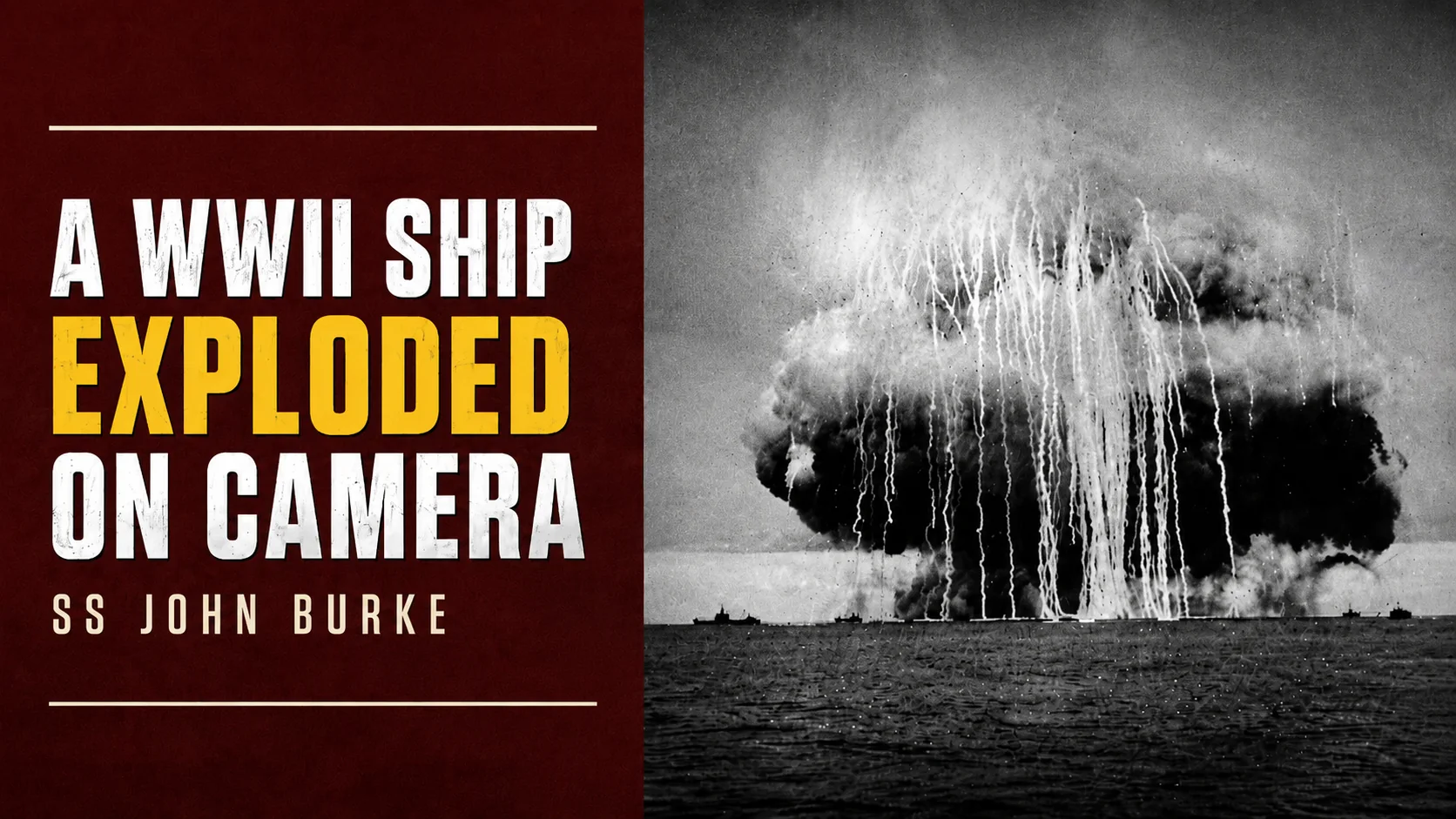
At first glance, the footage almost looks like a nuclear blast. A distant ship disappears behind a sudden wall of water, fire, smoke, and debris. A towering cloud rises over the sea, while nearby vessels continue moving through the chaos. But this was not a nuclear test. It was the real destruction of an American cargo ship during the Pacific War.
On December 28, 1944, the Liberty ship SS John Burke was sailing with a convoy bound for Mindoro in the Philippines. Her mission was not glamorous, but it was essential: she was carrying ammunition and military supplies for Allied forces fighting to retake the Philippines from Japanese occupation.
Within seconds, that mission ended in one of the most devastating ship explosions ever captured on film.
A Liberty Ship in the Pacific War
The SS John Burke was a Liberty ship, one of the mass-produced cargo vessels that became a symbol of American industrial power during World War II. These ships were not designed for speed, elegance, or heavy combat. They were built to move enormous quantities of cargo across oceans as quickly and efficiently as possible.
Liberty ships carried the fuel of war: ammunition, food, vehicles, tools, machinery, medical supplies, and equipment. Without them, armies could not advance, airfields could not operate, and invasions could not be sustained.
The SS John Burke was one small part of that massive logistical machine.
She was built in the United States and sent into the Pacific, where the war increasingly depended on long, dangerous supply routes. By late 1944, Allied forces were pushing back into the Philippines. The invasion of Mindoro was especially important because the island could provide airfields close enough to support further operations against Luzon, the largest and most strategically important island in the Philippines.
But to hold Mindoro, Allied troops needed supplies. They needed fuel, weapons, vehicles, food, and ammunition. That was the kind of cargo carried by ships like the John Burke.
And that cargo made her extremely vulnerable.
The Convoy to Mindoro
On the morning of December 28, 1944, the SS John Burke was sailing with a convoy of transports and supply ships heading toward Mindoro. The convoy was slow, heavily loaded, and valuable. To the Japanese military, it was a target worth attacking.
By this stage of the Pacific War, Japan was increasingly relying on kamikaze attacks. These were suicide missions in which pilots deliberately crashed their aircraft into Allied ships. The goal was simple and terrifying: if conventional attacks could no longer stop the Allied advance, a pilot and his aircraft could become the weapon.
For a convoy loaded with ammunition and fuel, the threat was especially dangerous.
Japanese aircraft began attacking the convoy. Anti-aircraft fire filled the sky. Ships maneuvered as best they could, but cargo vessels were slow and vulnerable. Among the ships in the convoy was the SS John Burke, carrying ammunition for the Mindoro operation.
Then a Japanese kamikaze aircraft struck.
The Explosion
The exact moment of impact is difficult to separate from the chaos of the footage, but the result is unmistakable.
A Japanese aircraft hit the SS John Burke. Moments later, the ammunition inside the ship detonated.
The explosion was catastrophic.
The John Burke did not simply sink like a conventional ship. She erupted. The blast threw a wall of water upward and produced a towering cloud of smoke and debris. In the footage, the ship seems to vanish almost instantly, swallowed by the force of its own cargo exploding.
Everyone aboard was killed.
The tragedy of the SS John Burke is not only the destruction of a ship, but the sudden disappearance of an entire crew. These were not men fighting on the deck of a battleship. They were merchant mariners and armed guards carrying the supplies that made the war effort possible. Their work was often less visible than frontline combat, but it was no less dangerous.
The explosion was so powerful that it affected vessels around her. The shockwave and debris spread across the convoy, and nearby ships were caught in the smoke and force of the blast.
For those watching from other vessels, it must have been almost impossible to process. One moment, a cargo ship was part of the convoy. Seconds later, it was gone.
The Camera That Captured the Moment
What makes the SS John Burke disaster so unforgettable today is that the explosion was captured on 16 mm film.
The footage was shot from the deck of the destroyer USS Bush, which was helping escort transports and supply ships bound for Mindoro. The cameraman was Lt. George Johnson, the ship’s medical officer. His film recorded the convoy, the Japanese air attacks, and the moment the John Burke disappeared in a massive explosion.
That detail matters.
Most catastrophic moments at sea during World War II were never filmed. They survived only in written reports, survivor accounts, or official records. But the destruction of the John Burke exists as moving image evidence. Viewers can see the scale of the blast for themselves. They can compare the cloud to the ships nearby. They can watch the convoy become engulfed in smoke.
The footage gives the event a visual power that written history alone could never fully convey.
It also explains why the video continues to circulate online today. Many viewers encounter the clip without context and assume it shows a nuclear explosion or a weapons test. In reality, it shows something just as historically important: the vulnerability of wartime logistics, the danger faced by merchant ships, and the destructive power of ammunition cargo when struck by enemy attack.
Why SS John Burke Mattered
The story of the SS John Burke is a reminder that wars are not fought only by soldiers at the front.
Every major campaign depends on supply. Ammunition must be delivered. Fuel must arrive. Food, medicine, spare parts, and equipment must cross thousands of miles of ocean. In the Pacific War, this logistical challenge was enormous. The battlefield stretched across islands, seas, airfields, ports, and convoy routes.
Liberty ships were the quiet backbone of that system.
They were not famous like battleships, aircraft carriers, or submarines. They rarely became symbols of victory. But without them, victory would have been impossible. Every landing operation, every air campaign, and every advance across the Pacific depended on ships willing to carry dangerous cargo through enemy waters.
The John Burke was one of those ships.
Her loss shows how a supply vessel could become a battlefield in an instant. A single kamikaze strike did not just destroy a ship; it destroyed ammunition, supplies, and human lives in one massive blast.
A Forgotten Disaster Preserved on Film
The SS John Burke is not one of the most famous shipwrecks of World War II. It is not remembered like the USS Arizona, the Yamato, or the Bismarck. Yet the footage of her destruction remains one of the most shocking visual records of the war at sea.
Part of its power comes from the contradiction at the center of the image.
The ship is distant. The camera is steady. The sea appears almost calm. Then, without warning, the horizon erupts.
That is what makes the footage so disturbing. It captures the suddenness of death in wartime. There is no dramatic buildup, no heroic final speech, no cinematic warning. There is only a ship, a flash, and then a cloud where the ship used to be.
For the men aboard the SS John Burke, there was no time to escape.
For the world watching decades later, the footage remains a rare and haunting reminder of the dangers faced by the merchant ships of World War II. These vessels carried the supplies that kept armies alive, but they often did so under constant threat from submarines, aircraft, mines, and suicide attacks.
The SS John Burke disappeared in seconds.
But because a camera happened to be rolling, the moment was not lost to history.