

The Airship That Symbolized the Future
In the 1930s, the sky still belonged partly to giants.
Before commercial jetliners crossed oceans in hours, before modern airports became symbols of global travel, there was another dream of flight: the rigid airship. These enormous vessels floated across continents and oceans, offering passengers a vision of travel that felt almost futuristic. They were not simply aircraft. They were flying hotels, engineering monuments, and symbols of national ambition.
Among them, none was more famous than the LZ 129 Hindenburg.
The Hindenburg was a German passenger airship built by the Zeppelin Company and operated by Deutsche Zeppelin-Reederei. At more than 800 feet long, it was one of the largest flying machines ever built. Its vast frame was filled with gas cells that provided lift, while its engines moved it through the sky with an elegance that made airship travel seem like the future of long-distance transportation.
For wealthy passengers, the Hindenburg offered a level of comfort that early airplanes could not match. It had passenger cabins, dining areas, lounges, and even a smoking room designed with special safety precautions. Crossing the Atlantic by airplane was still difficult and uncomfortable. Crossing it by airship felt almost like sailing through the clouds.
But beneath this image of elegance and progress, the Hindenburg carried a dangerous secret.
It was filled with hydrogen.
Why the Hindenburg Used Hydrogen
Hydrogen gave the Hindenburg the lift it needed, but it was also highly flammable. Helium would have been far safer, but Germany could not obtain enough of it. At the time, the United States controlled much of the world’s helium supply and restricted its export, especially to Nazi Germany.
As a result, the Hindenburg flew with hydrogen.
This did not mean the airship was seen as reckless at the time. The Zeppelin company had years of experience with hydrogen-filled airships, and German engineers believed they could manage the risk. The Hindenburg had already completed successful flights, including transatlantic journeys that impressed the world.
To many observers, the airship seemed like a triumph of technology.
Then came May 6, 1937.
The Final Flight to Lakehurst
The Hindenburg’s final journey began as a routine transatlantic flight from Germany to the United States. Its destination was the Naval Air Station at Lakehurst, New Jersey, a major landing site for airships.
On board were passengers and crew members expecting a safe arrival. Some were experienced travelers. Others were crossing the Atlantic in one of the most remarkable machines of the age. Below, at Lakehurst, reporters, photographers, and newsreel cameras had gathered to record the landing.
This was not unusual. The arrival of the Hindenburg was a public event. The giant airship descending from the sky was a spectacle, and media coverage helped turn each landing into a symbol of technological progress.
But the weather was not ideal. Storms and shifting conditions delayed the landing. The Hindenburg circled and maneuvered as the crew waited for the right moment to dock.
Finally, in the early evening, the airship approached the mooring mast.
Within moments, history changed.
The Moment the Sky Caught Fire
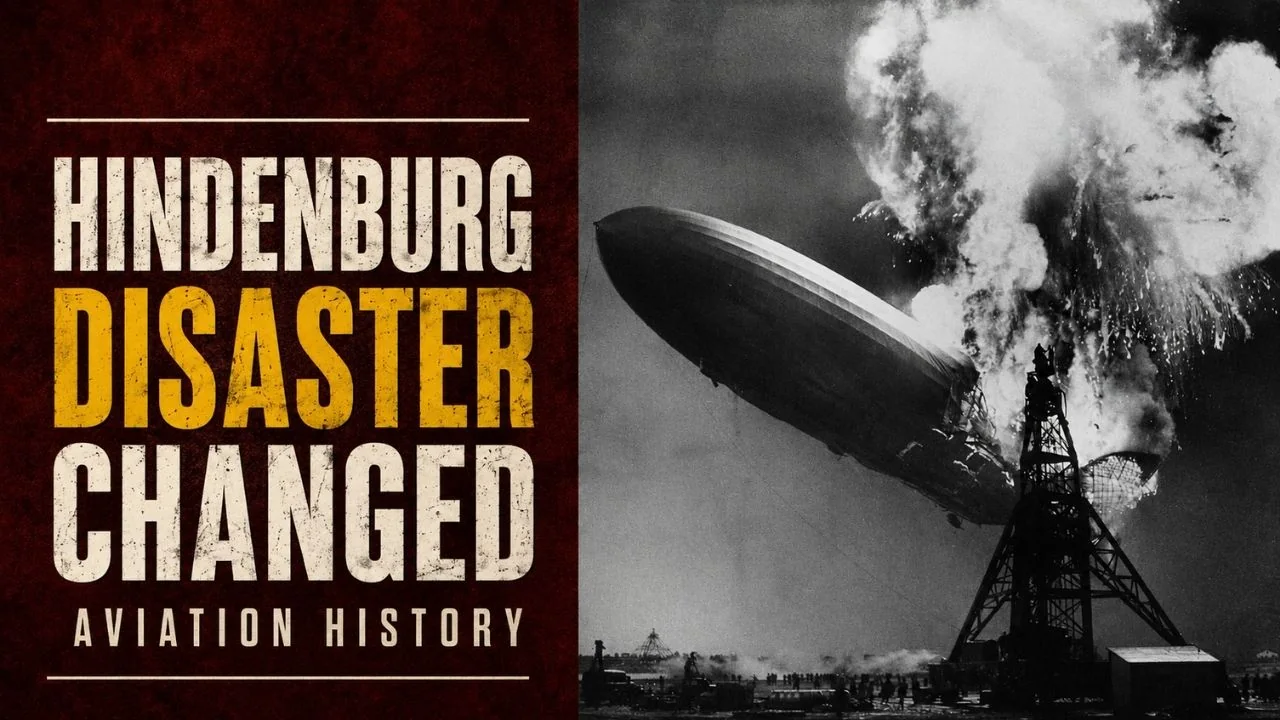
At approximately 6:25 p.m., as the Hindenburg was preparing to land, flames suddenly appeared near the rear of the airship.
What happened next unfolded with terrifying speed.
The fire spread rapidly through the hydrogen-filled structure. The giant airship, which had crossed an ocean and seemed almost invincible moments earlier, became a burning skeleton in the sky. Flames swallowed the rear section. Smoke rose over the landing field. The airship collapsed toward the ground as people below watched in horror.
Passengers and crew members fought to survive in chaos. Some jumped from windows. Others were trapped inside. Ground crew members ran as burning wreckage descended near them.
The destruction took less than a minute.
The disaster killed 35 people on board and one member of the ground crew. Remarkably, many others survived, escaping from the wreckage or jumping before the airship fully collapsed.
But the Hindenburg disaster was not remembered only because of the number of deaths. Other aviation accidents had been deadlier. What made Hindenburg unforgettable was that the world saw and heard it happen.
A Disaster Captured by Cameras and Radio
The Hindenburg disaster became one of the first major transportation catastrophes captured so dramatically by modern media.
Newsreel cameras recorded the airship falling in flames. Photographs froze the moment when the great symbol of airship travel became a burning monument to technological risk. Most famously, radio reporter Herbert Morrison witnessed the disaster as he was recording commentary for broadcast.
His emotional cry, “Oh, the humanity!” became one of the most famous lines in the history of broadcast journalism.
For audiences around the world, the Hindenburg was not a distant tragedy described only in newspaper text. It was visual. It was emotional. It was immediate. People could see the airship burn, hear the panic, and feel the shock of a dream collapsing in real time.
That media impact helped transform the disaster into something larger than an accident. It became a symbol.
What Caused the Hindenburg Disaster?
The exact cause of the Hindenburg disaster has been debated for decades.
The most widely accepted explanation is that hydrogen leaking from one of the airship’s gas cells mixed with air and was ignited by a spark, possibly caused by static electricity. The weather conditions, the landing procedure, and the airship’s structure may all have contributed to the disaster.
Other theories have been proposed over the years, including sabotage, lightning, engine failure, and the flammability of the airship’s outer coating. Some of these theories became popular because the Hindenburg was not merely a passenger aircraft; it was also a German symbol during the Nazi era. In that political atmosphere, speculation spread quickly.
However, no single theory has been proven beyond all doubt. The disaster remains one of aviation history’s most studied and debated accidents.
What is clear is that the Hindenburg’s use of hydrogen made the fire far more catastrophic once ignition occurred. The gas that allowed the airship to float also helped turn it into an inferno.
The End of the Airship Dream
Before the Hindenburg disaster, airships still represented a possible future for luxury long-distance travel. They were slower than airplanes, but they were spacious, graceful, and capable of crossing oceans in comfort.
After the disaster, public trust collapsed.
The Hindenburg did not instantly erase every airship from the sky, but it destroyed the image of the passenger zeppelin as a safe and glamorous future. The footage of the burning airship became impossible to separate from the idea of airship travel itself. For the public, the message was simple: these giants were too dangerous.
At the same time, airplanes were improving quickly. They were becoming faster, more reliable, and more practical for commercial transportation. The future of aviation no longer belonged to floating luxury liners. It belonged to fixed-wing aircraft.
In that sense, the Hindenburg disaster did not merely mark the end of one airship. It marked the end of an era.
More Than a Tragedy
The Hindenburg disaster is often remembered through a single image: a massive airship burning above Lakehurst.
But behind that image is a much larger story.
It is a story about ambition, engineering, national prestige, media, and the danger of believing too strongly in a technology before its risks are fully controlled. The Hindenburg was not just a machine. It was a promise — a promise that humanity could cross oceans through the sky with elegance and power.
On May 6, 1937, that promise burned before the cameras.
The disaster changed aviation history not because it was the deadliest air accident of its time, but because it became the moment when the world stopped believing in the future of passenger airships. The Hindenburg turned from a symbol of progress into a warning.
A warning that even the greatest machines can fall.
And sometimes, the future can disappear in flames.