On October 21, 1944, the German garrison at Aachen surrendered to American forces. Aachen became the first major German city captured by the Western Allies. The date marked the end of a battle whose photographs are full of narrow spaces: doorways, street corners, passages through buildings and roads choked with debris.
American troops had reached the German frontier in September after advancing across France and Belgium. Around Aachen, fortifications and determined resistance slowed that movement. Inside the city, infantry and armored vehicles worked through streets where ordinary buildings had become firing positions or obstacles. The civilians who remained faced bombardment and the destruction of their neighborhoods.
These four photographs follow the fighting at street level and its immediate aftermath. Two are securely dated October 15, six days before the surrender. The tank and prisoner photographs are dated only to October in their archive records; no more precise day is assigned here.
Topic: Battle of Aachen; Western Front; urban combat
01 / 04
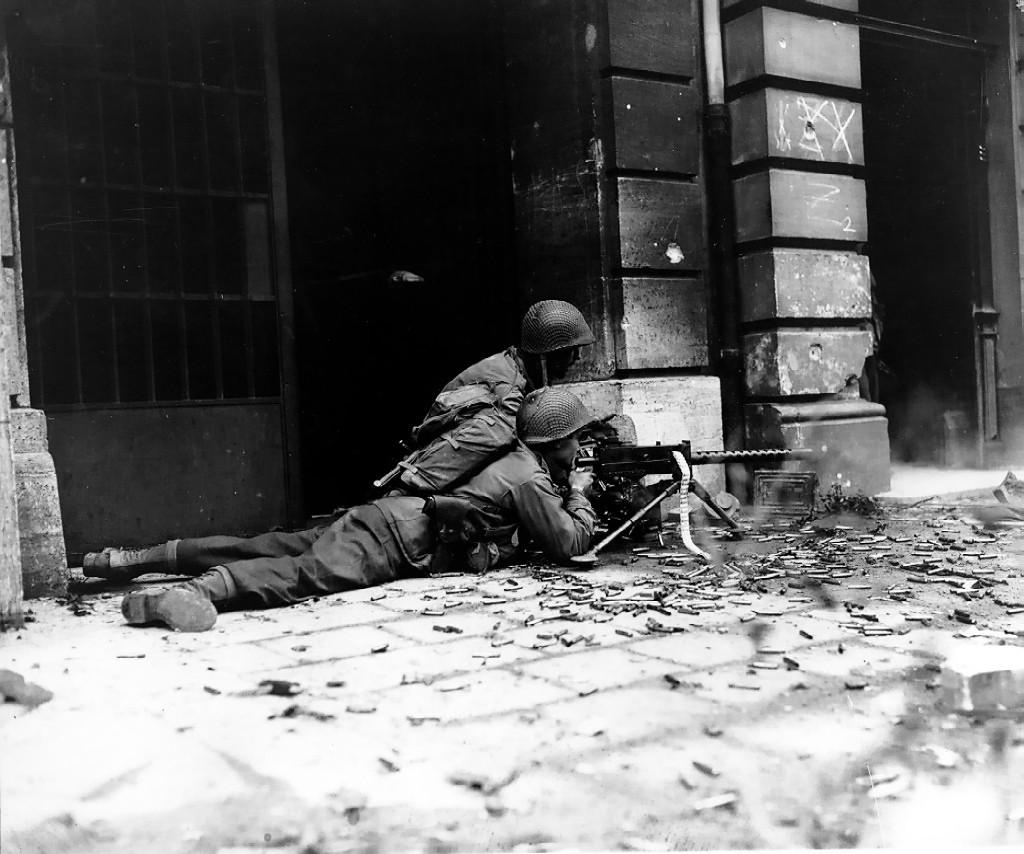
A Machine Gun at the Doorway
Two American soldiers keep low beside a building entrance, their Browning machine gun pointed along the street. The caption identifies them with the 2nd Battalion, 26th Infantry Regiment, on October 15. Most of the frame is taken up by pavement and masonry, the immediate terrain of an infantry fight. The Commons file corrects the left-right orientation of a widely reproduced version, a small archival detail that matters when reading the positions of men and weapons.
Photo details
Date
October 15, 1944
Location
Aachen, Germany
Photographer
Ellett, as credited; U.S. Army
Archive / collection
U.S. Army photograph; Wikimedia Commons orientation-corrected version
Rights / license
Public-domain U.S. Army photograph. This file corrects the left-right orientation of another circulating reproduction.
Ellett / U.S. Army, via Wikimedia Commons; corrected orientation
02 / 04
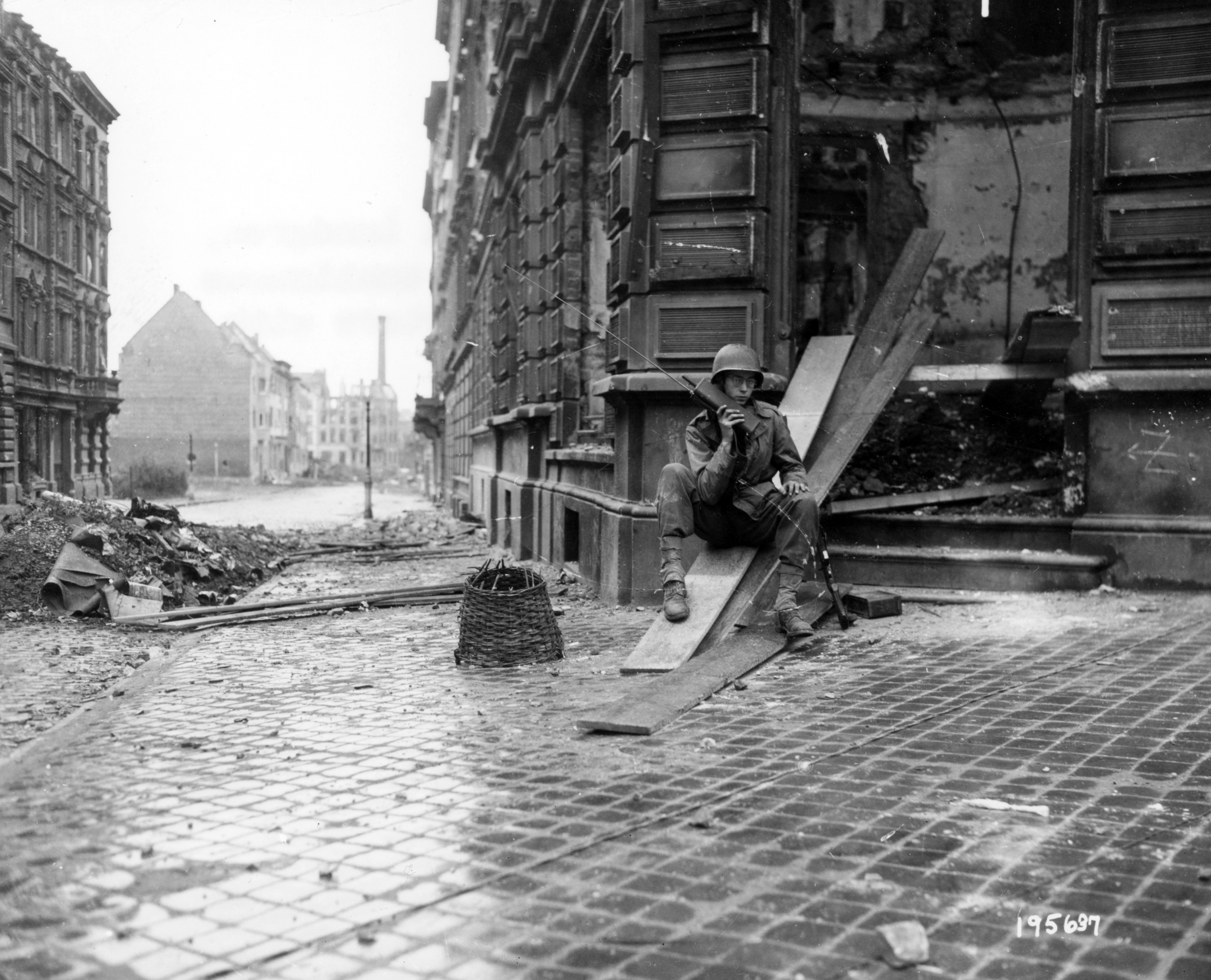
A Radio Beside the Rubble
Private First Class Ragnel Lundgren shelters beside the damaged corner of a building with a handheld radio. The Signal Corps caption identifies his task as maintaining contact with headquarters and dates the scene to October 15. Broken masonry fills the street behind him. Photographed by Westcott, the image records a piece of the battle that can disappear from accounts centered on weapons: men in separate buildings still had to communicate what they could see and where they needed help.
Photo details
Date
October 15, 1944
Location
Aachen, Germany
Photographer
Westcott, U.S. Army Signal Corps
Archive / collection
U.S. Army Signal Corps photograph SC 195637; Signal Corps Archive reproduction
Rights / license
Public-domain U.S. Army photograph; Public Domain Mark and PD-US-Army documented on the source record.
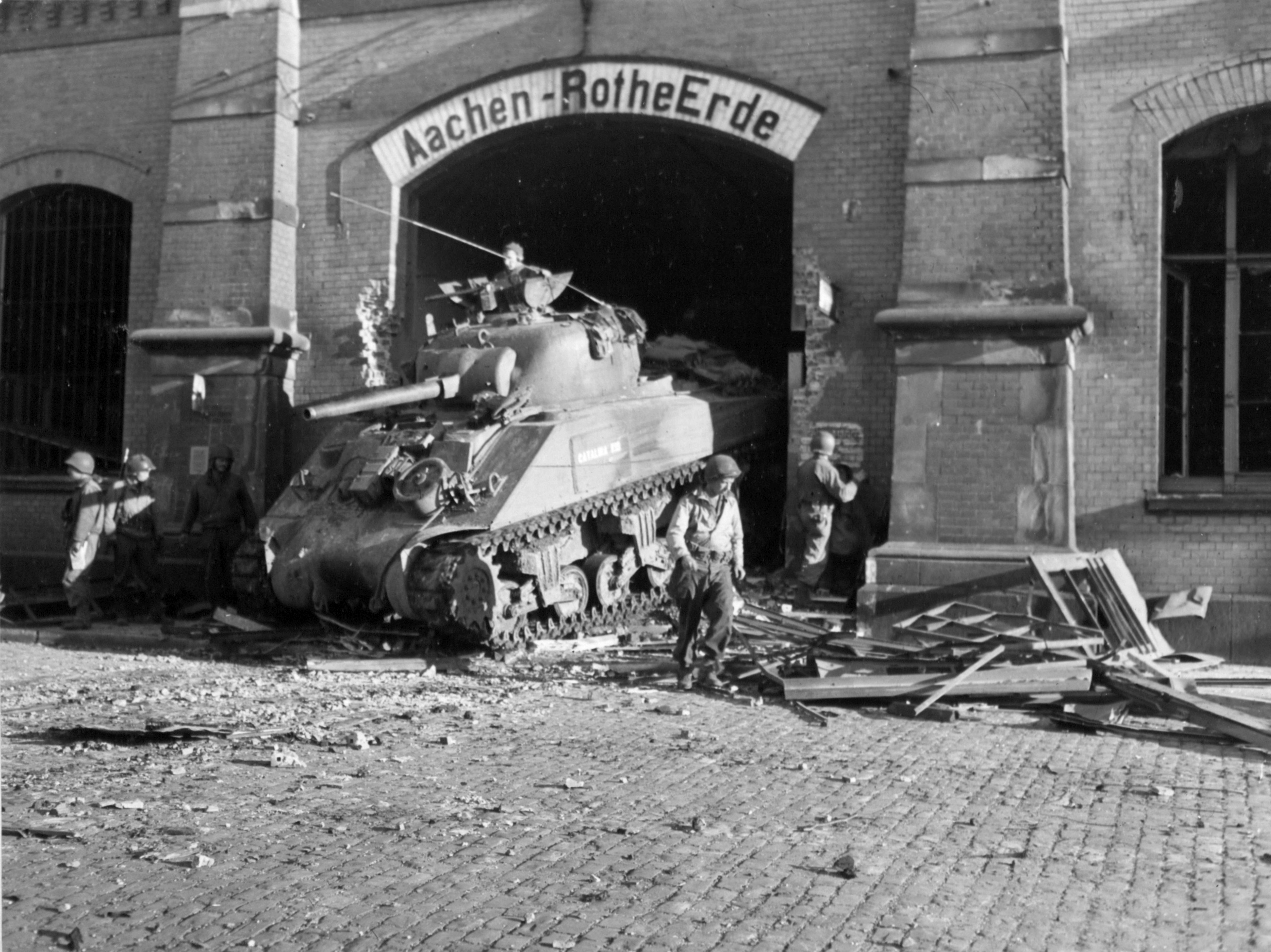
The station sign still reads Aachen-Rothe Erde above the opening, but an M4 Sherman now occupies the passage beneath it. The original Army Air Forces caption explains that a tank-dozer had made a route through the station after German demolition blocked the main approach. Railway architecture became a way around a battlefield obstacle. The archive dates the photograph to October 1944 without giving a day; it should not be labeled as a scene from the surrender on October 21.
U.S. Army Air Forces / National Archives, 342-FH-3A20086-54553AC
04 / 04
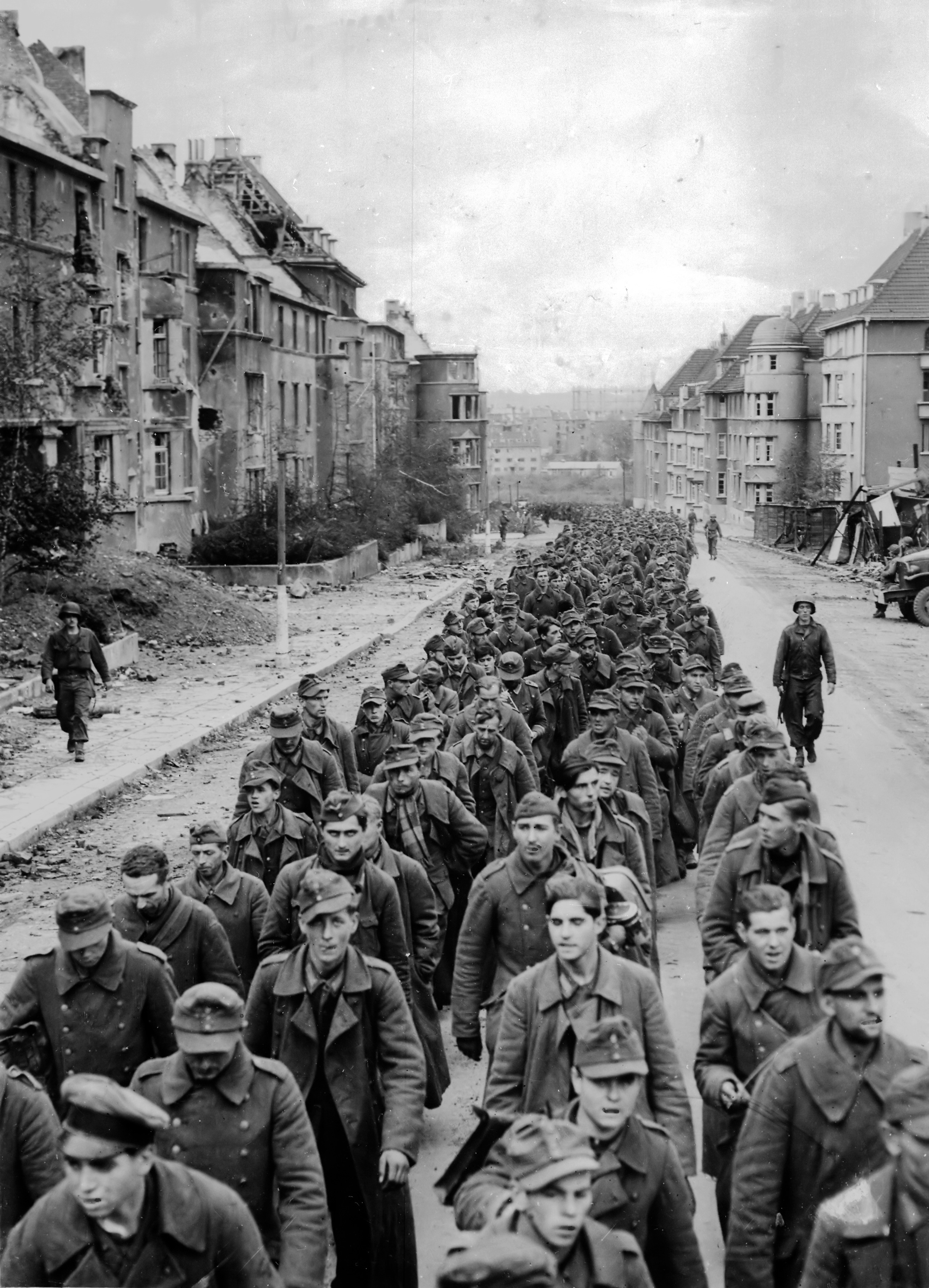
Prisoners on the Road Out
A column of German prisoners fills the road between damaged apartment buildings. American guards walk along its edges. The National Archives caption associates the procession with the fall of Aachen, though the surviving date is simply October 1944. After the garrison surrendered on October 21, the city was a place of captivity, occupation and damaged homes as well as a military objective taken. This elevated view lets the line of men and the surrounding destruction occupy the same frame.
Photo details
Date
October 1944, associated with the fall of Aachen; exact day not recorded