Back to Photo History

Photo History Historium

Nuremberg’s Last Night: October 16, 1946

Period
1945–1946 · Focus: October 15–16, 1946
Place
Palace of Justice and Nuremberg Prison, Germany

Five archival photographs trace the courtroom, prison cells and guarded passageways behind the night ten men condemned at Nuremberg were executed.

View 5 photographs
About this photo essay

After midnight on October 16, 1946, ten men sentenced by the International Military Tribunal were hanged inside Nuremberg prison. The proceedings in Courtroom 600 had ended two weeks earlier. Their final chapter took place in a small gymnasium behind the Palace of Justice.

The tribunal had imposed twelve death sentences. Martin Bormann had been tried in absentia; Hermann Göring died by suicide on the evening of October 15. The ten executions that followed included Joachim von Ribbentrop, Wilhelm Keitel and Julius Streicher. Seven other defendants received prison terms, and three were acquitted. Those different outcomes matter: the men seated together in the dock did not share a single fate.

These five photographs document the people and places behind that final night. They establish the setting rather than provide a photographic record of the executions. Each image carries its own archival date or dating limitation. The sequence moves from the public courtroom into the prison, then closes with an aerial view that locates the small building where the sentences were carried out.

The account of the night draws on Whitney R. Harris’s October 19, 1946 report to Robert H. Jackson, preserved in the Jackson Papers at the Library of Congress and reproduced by historian John Q. Barrett. Harris was in Nuremberg but was excluded from the execution chamber; he relied in part on journalists who witnessed the hangings. The Memorium Nuremberg Trials and the United States Holocaust Memorial Museum provide the wider historical and photographic context.

Topic: Nuremberg Trials · October 16, 1946 · The final night

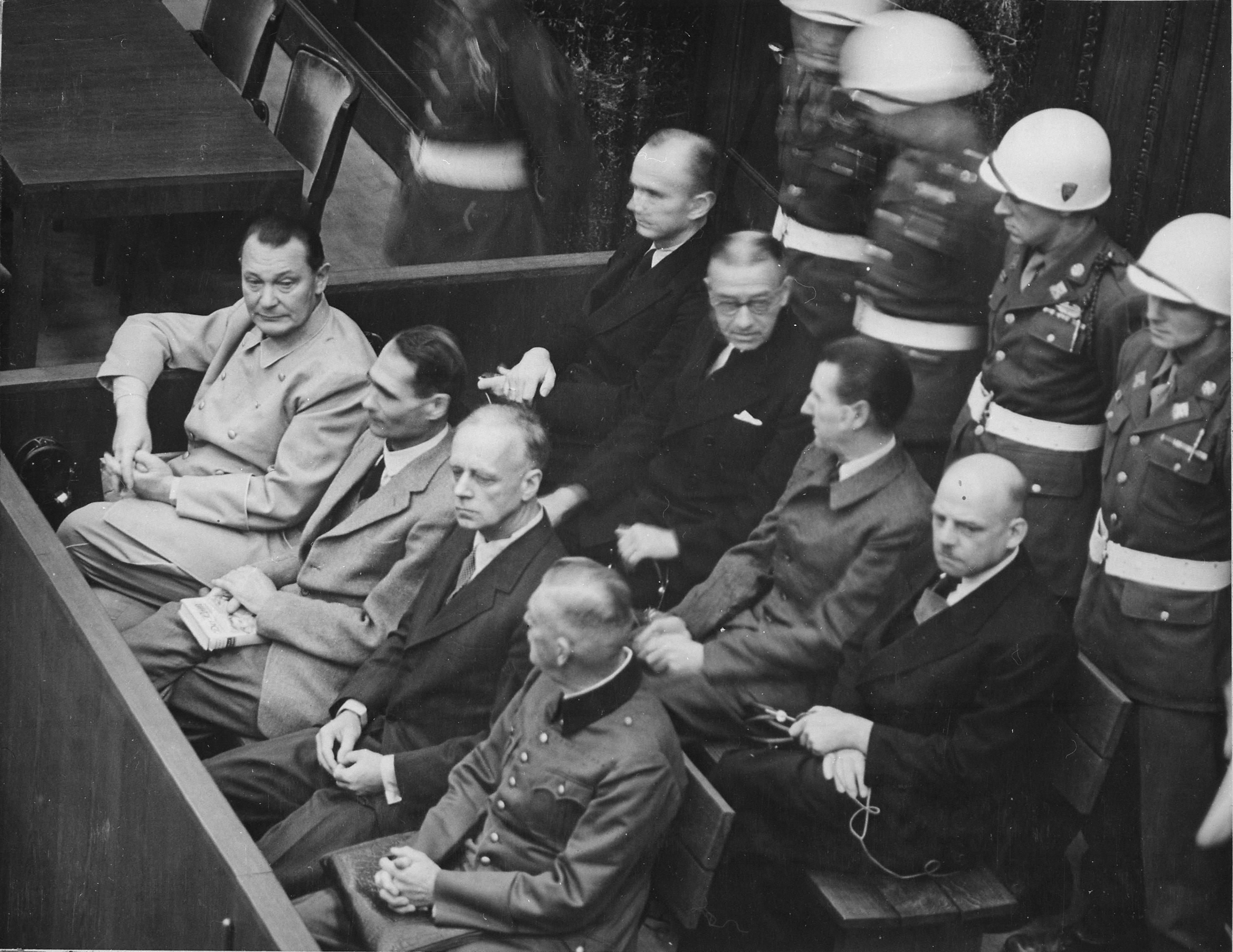
Eight defendants seated in two rows in the Nuremberg courtroom, with uniformed military guards behind them.

Twelve Death Sentences

The defendants sit beneath the eyes of military guards in Courtroom 600. In the front row, from left, are Hermann Göring, Rudolf Hess, Joachim von Ribbentrop and Wilhelm Keitel; behind them are Karl Dönitz, Erich Raeder, Baldur von Schirach and Fritz Sauckel. This photograph was made during the 1945–46 trial, not on the night of the executions.

By October 1, 1946, the tribunal had delivered its verdicts. Twelve defendants received death sentences, including the absent Martin Bormann. Among the men pictured here, Hess, Dönitz, Raeder and Schirach received prison terms. The courtroom image brings them together; the judgments separated their futures.

Photo details
Date
1945–1946; exact day not established
Location
Courtroom 600, Palace of Justice, Nuremberg, Germany
Photographer
U.S. government photographer; individual not identified in the source record
Archive / collection
U.S. National Archives and Records Administration · NAID 540128
Rights / license
Public domain in the United States; U.S. government photograph. Digital copy via Wikimedia Commons.
Credit
National Archives and Records Administration, NAID 540128; via Wikimedia Commons.
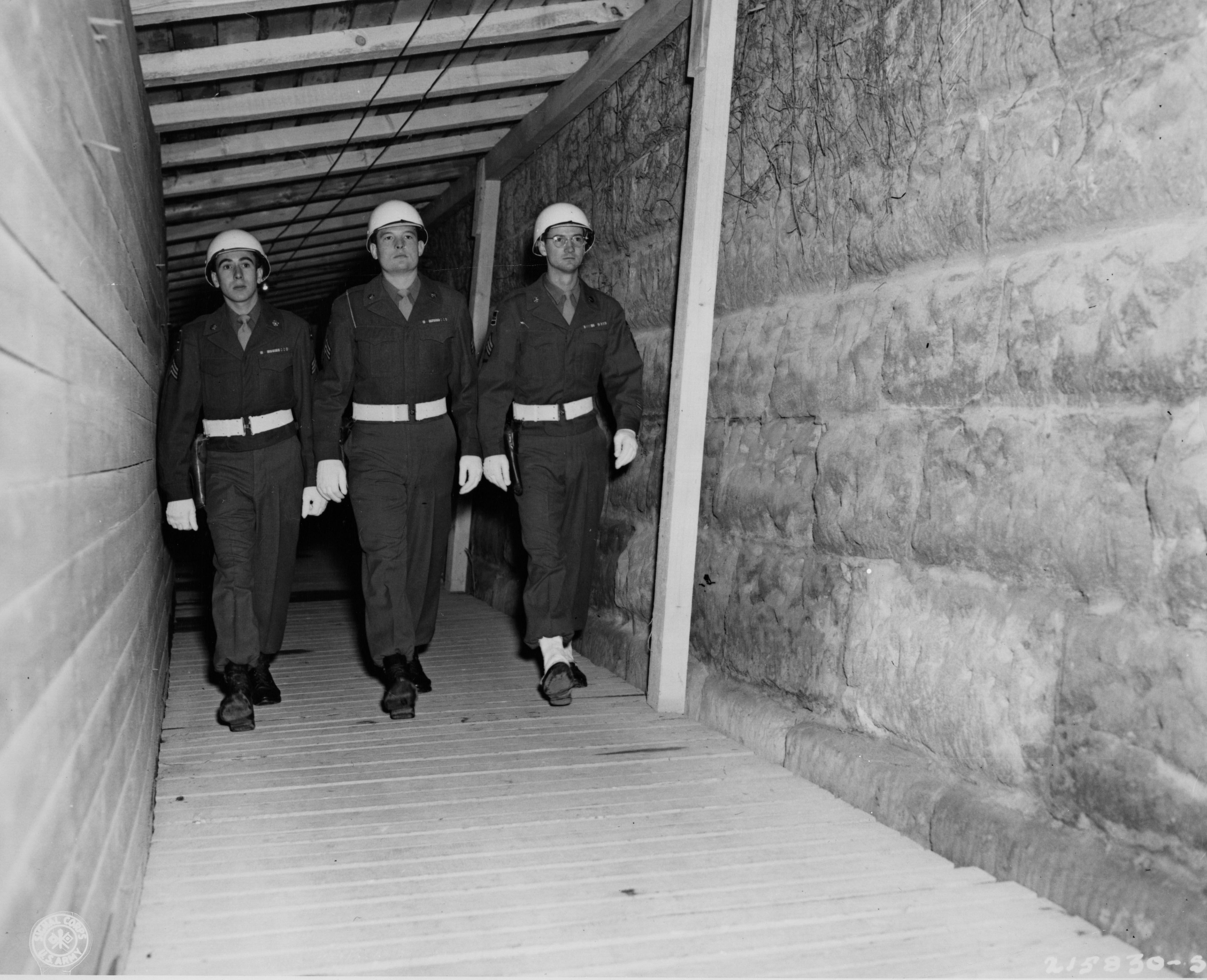
Three uniformed American prison guards walk through a narrow covered passage inside Nuremberg prison.

Inside the Prison Walls

Three American sergeants—George Cullette, Marvin Moebius and Guy Reppert Jr.—leave the cell-block area inside Nuremberg prison. The narrow, covered passage shows the guarded world behind the public courtroom. The source identifies the men but does not establish the day this photograph was taken.

The prison and Palace of Justice were protected by the 6850th Internal Security Detachment under Colonel Burton C. Andrus. After Robert Ley died by suicide in October 1945, each prisoner was placed under a guard’s continuous observation. By the evening of October 15, 1946, this security system had to oversee the final hours of the condemned men.

Photo details
Date
Nuremberg trial period, 1945–1946; exact date not supplied
Location
Nuremberg Prison, Germany
Photographer
U.S. Army Signal Corps; individual photographer not identified
Archive / collection
U.S. Army Military History Institute · World War II Signal Corps Photograph Collection
Rights / license
Public domain in the United States; official U.S. Army photograph. The 2009 date on the web record is a publication date, not the photograph’s historical date.
Credit
U.S. Army Military History Institute, World War II Signal Corps Photograph Collection; via Wikimedia Commons.
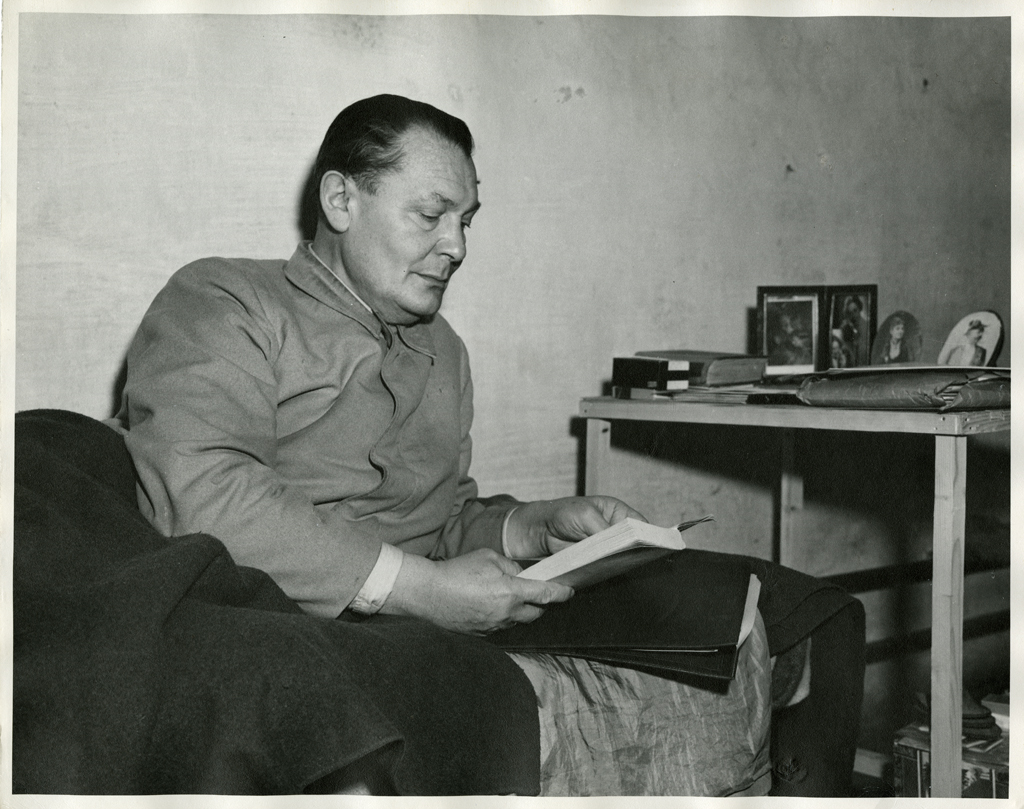
Hermann Göring sits reading in his prison cell beside a table holding framed family photographs.

Göring: A Death Before Midnight

Hermann Göring reads in his Nuremberg cell on December 21, 1945. Family photographs stand on the table beside him. The image records his imprisonment early in the trial; it does not show his final evening.

On October 15, 1946, hours before his scheduled hanging, Göring died by suicide using cyanide. His death reduced the number of men awaiting execution from eleven to ten. In his report to Robert H. Jackson four days later, Whitney R. Harris described the discovery of the poisoning and acknowledged that the source of the cyanide remained unresolved at the time. The photograph’s quiet domestic details belong to an earlier moment; the death came almost ten months later.

Photo details
Date
December 21, 1945
Location
Nuremberg Prison, Germany
Photographer
United States Army Signal Corps photographer
Archive / collection
Harvard Law School Library · digital reproduction via Wikimedia Commons
Rights / license
Public domain in the United States; official U.S. Army Signal Corps photograph. Wikimedia Commons records a Public Domain Mark.
Credit
U.S. Army Signal Corps; image courtesy of Harvard Law School Library, Harvard University; via Wikimedia Commons.
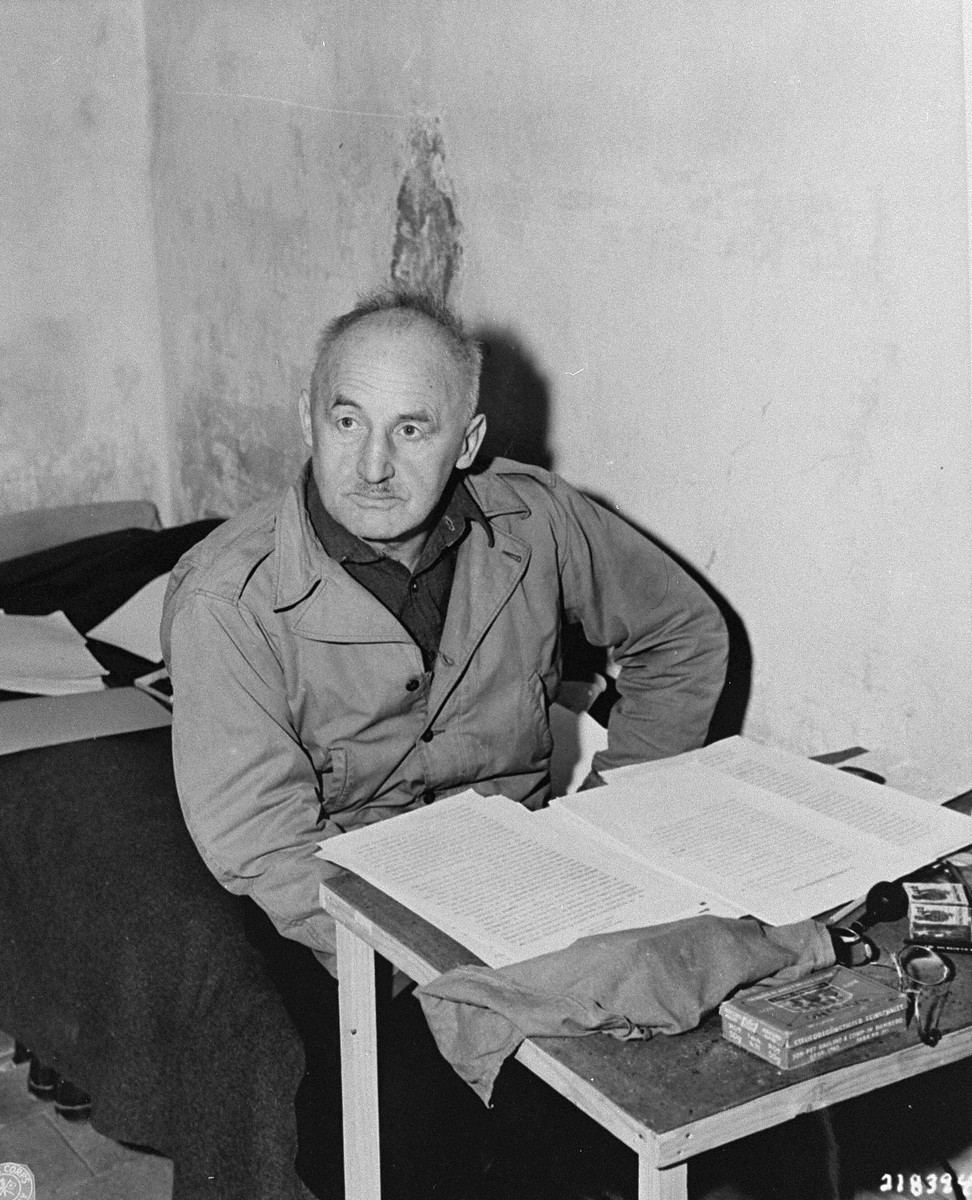
Julius Streicher sits in a prison cell at a small table covered with documents and writing materials.

Streicher: The Propagandist in a Cell

Julius Streicher sits at a small table covered with papers in his prison cell on November 24, 1945, four days after the trial opened. The photograph fixes an early moment in the proceedings, well before the sentence that would bring him back into the story of October 16.

As publisher of Der Stürmer, Streicher had helped spread virulent antisemitic propaganda. The tribunal convicted him of crimes against humanity for his role in inciting persecution and murder. He was among the ten men executed that night. His presence among the condemned shows that the case extended beyond battlefield command to the machinery of Nazi persecution.

Photo details
Date
November 24, 1945
Location
Nuremberg Prison, Germany
Photographer
U.S. Army Signal Corps; individual photographer not identified
Archive / collection
NARA · 111-SC-218394 (Album 5569) · USHMM photograph 74837
Rights / license
Public domain, as identified in the USHMM collection record.
Credit
United States Holocaust Memorial Museum, courtesy of National Archives and Records Administration, College Park; photograph 74837.
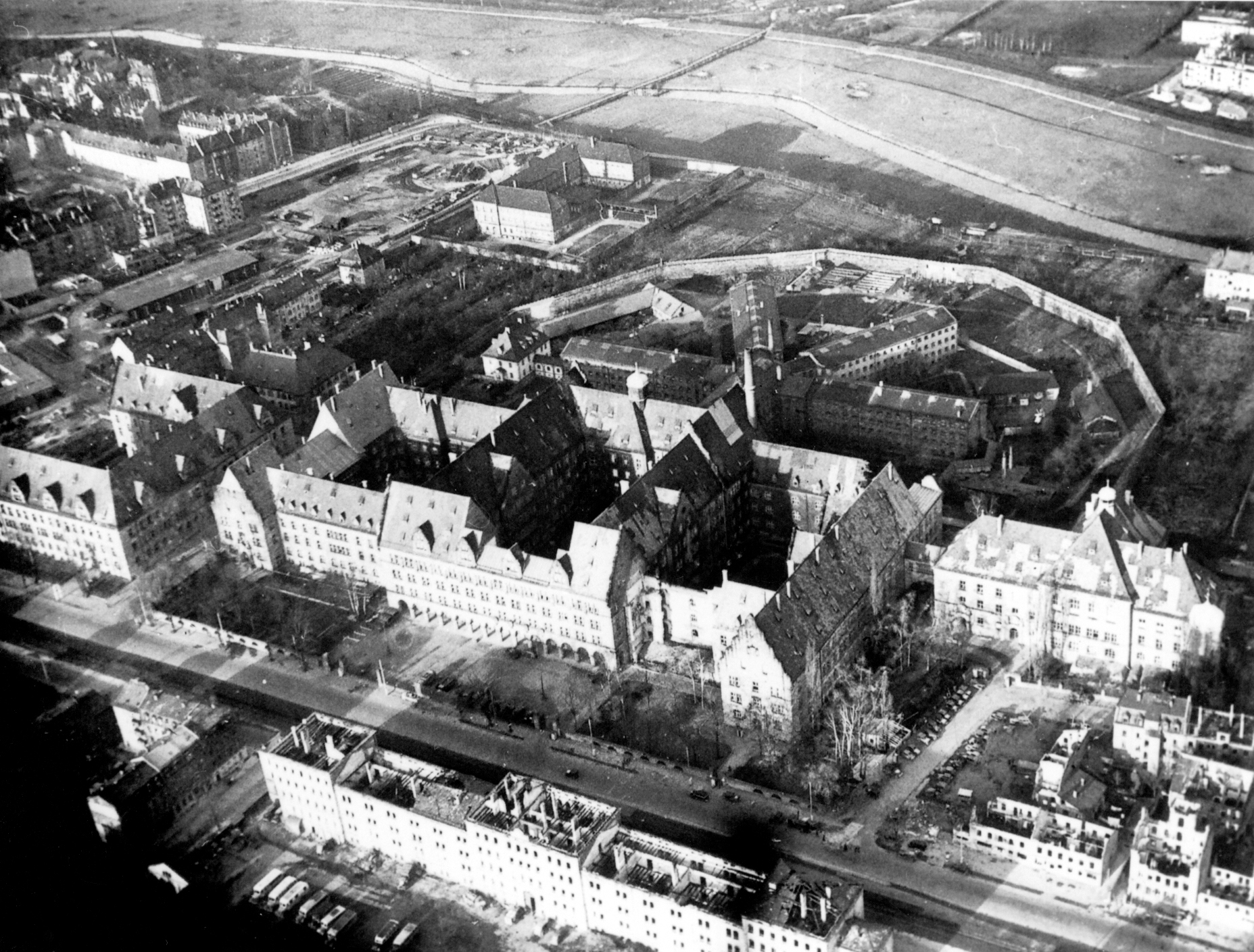
Aerial view of Nuremberg’s Palace of Justice and the prison buildings and yards behind it, before the October 1946 executions.

The Small Building Behind the Court

The Palace of Justice fills the foreground of this aerial view; the prison complex extends behind it. The Memorium Nuremberg Trials identifies the small gymnasium to the right of the cell block as the place where the death sentences were carried out. Its caption dates the view to winter 1945–46, while its credit line gives November 20, 1945. In either case, the image predates the executions.

Shortly after 1 a.m. on October 16, 1946, Joachim von Ribbentrop entered the execution chamber first. Wilhelm Keitel, Ernst Kaltenbrunner, Alfred Rosenberg, Hans Frank, Wilhelm Frick, Julius Streicher, Fritz Sauckel, Alfred Jodl and Arthur Seyss-Inquart followed. Harris’s report places Seyss-Inquart’s death at 2:57 a.m.

The bodies were subsequently taken to Munich and cremated; the ashes were scattered in a tributary of the Isar. The trial’s final night had unfolded inside an ordinary prison building, only a short distance from the courtroom that had commanded the world’s attention.

Photo details
Date
Winter 1945–46; museum credit gives November 20, 1945
Location
Palace of Justice and prison grounds, Nuremberg, Germany
Photographer
Ray D’Addario
Archive / collection
Stadtarchiv Nürnberg · StadtAN A 65/IV Nr. RA-141
Rights / license
The museum permits publication with its specified credit line, reproduced below. No Creative Commons license is claimed.
Credit
Bildnachweis: Stadtarchiv Nürnberg, Foto: Ray D'Addario (20. November 1945). (StadtAN A 65/IV Nr. RA-141)

More Photo History

Read the story