After the Berlin Wall Opened: Crossings, Graffiti and Fragments
Period
November–December 1989
Place
Berlin, Germany, and Washington, D.C.
Four archival photographs follow the Berlin Wall’s transformation in late 1989, from a guarded border to an opening, a public surface and a portable fragment.
The Berlin Wall did not disappear when its border crossings opened on the night of 9 November 1989. Concrete, guarded spaces and the habits of a divided city remained. What changed immediately was what people could do around the barrier. The photographs in this album follow that change through the weeks after the opening, rather than presenting every image as a scene from the same famous night.
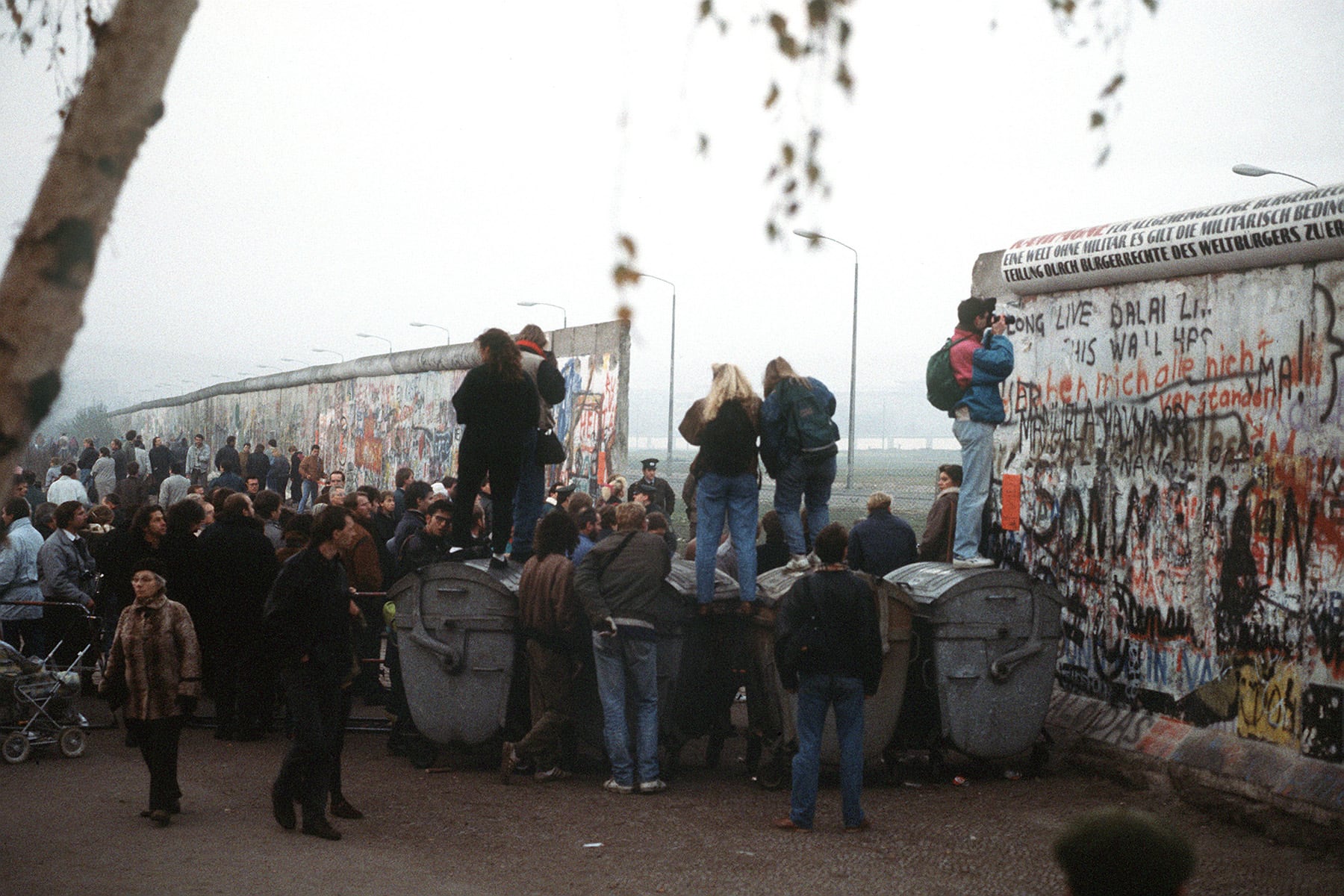
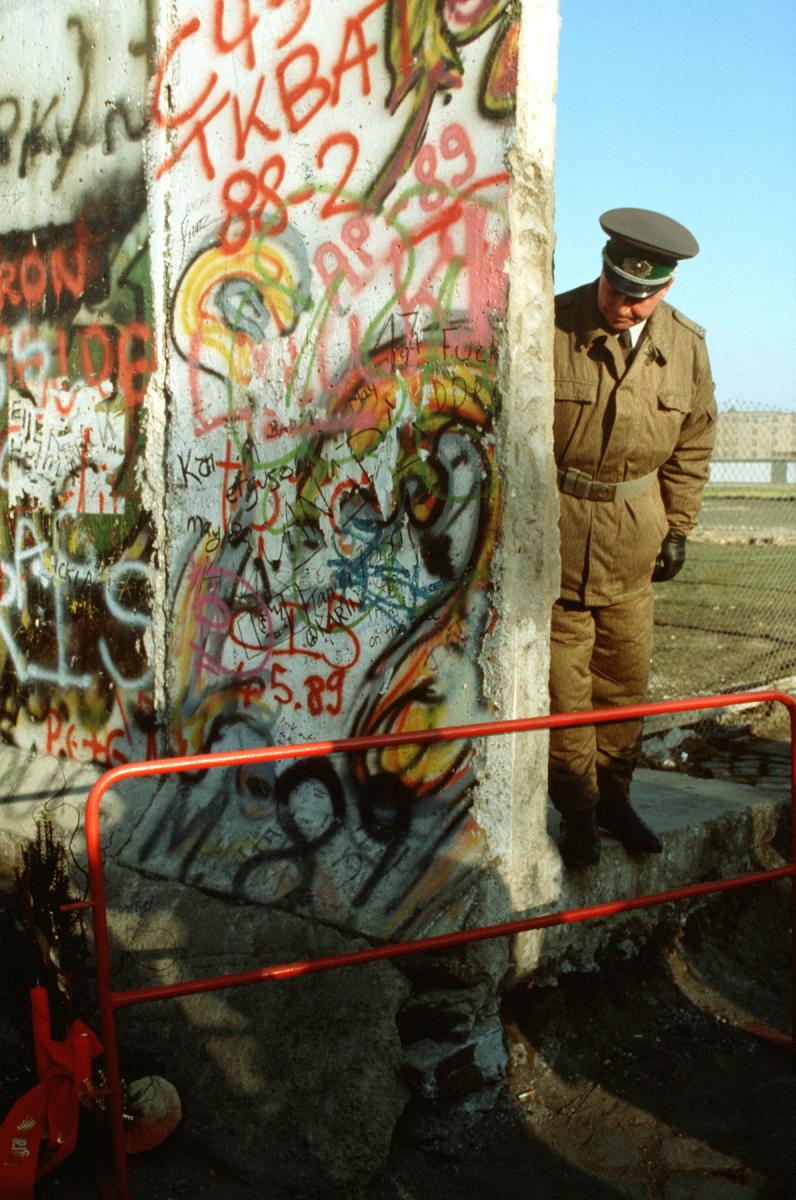
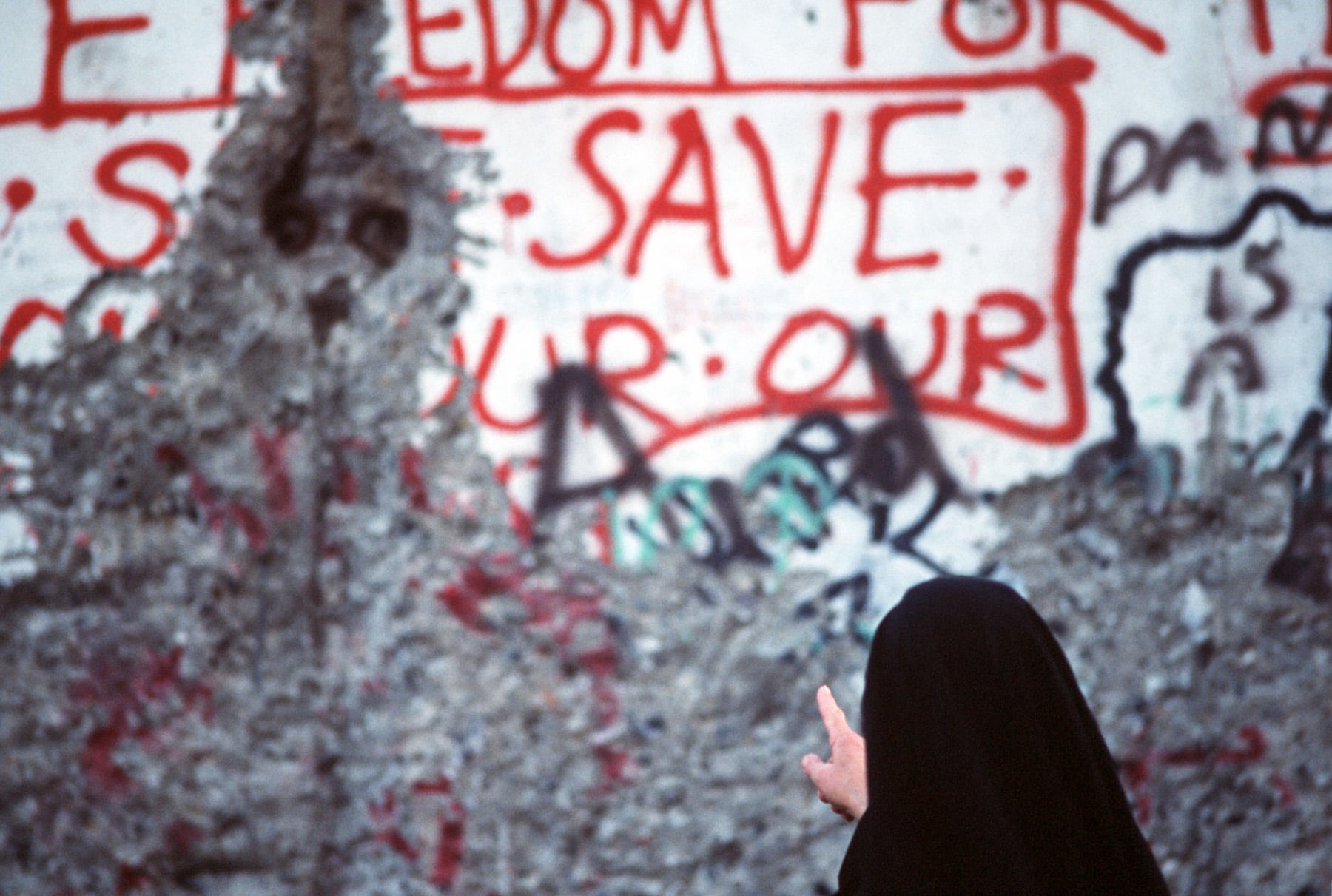
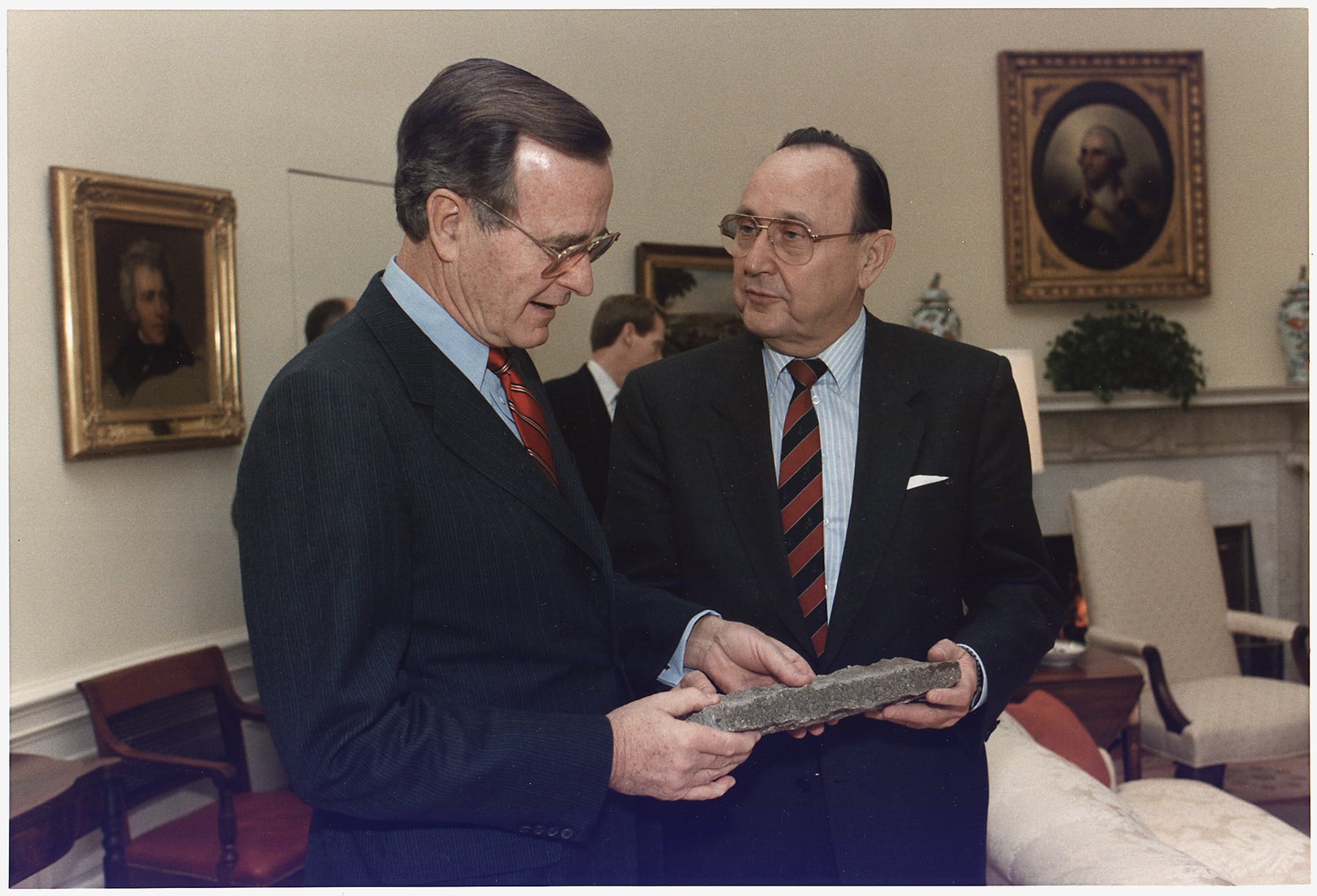
At Potsdamer Platz, a crowd gathers beside a new gap. Nearby, an East German policeman looks towards a small Christmas tree on the western side. In December, a nun studies writing on a surviving section. Across the Atlantic, a piece of the Wall is presented in the White House. The same structure appears as a crossing, a backdrop, a surface to read and an object that can travel.
These are photographs from U.S. government archival records, with their dates and identifiers retained. They provide particular views, not a complete account of the people and protests behind the opening. German reunification followed on 3 October 1990. Keeping those dates separate allows the pictures to show something more interesting than an instant ending: the physical and public transformation of a border.
Topic: Cold War and German history
01 / 04
A new opening draws a crowd
This scene was photographed at Potsdamer Platz on 14 November 1989, five days after the border opened. The distinction matters: it is a view of the changing city in the aftermath, rather than a photograph of the announcement or the first crossing that night. A crowd gathers around a newly created gap in the concrete barrier. The opening makes an abstract political change visible as a space that bodies can approach and pass through. Staff Sergeant F. Lee Corkran’s photograph survives among U.S. Defense Department records. It captures one location in a larger process, with the remaining Wall and the people beside it occupying the same frame.
Photo details
Date
14 November 1989
Location
Potsdamer Platz, Berlin, Germany
Photographer
Staff Sergeant F. Lee Corkran, U.S. Department of Defense
Archive / collection
National Archives — 6460115; 330-CFD-DF-ST-91-01380
Rights / license
National Archives / DocsTeach identifies this U.S. Department of Defense photograph as Public Domain, Free of Known Copyright Restrictions. https://docsteach.org/document/berlin-wall-potsdamer-platz/
U.S. Department of Defense / Staff Sgt. F. Lee Corkran, DF-ST-91-01380. National Archives Identifier 6460115
02 / 04
A guard looks through the gap
The National Archives caption identifies an East German policeman looking at a small Christmas tree on the west side of the Wall, at a newly created opening near Potsdamer Platz. A modest object changes the mood of a setting built for separation. The concrete remains, and so does the uniform, but the gap permits a view that no longer fits the earlier purpose of the barrier. The photograph does not reveal the policeman’s thoughts. It does let us compare the visible elements: an official presence, damaged edges and an ordinary festive tree. The Wall’s opening was a political event whose consequences also appeared in small arrangements at street level.
Photo details
Date
Late 1989; the cited archive caption does not supply an exact day
Location
Potsdamer Platz, Berlin, Germany
Photographer
U.S. Department of Defense photographer; individual photographer not identified in the cited gallery caption
Archive / collection
National Archives — 6460121; DF-ST-91-01386
Rights / license
Historical U.S. federal government photograph in the National Archives; public domain. Archival record and federal photographer credit are retained. https://www.archives.gov/research/still-pictures/permissions
U.S. Department of Defense / National Archives, DF-ST-91-01386, National Archives Identifier 6460121
03 / 04
A surviving section becomes something to read
On 21 December 1989, a nun studies graffiti on a section of the Berlin Wall. The photograph is quieter than the crowd at the opening, yet it records another change in how the structure was encountered. Attention rests on its painted surface rather than on the act of crossing. Concrete that had enforced separation could now be approached as a carrier of public messages and a witness to the recent past. The woman’s presence gives those marks a reader, without telling us which words interested her or what she thought of them. The surviving Wall is still large and solid, but its meaning is being made in encounters like this one.
Photo details
Date
21 December 1989
Location
Berlin, Germany
Photographer
Staff Sergeant F. Lee Corkran, U.S. Department of Defense
Archive / collection
National Archives — 6460723; DF-ST-91-03566
Rights / license
Historical U.S. federal government photograph in the National Archives; public domain. Archival record and federal photographer credit are retained. https://www.archives.gov/research/still-pictures/permissions
U.S. Department of Defense / Staff Sgt. F. Lee Corkran, DF-ST-91-03566, National Archives Identifier 6460723
04 / 04
The barrier reaches an office in Washington
On 21 November 1989, West German Foreign Minister Hans-Dietrich Genscher presented President George H. W. Bush with a piece of the Berlin Wall in the Oval Office. A structure designed to prevent movement had become an object that could be carried across an ocean. The formal setting makes this more than a souvenir photograph: the fragment entered a diplomatic encounter while Germany’s future was still being negotiated. It was not a picture of reunification, which came the following year. Placed at the end of this album, the scene shows how a local material change in Berlin acquired an international afterlife, with a small piece standing for a much larger barrier.
Photo details
Date
21 November 1989
Location
Oval Office, White House, Washington, D.C.
Photographer
White House photographer; individual photographer not identified in the cited gallery caption
Archive / collection
National Archives / George H. W. Bush Presidential Library — 186404; 29-0040M
Rights / license
Historical U.S. federal government photograph in the National Archives; public domain. Archival record and federal photographer credit are retained. https://www.archives.gov/research/still-pictures/permissions