Those letters, LO, became a memorable beginning for the ARPANET. The successful login followed about an hour later. There was no audience watching a product launch. Programmers were testing a connection, checking what arrived and fixing what did not.
Two computers, and a telephone call
Charley Kline was working at UCLA, where Leonard Kleinrock led the network research group. Bill Duvall was at the Stanford Research Institute in Menlo Park. Their host computers were different machines: an SDS Sigma 7 at UCLA and an SDS 940 at SRI.
The men also kept a telephone connection open. As Kline typed, Duvall confirmed what had arrived. L came through. So did O. When the next letter was attempted, the SRI system failed. Kleinrock’s later account describes the intended command as LOGIN, with SRI’s system expected to complete the word after the first three letters.
The log preserves the date, time and Kline’s initials. The familiar account of the interrupted word comes from the participants’ recollections. Together they describe a working experiment that briefly failed, then worked again that same evening.
A network built between machines
The project was funded by the Advanced Research Projects Agency, then known as ARPA. Connecting research computers promised to make expensive computing resources available beyond the laboratory that owned them. It also presented a difficulty: institutions did not all use the same hardware or software.
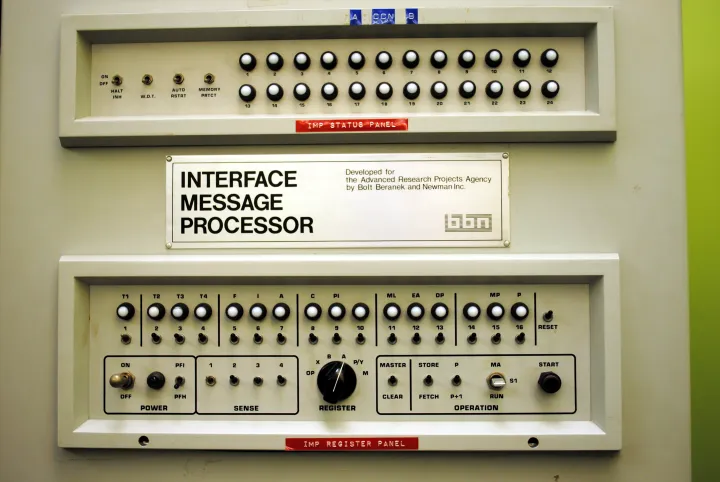
Bolt Beranek and Newman built Interface Message Processors, or IMPs, to handle communication between sites. Each host connected to one of these machines. Rather than expecting every host to manage the whole network, the system placed a separate piece of equipment between the local computer and the distant links.
The first IMP arrived at UCLA at the end of August 1969 and was connected to its host in early September. SRI followed. By December, the initial four-site network included the University of California, Santa Barbara, and the University of Utah. A surviving sketch lists those four nodes and the computers attached to them.
The agreements behind the connection
Equipment was only part of the work. In April 1969, Steve Crocker’s first Request for Comments described tentative agreements and unresolved questions about host software. It separated the responsibilities of the IMPs from those of the host computers and invited other researchers to respond.
The document explained how a message would be broken into smaller packets for transmission between IMPs and then reassembled at its destination. It also asked what the host programs needed to do to establish connections, exchange information and check for errors. The questions were concrete because two institutions had to make their programs cooperate.
October 29 is therefore a milestone in the development of the internet, not the date on which every feature of the modern internet appeared. ARPANET still had to grow, and networks would later need agreed ways to communicate with one another. The World Wide Web was a separate, much later development.
The laboratory’s surviving cabinet, control panel and logbook make the scale of that first test easier to grasp. A remote login was an ordinary computing task made newly possible across a network. For Kline and Duvall that evening, success meant getting past the third letter and completing it.
Cover photograph: Andrew “FastLizard4” Adams / Wikimedia Commons; CC BY-SA 3.0. Photograph taken October 29, 2011.