Photographs preserved by the Anglo-Ethiopian Society show the preparations as well as the pageantry. A triumphal arch was made from wood and muslin. A canvas extension stood beside the cathedral. A Movietone News vehicle appears among the crowds. The ceremony was rooted in Ethiopian monarchy and religion, but its organizers understood the reach of modern publicity.
A ruler before the coronation
The man receiving the crown was already experienced in government. Born Tafari Makonnen, he had served as regent from 1916 under Empress Zewditu. Her death in 1930 brought his succession; the November ceremony gave that change its formal public expression. Coronation and accession were stages of the same transition, rather than interchangeable dates.
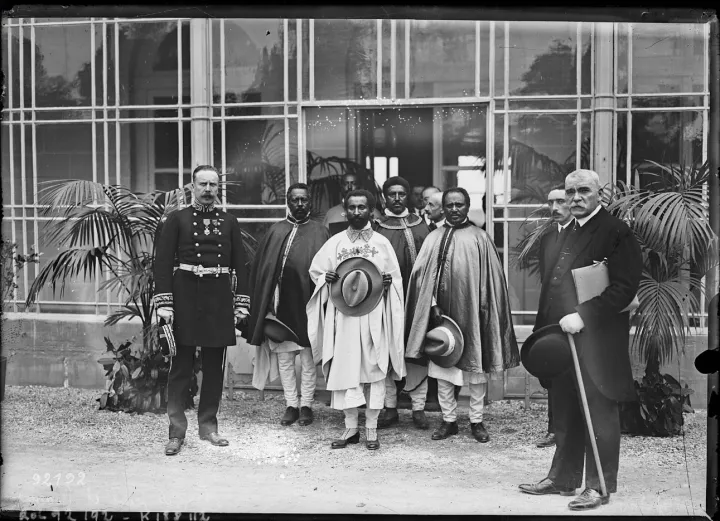
His earlier diplomacy can be seen in French press photographs from 1924. They show Ras Tafari visiting Europe years before the coronation. These images matter because the familiar sequence of a crowned emperor, an Italian invasion and an appeal for help can obscure the political work that preceded his reign.
November 2 also made a statement about sovereignty. Ethiopia maintained its independence in a continent largely divided among colonial powers. Receiving overseas delegations in Addis Ababa placed an African court at the center of an international occasion, even as European governments pursued their own interests around Ethiopia’s borders.
Reform under imperial authority
The constitution issued on July 16, 1931, helps explain what the new reign promised and what it withheld. It established two legislative chambers and described legal protections for Ethiopian subjects. It also reserved supreme authority to the emperor, who appointed senators and retained sweeping powers over administration, the military and treaties.
The document attached the succession to Haile Selassie’s descendants and incorporated the dynasty’s claim to descent from Solomon and the Queen of Sheba. That genealogy was a statement of royal legitimacy within the constitution. It should not be confused with independently established historical ancestry.
Reform moved unevenly. Measures against slave raiding and the slave trade had begun during Tafari’s regency, followed by legislation aimed at gradual emancipation. Slavery nevertheless survived the coronation. As the Law Library of Congress documents, the decisive abolition proclamation came in 1942, after the Italian occupation. Moving that achievement back to 1930 would erase twelve difficult years.
Invasion, exile and return
Italy invaded Ethiopia in 1935. Haile Selassie went into exile the following year and appealed to the League of Nations in Geneva on June 30, 1936. The international institutions in which Ethiopian diplomacy had invested could not prevent the conquest.
His return in 1941 depended on a wartime campaign involving Ethiopian resistance fighters and British-led forces. Official photographs show him at Dambacha Fort in April, followed by gatherings in Addis Ababa. President Franklin Roosevelt’s congratulatory telegram of May 20 acknowledged the emperor’s return to the capital. It was a restoration achieved through war, far removed from the carefully prepared ceremonies of 1930.
Haile Selassie remained an international presence for decades. In May 1963, Addis Ababa hosted the summit that created the Organization of African Unity; later that year he visited President John Kennedy in Washington. His government eventually fell in 1974. The coronation photographs therefore belong to the beginning of a long, disputed reign: one associated abroad with Ethiopian sovereignty, and at home with the enduring concentration of power in the palace.
Cover image: L’Illustration; reproduction by Philippe Alès / Wikimedia Commons; CC BY-SA 4.0