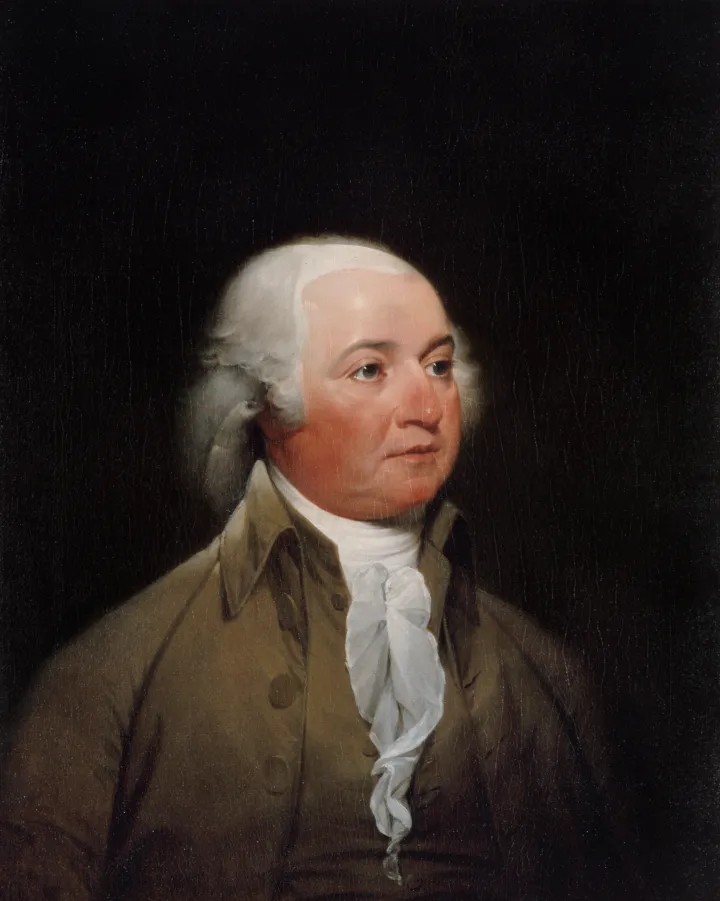
The house where he was born survives in what is now Quincy. It offers a modest starting point for a life usually introduced through large titles: revolutionary, diplomat, first vice president and second president of the United States. Adams spent much of that life arguing about how power should be restrained. His own presidency would expose some serious limits to his answers.
A defense that did not fit the slogans
In 1770, Adams helped defend British soldiers prosecuted after the Boston Massacre. Five colonists had died following the confrontation on March 5. To many opponents of British rule, the shooting was evidence of military tyranny. Paul Revere’s famous print helped make that interpretation visible.
A courtroom required a different kind of account. Adams pressed the jury to consider the evidence and the circumstances of the confrontation. Captain Thomas Preston was acquitted in a separate trial. Of the eight soldiers subsequently tried, six were acquitted and two were convicted of manslaughter. Their punishment was branding on the thumb after they invoked benefit of clergy.
Defending the accused did not turn Adams into a supporter of British policy. It showed that the legal work and the political struggle could pull in different directions. The verdicts also resist the neat version in which he simply secured an acquittal for everyone.
Independence was a collective undertaking
Adams became a forceful advocate of independence in the Continental Congress. He served on the committee responsible for preparing the Declaration alongside Thomas Jefferson, Benjamin Franklin, Roger Sherman and Robert Livingston. Jefferson wrote the principal draft; Adams helped advance the cause in Congress.
John Trumbull’s later painting places those five men together presenting the document. It is a commemorative reconstruction, not a literal record of everyone in the room. The Architect of the Capitol notes that Trumbull included some delegates who had not attended the represented event. The familiar image compresses a political process into a single scene.
That work depended on households as well as assemblies. During John’s absences, Abigail Adams managed the family’s farm, finances and children. Their letters carried news and arguments in both directions. In 1776, she pressed him to consider women when new laws were being made. Her contribution cannot be reduced to cheering him on from home.
The president and his critics
Adams succeeded George Washington in 1797. Relations with France dominated his presidency, and he pursued a settlement that prevented the maritime conflict from expanding into a full war. At home, however, he approved measures that narrowed political freedom.
The four Alien and Sedition Acts of 1798 increased the residency requirement for citizenship, expanded powers over noncitizens and restricted certain criticism of the federal government. The National Archives records that the newspaper editors prosecuted under the Sedition Act were Democratic-Republicans, opponents of the governing Federalists. These were practical restrictions with partisan consequences.
Adams lost the election of 1800 to Jefferson. Remembering his birthday therefore means holding several records together: the lawyer who defended unpopular clients, the advocate of independence, the diplomat seeking security and the president who signed laws used against critics. The documents preserve all of them. A portrait on its own cannot.
Cover image: John Trumbull / White House Collection / White House Historical Association; Public domain: expired copyright