The armistice ended hostilities between Austria-Hungary and the Allied and Associated Powers on the Italian front. It did not end the entire First World War on November 3. Germany’s armistice followed on November 11, and the political settlement took much longer. A date on a signed document was only one part of an uneven ending.
An army coming apart
Italy’s offensive began on October 24. During the battle of Vittorio Veneto, Austro-Hungarian forces faced military defeat while the state behind them was breaking apart. National movements were establishing new authorities, and Hungary withdrew from its union with Austria. An imperial delegation now had to negotiate for an army whose political foundations were disappearing.
General Viktor Weber von Webenau led that delegation. The Austrian State Archives’ account follows its attempts to establish contact across the lines and the urgency of its exchanges with the imperial leadership. By the time the delegates reached Villa Giusti, the Allies were advancing and the scope for bargaining was narrow.
The Italian delegation was led by General Pietro Badoglio. Seven representatives of each supreme command signed the documents. Their task was to accept and put into effect conditions that covered far more than the firing of guns: troops, artillery, railways, prisoners, ports and warships all had to be accounted for.
Inside a private house
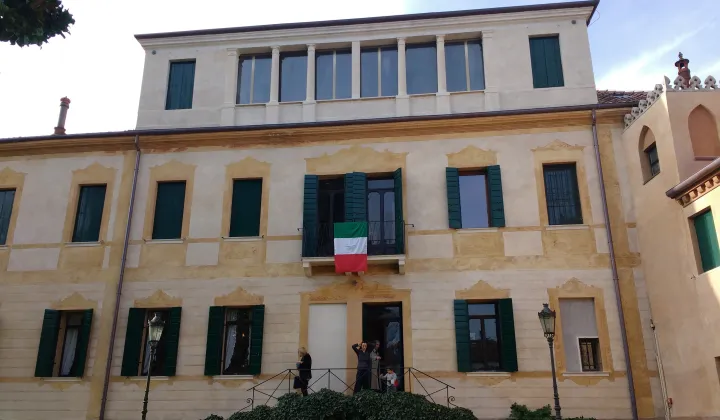
Villa Giusti had already served wartime purposes. King Victor Emmanuel III had stayed there between November 1917 and January 1918. Its position outside central Padua and its relatively private character made it useful for sensitive meetings. In late October, it became the destination for the Austro-Hungarian armistice party.
The negotiations took place in an upstairs room that had been an ordinary connecting space between bedrooms. The villa’s own historical account dates Badoglio’s arrival to November 1 and describes long discussions over the next two days. Today the room preserves the signing table and much of its furniture. That domestic scale is striking: decisions affecting entire armies were put on paper around a modest table.
What the armistice required
The terms demanded extensive demobilization, the surrender of military equipment and withdrawal from occupied territories and other specified areas. Allied forces gained freedom of movement over transport routes and the right to occupy strategic points. Allied prisoners were to be released without an equivalent immediate release of Austro-Hungarian prisoners.
The naval clauses required the surrender of specified warships and submarines, the disarming of others and access to important maritime facilities. These were arrangements for enforcing defeat, not merely a pause between opponents still holding equal bargaining power.
The supplementary protocol settled the timing explicitly: hostilities were to cease at 3 p.m. on November 4, Central European time. Confusion and uneven orders on the Austro-Hungarian side helped turn the interval into a disaster for men who had already stopped resisting. Italian and Allied advances continued before the deadline, and large numbers became prisoners.
Two dates in public memory
On November 4, General Armando Diaz issued the Victory Bulletin. Its language presented the conclusion through the Italian army’s achievement. The bulletin was later reproduced on public buildings and memorials across Italy, in stone and bronze, giving the announcement a lasting physical presence.
Villa Giusti preserves a different kind of evidence: the room, the furnishings and the written terms. Read together, they keep the dates distinct. November 3 was the day the agreement was signed. November 4 was the day its ceasefire took effect. Between them lay the final movements of an army and the captivity of men for whom the war had seemed already over.
Cover image: Red Foxes / Wikimedia Commons