The Luftwaffe’s shift toward night attacks left civilian families facing a different kind of battle. The Blitz overlapped the fighter campaign and continued through the following spring.
The invasion that required an air victory
France's defeat in June 1940 left Germany holding airfields and ports across the Channel. The British government chose to continue the war. Before a German invasion could be attempted, the Luftwaffe needed to overcome RAF Fighter Command. The air campaign therefore had a practical military objective beyond destroying aircraft or terrorizing a population.
The attacks changed over the summer. Shipping and ports came under pressure, followed by airfields and the machinery of fighter defense. In September, large formations struck London. These phases overlapped; neither the defenders nor the attackers experienced them as tidy chapters with clean beginning and ending dates.
A network behind the fighters
The Spitfire and Hurricane became the battle's most recognizable machines. Their performance mattered, but aircraft alone could not provide a defense. Radar stations and observers reported approaching formations. Information was assessed and passed through a command structure so that controllers could direct squadrons toward the threat.
This was the system developed under Air Chief Marshal Hugh Dowding. It helped the RAF concentrate a limited force where it was needed instead of keeping every fighter continuously airborne. A photograph of Duxford's sector operations room makes the process visible: telephones, maps, controllers and operators occupy the frame, rather than a single celebrated pilot.
The pilots themselves came from several countries. Airmen from the Commonwealth flew beside men who had escaped occupied Europe, including Polish and Czechoslovak personnel. Ground crews, factory workers and repair teams supplied another indispensable part of the defense. Aircraft losses were not simply a subtraction from a fixed stock; production and repair continued during the fighting.
Why October 31 became the endpoint
Hitler postponed the invasion in September. In a 1990 parliamentary answer explaining the official date, Britain's defense minister pointed to evidence that the invasion fleet was dispersing and that invasion units had been disbanded. The Defence Committee's October 31 assessment that the immediate invasion danger had passed helped establish the campaign's endpoint.
The day's weather also discouraged major air activity. Imperial War Museums describes some German fighter and fighter-bomber operations, but no decisive final aerial encounter. There was no equivalent of an army surrendering on a battlefield. The conclusion emerged from the failure of Germany's plan and the changing character of its attacks.
The fighting that continued
London had been subjected to sustained bombing since September. Other industrial cities and ports also faced attacks; Coventry's devastating raid came in November, after the Battle of Britain's official closing date. Civil-defense workers and civilians remained on the front line long after October ended.
Britain's victory was real, but specific. Fighter Command survived, Germany failed to secure the air superiority required for its invasion preparations, and Britain remained in the war. October 31 gives that achievement a place on the calendar. It should not erase the dangerous nights that followed.
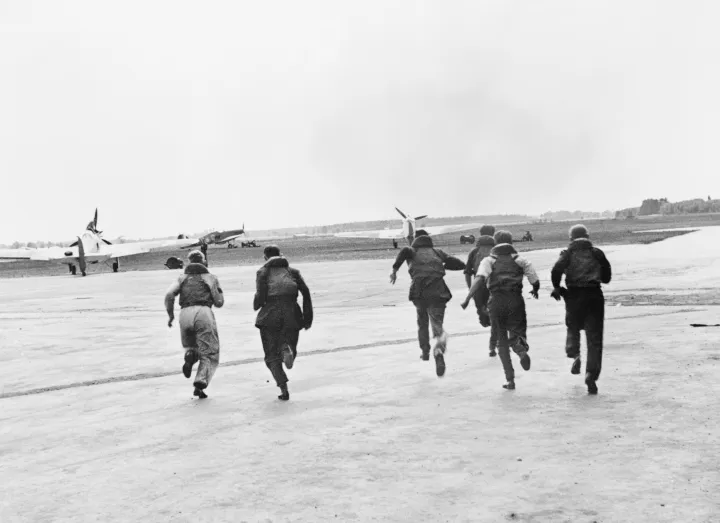
Cover photograph: Royal Air Force official photograph, IWM CH 1499. Public domain: expired UK Crown copyright.