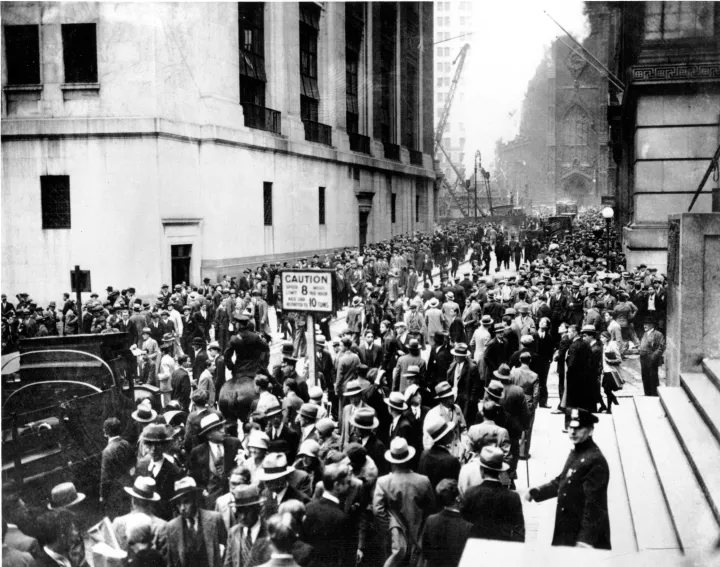
Black Tuesday became the date most often attached to the crash. It was one day in a sequence, however, and neither the beginning nor the end of America's economic collapse. A recession was already under way. The banking disasters that would turn it into something much worse still lay ahead.
A market running out of buyers
Through much of the 1920s, rising share prices had made speculation look dependable. Investors could buy on margin, borrowing part of a purchase price and expecting an increase in the stock's value to cover the debt. That arrangement magnified a gain. It also meant that falling prices could force a borrower to find more cash or sell.
The market had reached its peak in September. As prices became unstable, reassuring statements from prominent financiers did little to repair the underlying dependence on credit and confidence. Federal Reserve officials had already been arguing over how to restrain speculative lending. There was no agreement that raising interest rates was the right instrument, since higher rates could hurt ordinary business along with stock-market borrowers.
On October 24, Black Thursday, heavy selling brought crowds into the streets around the New York Stock Exchange. Bankers organized purchases intended to steady the market. The intervention bought a little time. The falls on October 28 and 29 showed how little control even wealthy institutions had over a rush for the exits.
What the street photographs can tell us
Associated Press photographs from that week record people packed around the exchange and the nearby steps of Federal Hall. Some of the best-known crowd images were taken on October 24, five days before Black Tuesday. They belong to the crash, but they do not record the same trading session.
A photograph of brokers on October 25 catches the exchange between the first panic and the following week's deeper falls. The New York Times front page of October 30 supplies a different kind of evidence: the previous day's trading was now a national news story. Photographs and a newspaper put faces, buildings and headlines beside the price movements. They cannot tell us how every person in a crowd was invested or what happened to that person's savings afterward.
From a crash to a depression
The immediate pressure on New York's banks did not produce a complete collapse of the banking system in October 1929. That distinction matters. A plunging stock exchange and a bank run are different events, even when losses and fear connect them.
The more destructive banking panics began in 1930. Banks depended on one another for access to cash; the failure of one institution could expose others. Frightened depositors withdrew funds, while surviving banks became less willing to lend. Businesses then found credit harder to obtain, including firms far removed from speculative trading.
Federal Reserve responses varied between districts. Some officials supplied emergency funds broadly; others took a narrower view of whom the central bank should help. The loss of banks, credit and money helped drive prices downward. Falling prices made existing debts harder to repay and pushed more borrowers toward failure.
By March 1933, the crisis had reached the national banking system. Federal deposit insurance and other reforms followed. The years between the crowded streets of October 1929 and those reforms were not a pause after a single catastrophe. They were the period in which repeated failures of finance and policy made the catastrophe larger.
Cover photograph: Associated Press / Wikimedia Commons; public domain. Photograph dated October 24, 1929.