Evans was born in St. Louis on November 3, 1903. His birthday offers a reason to look again at photographs that helped shape the visual memory of the Great Depression. Looking again means paying attention to their dates, their makers and their subjects, rather than treating every worn building or serious face as interchangeable evidence of poverty.
A photographer drawn to ordinary things
Evans’s early interests included literature. He spent a year at Williams College, worked in New York and traveled to Paris before photography became his principal occupation. By the early 1930s, his subjects ranged from American houses to the streets of Cuba. People mattered to him, but so did signs, shop windows, tools and the arrangements of objects in rooms.
These pictures often appear straightforward. A building faces the camera; its boards and lettering are sharply visible. Yet apparent simplicity requires decisions. Distance, framing and the position of the camera determine what enters the photograph and what remains outside it. Evans’s attention to everyday surfaces was an artistic practice as well as a way of gathering information.
Inside the federal documentary project
In 1935, Evans began working for the Resettlement Administration, the predecessor of the Farm Security Administration. The photographic project directed by Roy Stryker documented rural conditions and government programs during the Depression. Its surviving archive also records towns, industries and, later, wartime mobilization.
The agency name is worth keeping straight. Many of Evans’s best-known pictures were made in 1935 and 1936, before the Farm Security Administration took that name in 1937. They now belong to the Library of Congress’s combined FSA–OWI collection. An archive’s present title can describe the collection accurately without being the precise name of the photographer’s employer on a particular day.
His photograph of Bethlehem, Pennsylvania, places a graveyard, houses and a steelworks within one view. No single object supplies the entire subject. The image asks the eye to move through a town in which domestic life, industry and burial occupy adjoining spaces. It gives those relationships a visible form without requiring a dramatic incident.
The Alabama assignment
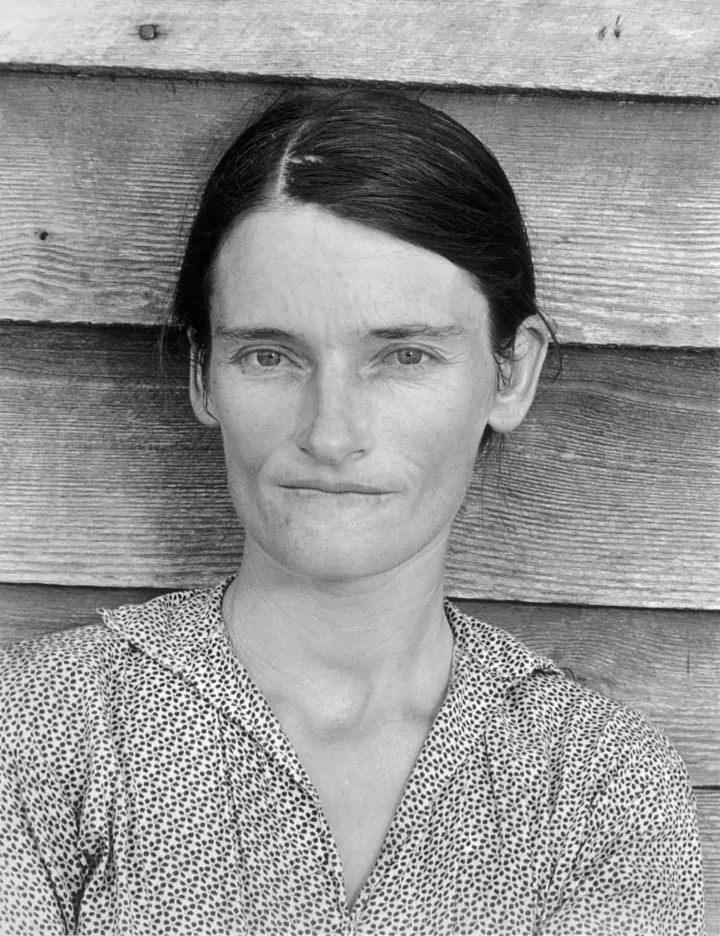
In the summer of 1936, Evans took leave to accompany writer James Agee on an assignment for Fortune. They worked with three Alabama tenant-farming families. The magazine did not publish the proposed account. Their collaboration eventually became Let Us Now Praise Famous Men, issued in 1941.
The Library of Congress preserves two albums containing 107 photographs associated with the project. They include family portraits, houses, rooms, clothing, work and nearby stores. That range matters. Isolating a celebrated face from the surrounding photographs can turn a particular household into a generalized symbol, losing the material details that Evans took the trouble to record.
Beyond the Depression years
In September 1938, the Museum of Modern Art presented American Photographs, its first solo photography exhibition, accompanied by a book. Evans’s later work included New York subway passengers and two decades as a photographic editor at Fortune, where he also wrote and arranged his picture essays.
His career extended well beyond the rural images most often reproduced today. The common thread was sustained attention: to a storefront’s lettering, to a room’s contents, to a face that would otherwise pass unnoticed. His photographs reward that same patience from their viewers.
Cover image: Walker Evans / Library of Congress