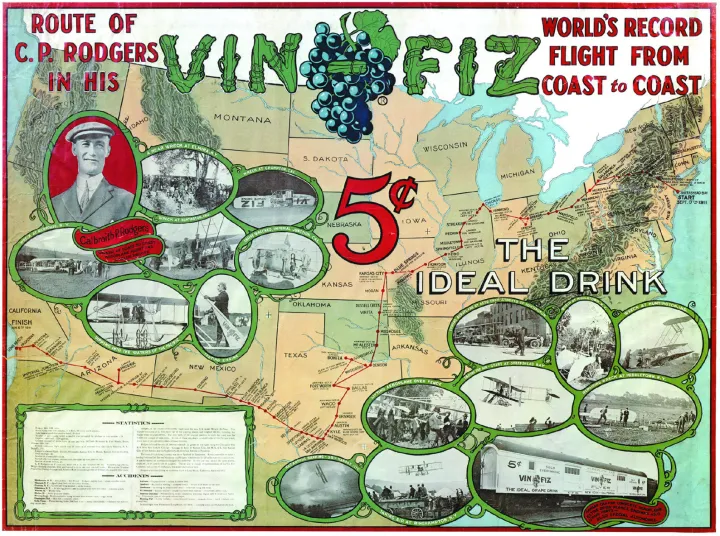
The missed deadline did not erase the achievement. Rodgers had made the first crossing of the United States by airplane. It was a journey assembled out of short flights, forced landings and long stretches of repair work. The aircraft's name, Vin Fiz, came from a grape soft drink. Behind the romance of a lone pilot heading west stood an unusually elaborate advertising campaign—and a train.
An airplane with a railway behind it
Rodgers left Sheepshead Bay, New York, on September 17. His sponsor, the Armour Company, supplied a special train to follow the flight. It carried his family, mechanics, fuel and replacement parts. One carriage served as a traveling workshop. An automobile could be unloaded to retrieve him when a landing left him some distance from the tracks.
The railway operation required its own organizer. Fred Howard, an Erie Railroad passenger agent, coordinated the Vin Fiz Special during the eastern part of the trip. The schedules and telegrams preserved at the Smithsonian show how much depended on people working on the ground. A delay for the airplane meant changed plans for everyone following it.
Getting west, one repair at a time
The Wright EX was a small exhibition airplane, a development of the Wright Company's Model B. Its exposed structure left Rodgers with little protection from the weather. A 35-horsepower engine drove two propellers. This was machinery built when powered flight itself was less than a decade old; crossing an entire continent demanded far more than keeping a bearing.
Accidents repeatedly damaged the aircraft. The Caltech account records seventy landings and at least sixteen crashes. Mechanics replaced broken components and sent Rodgers back into the air. Charles Taylor, who had built the engine for the Wright brothers' first powered airplane, was among the support crew. The further the journey went, the less useful it became to imagine the machine as an untouched object that had simply flown from one coast to the other.
After Kansas City, Rodgers traveled south toward Texas, then west through the border country. Near Imperial Junction on November 3, an engine cylinder exploded. Fragments injured his right arm and damaged a wing. He brought the airplane down, waited for repairs and continued. Further engine trouble interrupted the approach to Pasadena.
Pasadena was a finish, but not the ocean
On November 5, Rodgers finally reached Tournament Park. Among those recording the arrival was thirteen-year-old Max Benshoff, whose photograph survives in the Caltech Archives. The public celebration made a hero of a pilot who had failed the competition's timetable but completed the crossing.
There was still another destination. Pasadena lies inland, and Rodgers wanted the airplane to reach the Pacific. More delays followed before he arrived at Long Beach on December 10 and brought the Vin Fiz to the water. That later date explains why accounts of the trip can give different finishing points without describing different expeditions.
The surviving pictures contain both versions of the story. There is a celebrated aviator accepting a drink in Pasadena, and there are men working around an engine in the desert. The second scene explains how the first became possible.
Cover image: Unknown photographer / The World’s Work, volume 23, 1911–1912 · Public domain