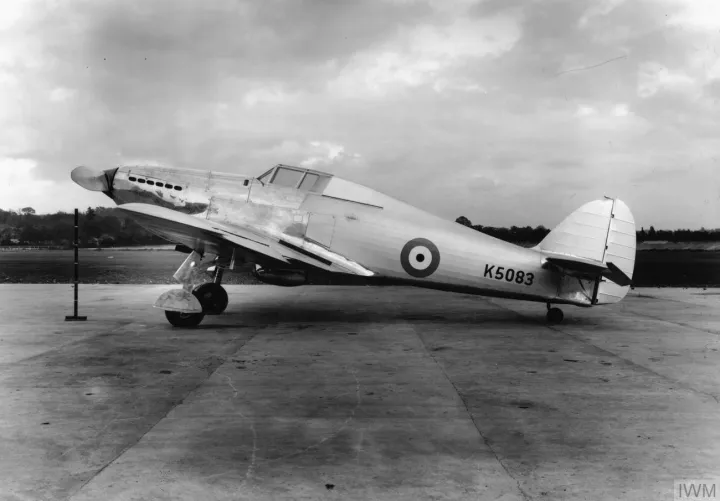
Camm’s design emerged from a company experienced in building biplanes. The new aircraft had a single low wing, retractable landing gear and the Rolls-Royce engine that became known as the Merlin. Those choices reduced drag and opened the way to better performance. Hawker had persisted with development when the earlier proposal failed to attract government funding, then received support for a full-size prototype in 1934.
Building before the orders arrived
Confidence in the aircraft carried a commercial risk. Hawker began preparing its Langley factory for production before it had an order. Trials followed, and in June 1936 the RAF ordered an initial 600 aircraft. The Hurricane entered service in 1937 as the RAF’s first eight-gun monoplane fighter.
Its construction combined newer aerodynamic features with methods inherited from an earlier generation. Tubular steel and fabric remained important parts of the airframe. That could look old-fashioned beside more advanced stressed-skin designs, but the Hurricane was sturdy, relatively economical to manufacture and accessible to repair crews. A damaged fighter that could be restored quickly was an asset in a campaign measured in repeated sorties.
A photograph taken at Vassincourt in April 1940 catches that practical world. Ground crew refuel a No. 1 Squadron Hurricane while its engine receives attention. The machine was only one part of a working system. Fuel, tools, spare parts and trained hands made the next flight possible.
From France to the defense of Britain
Hurricanes bore much of the RAF’s fighter effort in France during the German invasion of May 1940. The campaign exposed the danger of losing aircraft on the ground as well as in combat. Retreat left damaged or unserviceable machines behind, while the RAF also needed fighters at home. Surviving squadrons returned to a struggle in which Britain itself was the immediate target.
During the Battle of Britain, Hurricanes were more numerous than Spitfires. Their contribution was central to Fighter Command’s resistance. A July 1940 view of No. 17 Squadron at Debden shows aircraft spread across the grass as another approaches to land. It is a quieter scene than a dogfight, but the cycle of takeoff, landing, servicing and takeoff again was how the defense kept operating.
A longer war
The Hurricane’s service did not end with the autumn of 1940. It flew in North Africa and the Far East, and later versions took on ground-attack duties. The Mark IID carried two 40-millimeter anti-tank cannon. A photograph from Shandur in Egypt shows a pilot beside one of those aircraft, with the conspicuous gun installation beneath the wing.
Production kept pace with that changing work. In Britain, official photographer Richard Stone recorded women assembling Hurricanes in 1942. The workers included Winnie Bennett, Dolly Bennett and Florence Simpson. Their names bring some of the factory labor back into a story usually told through pilots and designers.
November 6 marks the beginning of that aircraft’s flying life. Its wartime usefulness came from more than the promise of a successful test. The Hurricane could be built in numbers, kept in service and adapted as demands changed. At Brooklands in 1935, those were still possibilities waiting to be proved.
Cover image: Imperial War Museums, ATP 8654D; via Wikimedia Commons