
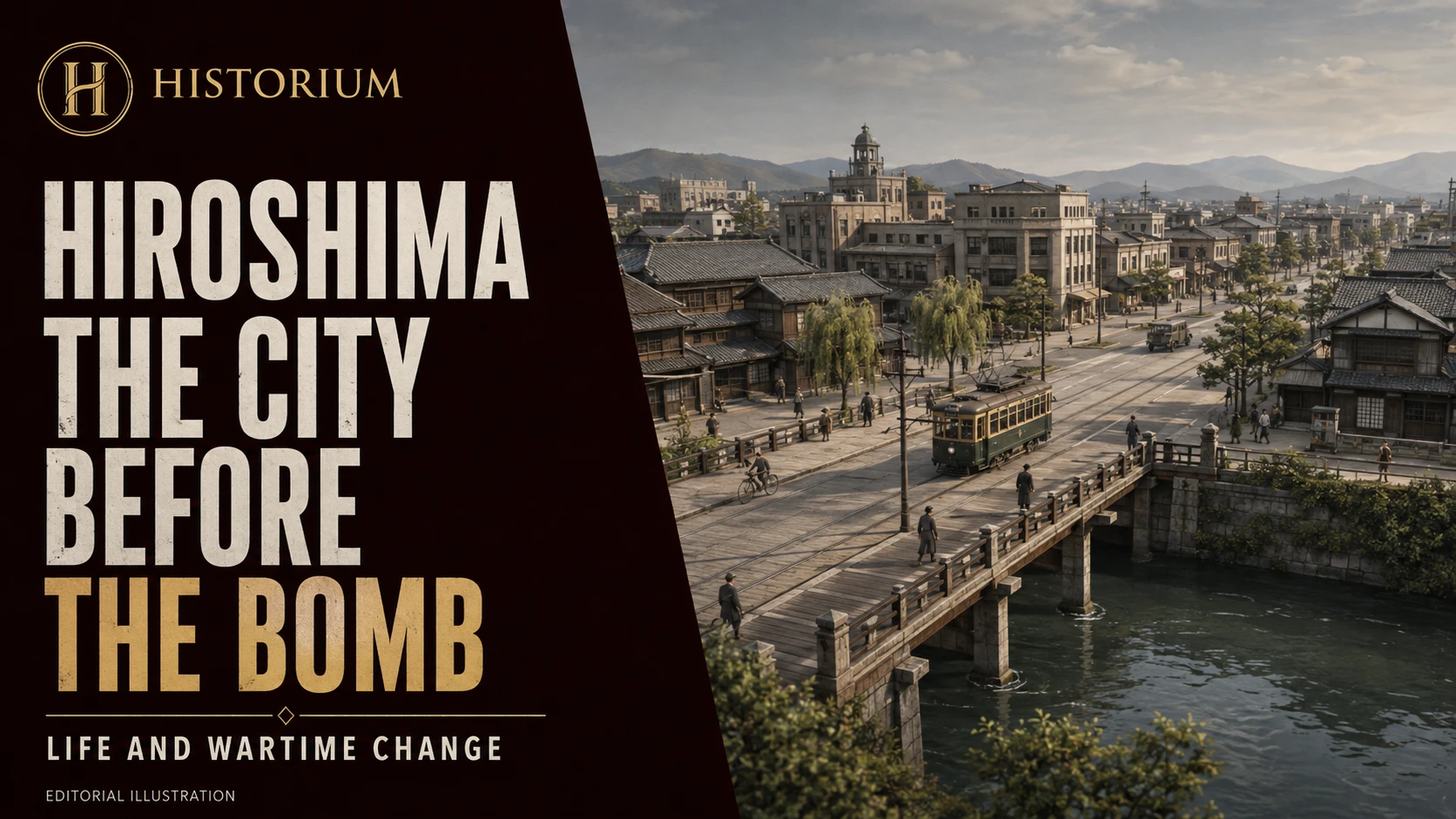

Photographs of Hiroshima before 6 August 1945 ask us to look at the city before its name became inseparable from the atomic bombing. Streets were routes to work and school. Buildings housed businesses, public institutions and homes. The people moving through that landscape had lives whose meaning extended beyond what would later happen to them.
A history of the city before the bomb must also include the pressures of war. Hiroshima’s civilian neighborhoods, cultural institutions and transport system existed alongside military facilities and industries. Recognizing both helps reconstruct the place without reducing its residents to either an idyllic picture or a military target.
The Neighborhood Beneath the Peace Park
The present Peace Memorial Park occupies part of the former Nakajima district. The Hiroshima Peace Culture Foundation’s historical account describes a busy urban area between rivers, with markets, temples, a primary school, a hospital and government offices. Nakajima-honmachi had shops, cinemas, restaurants, clinics and pharmacies standing close together.
These details change how we imagine the ground now occupied by memorials. It was a network of destinations and relationships: places to purchase goods, seek treatment, meet other people and earn a living. The district’s connections to river traffic also reached back into the city’s commercial history, when barges carried travelers and goods and timber arrived along the water.
The park’s open space can make that earlier density difficult to picture. Historical maps and descriptions return the neighborhood to view without pretending that a list of buildings can recover every household’s story.
Travel Across a Growing City
Hiroshima’s streetcars began operating on 23 November 1912. The Hiroshima Electric Railway’s history of the opening identifies initial routes linking the railway station, Aioi Bridge and other parts of the city. Crowds gathered to see decorated cars marking the occasion. The system connected transport planning to the redevelopment of streets and former castle moat land.
A tram in an old image is therefore more than a picturesque vehicle. It points toward a city being reorganized around regular urban journeys. Tracks, bridges and stops linked different districts and created shared spaces for people whose destinations differed. The vehicles belonged to the infrastructure of daily life.
The Dome Before It Became a Ruin
The building now known as the Atomic Bomb Dome was completed in April 1915 as the Hiroshima Prefectural Commercial Exhibition Hall. Designed by Czech architect Jan Letzel, it presented a striking European architectural form within a center largely composed of wooden buildings. The city’s account of its original role describes the promotion of local products, commercial research and advice, and access to trade-related reading material.
It also provided space for cultural exhibitions. Remembering those functions restores an identity often hidden by the building’s later symbolism. Before it became a surviving ruin associated with nuclear destruction, it was a place where products and ideas were displayed and where the city expressed ambitions for commerce and culture.
Reading the City’s Own Archive
Around 1939, a detailed business map recorded not only major institutions and companies but smaller shops and inns. The Hiroshima City Archives’ prewar exhibition presents it alongside photographs of streets and wartime activities. Such a map preserves a commercial texture that broad aerial views cannot easily convey.
A separate section on the prewar city’s cultural life includes the Asano Library, opened in 1926, and Hiroshima Higher Normal School, founded in 1902 to train teachers. These institutions place reading and education within the urban landscape. They remind us that a city’s history includes the circulation of knowledge as well as the movement of goods.
Later images in the archive record a transformed school environment: a potato field in the grounds of Noboricho National School and evacuated children sharing a meal with visiting parents in 1945. Schooling, food production and family separation had become closely connected under wartime pressure.
Military Importance and Civilian Experience
The City of Hiroshima’s historical overview explains the city’s development as a military transport center, particularly through Ujina, and the growth of industries connected with wartime production. In April 1945, the headquarters of the Second General Army was established in Hiroshima. Military institutions were a real part of the city’s history.
The same history includes rationing, mobilization, evacuation and the demolition of buildings to create firebreaks against anticipated air raids. These were changes imposed on ordinary routines. Describing the military presence explains the setting; it does not establish that civilian inhabitants deserved destruction or that every person’s activity was reducible to a military function.
Students Keeping the Trams Running
The transport company’s account of the wartime years provides a concrete example of mobilization. As personnel shortages increased, it established a girls’ school in 1943. Students combined study with work as conductors and drivers on trams and buses. Other mobilized students helped repair vehicles, while new lines opened in 1944 to improve transport to munitions factories.
Work, education and the war economy consequently met inside a familiar piece of civilian infrastructure. The history of a tram route could include students maintaining services under difficult conditions as well as workers traveling to industrial jobs. Looking closely makes these people visible within an account otherwise dominated by maps and strategic descriptions.
What Historical Footage Can Establish
The city archives’ exhibition program distinguishes footage of prewar Hiroshima from films made during reconstruction. That distinction matters when watching a modern compilation. A title alone cannot prove the date or location of every clip, and this companion article does not claim to have authenticated all the accompanying video’s shots.
Archive descriptions, recognizable buildings and original film records can help establish where an image belongs. The purpose of looking backward is more substantial than finding an undamaged view: it is to recover something of the inhabited city, its institutions and its changing routines before the bombing abruptly transformed them.