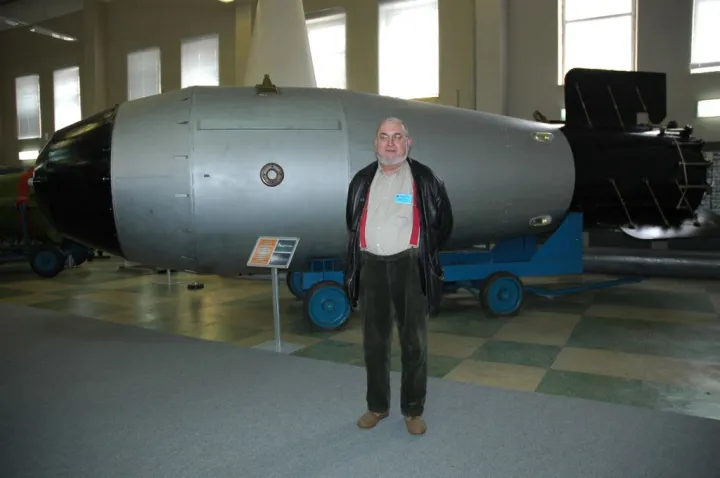
The number is difficult to picture. A megaton is an energy comparison, equivalent to a million tons of TNT; it does not describe the weight of the bomb. Fifty of them made this test an extraordinary demonstration even by the standards of the nuclear arms race. The British diplomat Leigh Turner later described a mushroom cloud reaching roughly 60 kilometers into the atmosphere.
A test in a year of confrontation
The explosion followed the breakdown of a pause in nuclear testing. An American Institute of Physics account of Andrei Sakharov’s career describes Nikita Khrushchev announcing his decision to resume tests at a Kremlin meeting in July 1961. Sakharov objected. He believed that renewed testing would worsen international security while offering little technical benefit.
That objection did not remove him from the program. He continued working on preparations, and the enormous weapon was developed under his direction. His position was deeply uncomfortable: a scientist helping to produce Soviet nuclear power while arguing that testing endangered people far beyond the test range.
The political atmosphere offered little room for reassurance. John F. Kennedy and Khrushchev had met in Vienna that June. Their talks exposed sharp differences, especially over Berlin. Photographs of the two men sitting together can suggest an orderly diplomatic occasion; the Kennedy Library’s account describes a difficult encounter that brought no immediate easing of Cold War tensions.
The scientist and the fallout
Sakharov’s doubts had begun before the October explosion. In the late 1950s, he examined the lasting dangers of radioactive material released by nuclear tests. He challenged claims that tests could be treated as essentially harmless. The consequences might be dispersed across countries and generations, but that did not make them irrelevant.
His later life is often told as a clean break between bomb maker and dissident. The chronology is messier. Scientific work, patriotic conviction, criticism and obedience overlapped. The Nobel Foundation dates his warnings about the arms race to the late 1950s, well before the 1975 Peace Prize that recognized his defense of human rights, disarmament and international cooperation.
What the later treaty changed
On August 5, 1963, the United States, Soviet Union and United Kingdom signed the Limited Test Ban Treaty in Moscow. It entered into force on October 10. Tests in the atmosphere, outer space and under water were prohibited. Underground testing remained possible, provided radioactive debris did not cross the testing state’s borders.
This was a restriction on testing, not an agreement to dismantle nuclear arsenals. Nor was it simply the automatic result of one spectacular explosion. The National Archives traces international negotiations back to 1955. Years of public concern about fallout, arguments over verification and changing relations between governments lay behind the eventual agreement.
Tsar Bomba belongs in that longer history. Its scale made Soviet destructive capacity unmistakable. The debate surrounding nuclear tests asked a different question: what obligations followed from possessing that capacity? Two years later, the treaty drew a limited boundary around where nuclear explosions could occur. It left much of the arms race intact.
Cover image: MODIS Land Rapid Response Team, NASA GSFC / NASA / Wikimedia Commons; Public domain: U.S. government work