The distinction between announcement and implementation is small but necessary. So is another distinction Johnson himself made: a bombing halt did not mean the Vietnam War was over. Fighting would continue, and the proposed negotiations had obstacles still waiting in front of them.
A campaign built around pressure
Operation Rolling Thunder had begun in March 1965. American planners expected bombing to disrupt supplies moving south, encourage the South Vietnamese government and raise the cost of Hanoi's war effort. Targets gradually extended farther into North Vietnam. Periodic pauses were intended to make negotiation more attractive.
The campaign inflicted enormous destruction without producing the political settlement Washington wanted. Bridges and transport routes could be attacked repeatedly; supplies still found ways south. Aircrews faced missiles, antiaircraft fire and fighters, while people on the ground lived with the consequences of an increasingly prolonged air war.
By 1968, military operations and American domestic politics had become inseparable. The Tet Offensive challenged official expectations, opposition to the war intensified and Johnson faced a difficult election year. On March 31, he announced a partial bombing halt and withdrew from the presidential race. Talks between American and North Vietnamese representatives began in Paris in May.
What changed in October
For months, the talks produced little movement. American representatives W. Averell Harriman and Cyrus Vance sought a basis for ending the remaining bombardment. Washington insisted that the South Vietnamese government be able to take part in substantive negotiations. Johnson also wanted assurances that stopping the attacks would not expose American troops to greater danger.
Late October brought what the administration considered sufficient progress. The National Security Council's records show the expectations behind the decision: restraint around the demilitarized zone, no attacks on South Vietnamese cities, and negotiations that included Saigon. These were understandings to be tested, not a signed peace treaty with an agreed enforcement mechanism.
Soviet diplomacy also mattered. In a letter to Premier Alexei Kosygin on October 31, Johnson acknowledged that Soviet assurances about Hanoi's seriousness had influenced him. He asked Moscow to help move the negotiations toward a settlement. The decision emerged from several channels of communication, some public and some carefully concealed.
The ally who had not agreed
South Vietnamese president Nguyen Van Thieu remained reluctant. At the final White House meeting, officials were still uncertain whether Saigon would join the announcement. Johnson proceeded anyway. His broadcast said the next Paris session could include South Vietnamese representatives and the National Liberation Front, while emphasizing that the Front's attendance did not amount to American recognition.
The calendar made every calculation more charged. Americans would elect a president on November 5, five days after the broadcast. Johnson said all three major candidates had been briefed. Behind the scenes, he also learned of contacts involving Nixon campaign intermediaries and South Vietnamese officials that encouraged Saigon to delay. The surviving records of the Chennault affair reveal a political struggle the television audience could not see.
A decision with an unfinished ending
Expanded talks did not begin as smoothly as the announcement suggested. South Vietnamese objections and disputes over procedure continued into the transition between administrations. The air war's suspension was therefore a substantial change in policy, but not a shortcut around the competing aims of the governments involved.
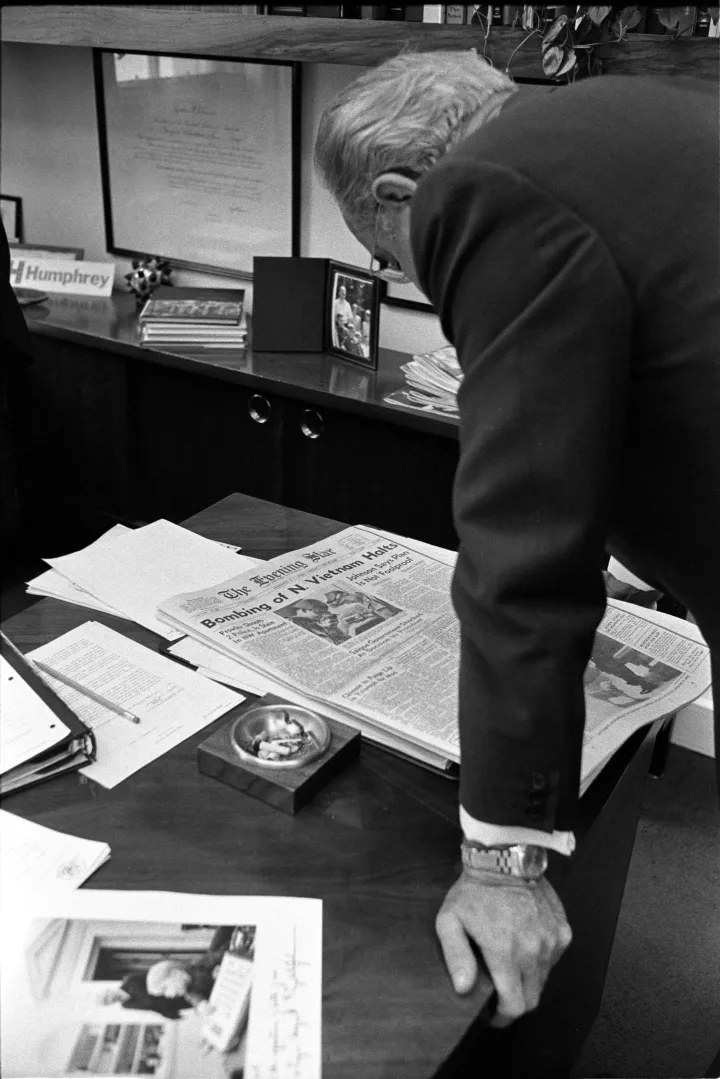
A photograph taken on November 1 shows Johnson reading a newspaper headline about the halt. The large type gives the decision a clean, finished appearance. The documents around it tell a less settled story: military advice, diplomatic promises, an anxious ally and a president gambling that stopping one part of the war might finally make room to end the rest.
Cover image: Mike Geissinger / LBJ Presidential Library, B2316-31; public domain.