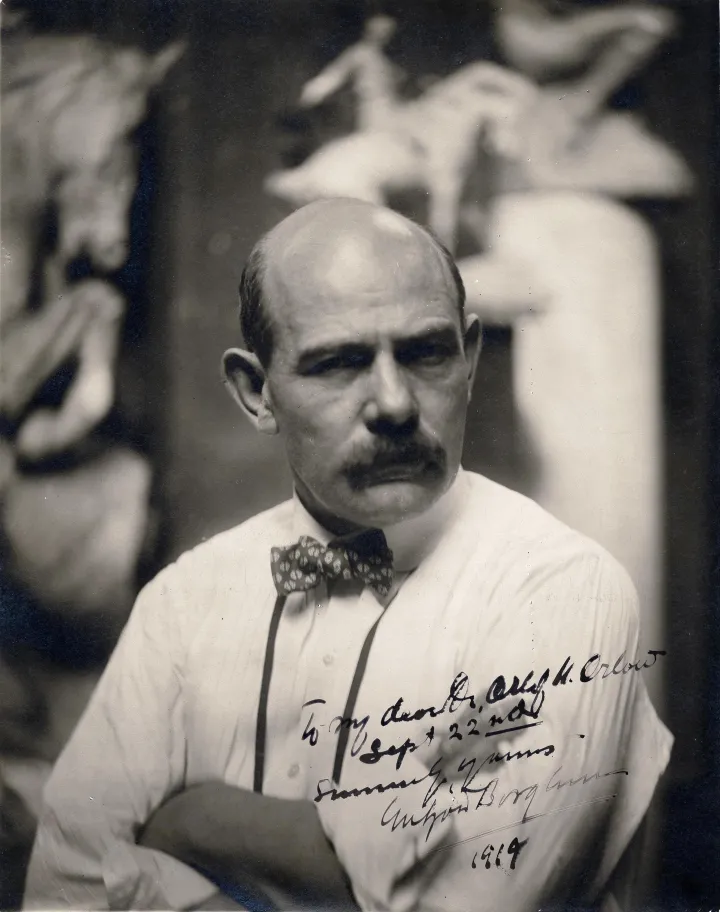
Gutzon Borglum had imagined more: bodies beneath the heads, an inscription and a chamber that would explain the monument to distant generations. Money, politics, geology and the sculptor's death narrowed those ambitions. The result became one of the most recognizable images in the United States precisely in the form that circumstances allowed.
A tourist attraction becomes a national statement
South Dakota historian Doane Robinson wanted visitors to come west. His proposal in the early 1920s was a mountain sculpture in the Black Hills, a way to give travelers a compelling reason to make the journey. Borglum turned a regional attraction into his own version of national history.
He selected George Washington, Thomas Jefferson, Theodore Roosevelt and Abraham Lincoln. Together they were meant to represent the country's founding, expansion, development and preservation. He also changed the proposed location. The granite needles first considered would not suit the work; Mount Rushmore offered a massive cliff face and more favorable stone.
This was already a place with a history. The Lakota knew the mountain as Six Grandfathers. The Black Hills held religious and cultural significance long before a sculptor arrived. The United States had recognized them as part of the Great Sioux Reservation in the 1868 Fort Laramie treaty, then confiscated the land in 1877 after gold discoveries and war. Carving presidents into that landscape made an argument about the nation while leaving the broken treaty outside the frame.
The men on the ropes
Actual carving began in October 1927. The project depended on drillers, blacksmiths, laborers and the people who kept the work camp operating. Nearly 400 men and women worked there over its lifetime. Some wanted a dependable paycheck; some came to regard the mountain as their life's work. Employment could be uncertain, and a famous sculptor's ambition did not make the weather kinder.
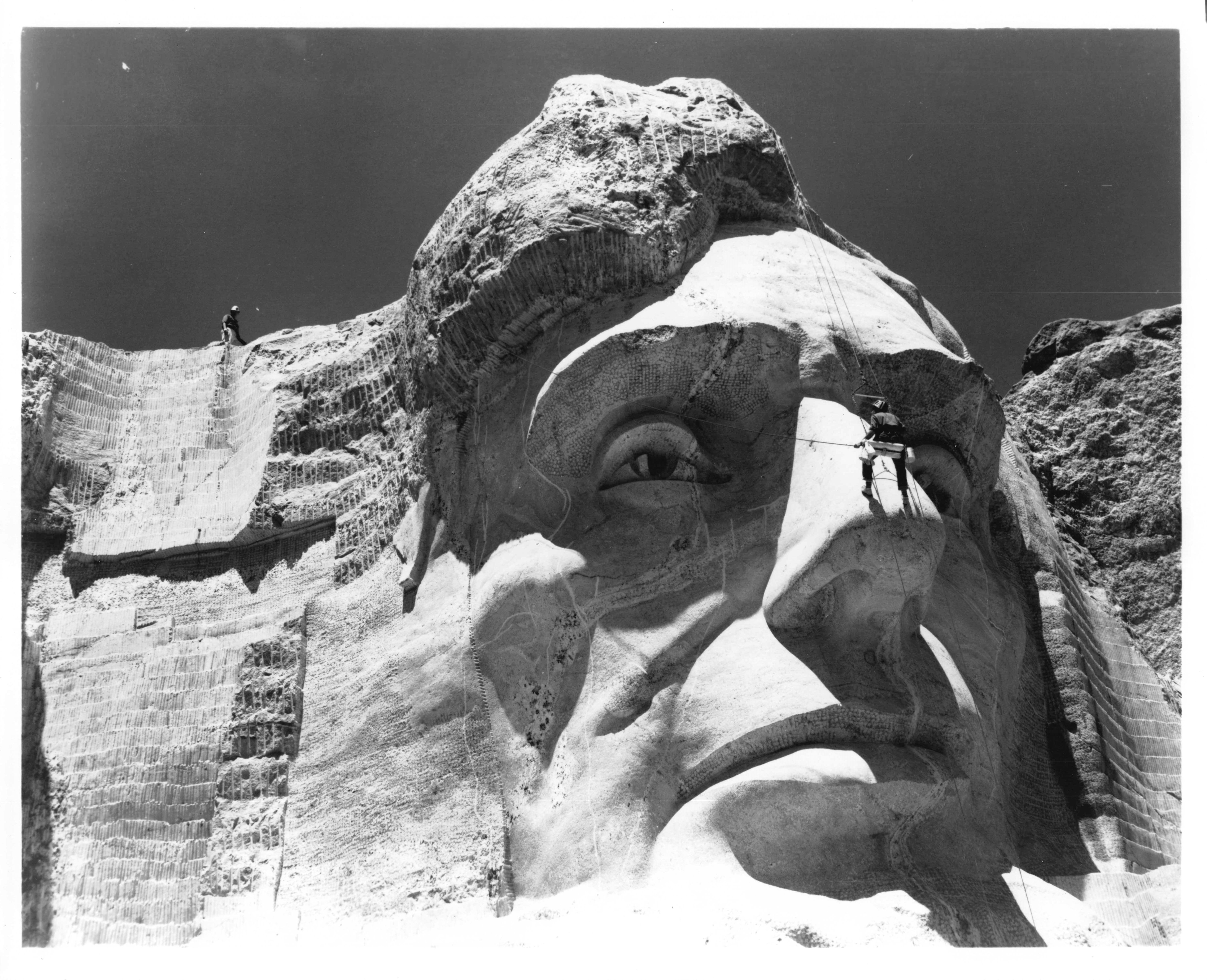
Workers climbed hundreds of steps, operated heavy equipment and sat in suspended chairs against the cliff. Explosives removed much of the unwanted granite; increasingly precise drilling and finishing brought features out of the remaining rock. The scale could be misleading from the visitor area. Up close, a single nose was a worksite.
The presidential faces received separate dedications as the carving advanced: Washington in 1930, Jefferson in 1936, Lincoln in 1937 and Roosevelt in 1939. Those ceremonies advertised progress, but they did not end the need for federal appropriations. Congress eventually insisted that money be used to finish the sculpture, forcing Borglum to stop work on his Hall of Records.
The last season
Borglum died on March 6, 1941. His son Lincoln, who had worked his way through jobs on the mountain and already supervised its operations, took responsibility for the remaining carving. He refined the faces while the country's attention and resources shifted toward war. The funds ran out later that year.
October 31 was therefore both a completion date and a stopping point. The public got the four faces, without all the work their designer had intended around and beneath them. The discarded stone remained below. So did a harder question about the land: whose history had been made monumental, and whose had been displaced to make room for it?
Cover photograph: National Park Service / public domain