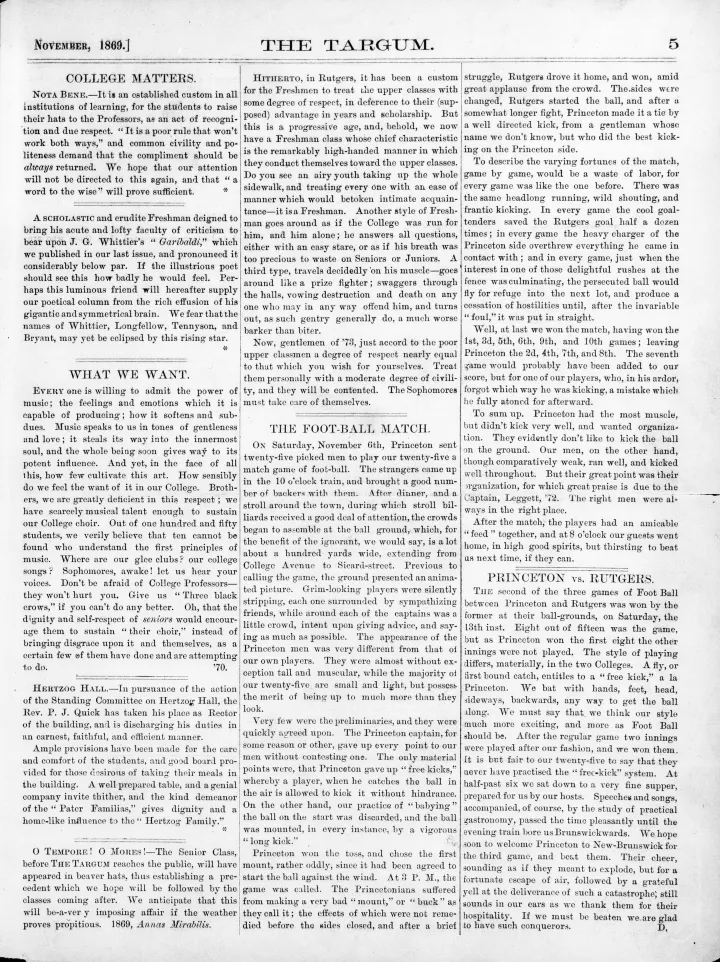
Fifty students played on a field in New Brunswick, New Jersey, twenty-five on each side. The contest became the conventional starting point for American intercollegiate football. Its rules, however, belonged to the crowded and unsettled family of kicking games from which several modern sports emerged. There was no quarterback directing an eleven-man offense through four downs.
The challenge came by letter
Rutgers captain William J. Leggett proposed a series of three matches to William Stryker Gummere, the Princeton captain. Their colleges already had reasons to compete. A dispute over a Revolutionary-era cannon had nourished the rivalry, and Princeton had handed Rutgers a forty-to-two defeat in baseball in 1866. A different game offered a fresh opportunity.
The visitors arrived by train. Rutgers students welcomed them and showed them around New Brunswick before the captains settled the rules. The encounter combined hospitality with a determination to win. It was arranged by students who knew each other through a small collegiate sporting world, rather than by athletic departments organizing a commercial season.
Twenty-five players and a round ball
Leggett proposed rules drawn from the London Football Association. Players advanced a round ball by kicking it or batting it with parts of the body; carrying it was not the basis of the game. Rutgers accounts sometimes use the broad label “rugby-like,” but the kicking contest described in the surviving reports bears a much closer resemblance to association football than to today's American game.
The large teams did have assignments. Some men stayed close to the opposing goal, ready to exploit a chance, while others concentrated on moving or stopping the ball. Princeton's George Billmeyer and Homer Boughner later appear in player biographies as “captains of the enemy's goal.” The phrase makes the arrangement sound peculiar now. For the students on the field, it described a straightforward job.
Rutgers players used scarlet head coverings to distinguish themselves. Around a hundred spectators watched, some sitting on a fence. Later recollections supplied vivid collisions and tactical inventions, but the contemporary Targum report is especially valuable: it records the contest before decades of anniversaries turned the afternoon into a founding legend.
A season lasting two matches
The teams met again the following week at Princeton. Playing under the home side's rules, Princeton won eight goals to none. The projected third game never took place. College authorities objected to the distraction from academic work, leaving each school with one victory and one defeat.
Calling the New Brunswick match a beginning should not imply that the finished sport arrived with it. A program preserved by Princeton from 1892 describes eleven players, a center putting the ball into play and specialized backs behind the line. Those arrangements required subsequent experiments and arguments. The twenty-five-man contest of 1869 was one stage in that development.
The players outlived the afternoon
Leggett became a clergyman; Gummere became chief justice of New Jersey. Their teammates pursued ordinary and sometimes distinguished lives outside sport. Reconstructing the Princeton roster much later required a researcher to compare incomplete lists and student records. Even an event commemorated so enthusiastically had gaps in its paperwork.
The result itself remained secure: Rutgers six, Princeton four, November 6, 1869. A surviving newspaper page, individual portraits and later photographs preserve different pieces of the story. Together they bring the occasion down from the scale of a national origin myth to something recognizable: neighboring students agreeing on rules, making room for spectators and trying hard to beat one another.
Cover image: The Targum / Rutgers University Libraries