November 1 marks the inauguration of the completed ceiling, not the opening of a new chapel. The Sistine Chapel had already served the papal court for decades. Its walls carried the work of major painters, and its name belonged to Julius’s uncle, Pope Sixtus IV. Michelangelo entered an established room and changed the experience of standing inside it.
A commission that grew
The old ceiling had been a field of stars painted by Pier Matteo d’Amelia. A serious crack opened in 1504, and the architect Bramante installed ties above the chapel to address the building’s structural trouble. Damage to the decoration helped create the opportunity for something new.
Michelangelo signed his contract on May 8, 1508. The initial plan called for twelve apostles and ornamental decoration. It was a much smaller undertaking than the one that followed. He found that scheme inadequate, and Julius allowed him to develop a broader program. The Vatican Museums considers consultation with theologians at the papal court likely, although the surviving ceiling cannot be reduced to a list of instructions handed to a painter.
The setting mattered. Julius was also assembling ancient sculpture and employing Raphael to decorate his rooms. Art gave visible form to the papacy’s authority and its claim to inherit both Christian and Roman traditions. The ceiling belonged to that ambitious remaking of the Vatican, even as Michelangelo gave it a force and physical presence entirely his own.
More than two almost-touching hands
The Creation of Adam is now so familiar that its hands can seem to stand for the whole ceiling. In the chapel, it occupies one part of nine central scenes from Genesis. God separates light from darkness, forms the heavens and the earth, and gives life to humanity. Adam and Eve lose Eden. Noah’s story brings destruction and survival.
Michelangelo made those events bodily. Adam’s relaxed arm contrasts with the movement carrying God toward him. In the expulsion scene, two moments share one landscape: the invitation of the forbidden fruit and the flight from the garden. In the Flood, the story spreads among people carrying possessions, clinging to one another and searching for ground above the water. The figures make large theological claims immediate through gestures small enough to recognize.
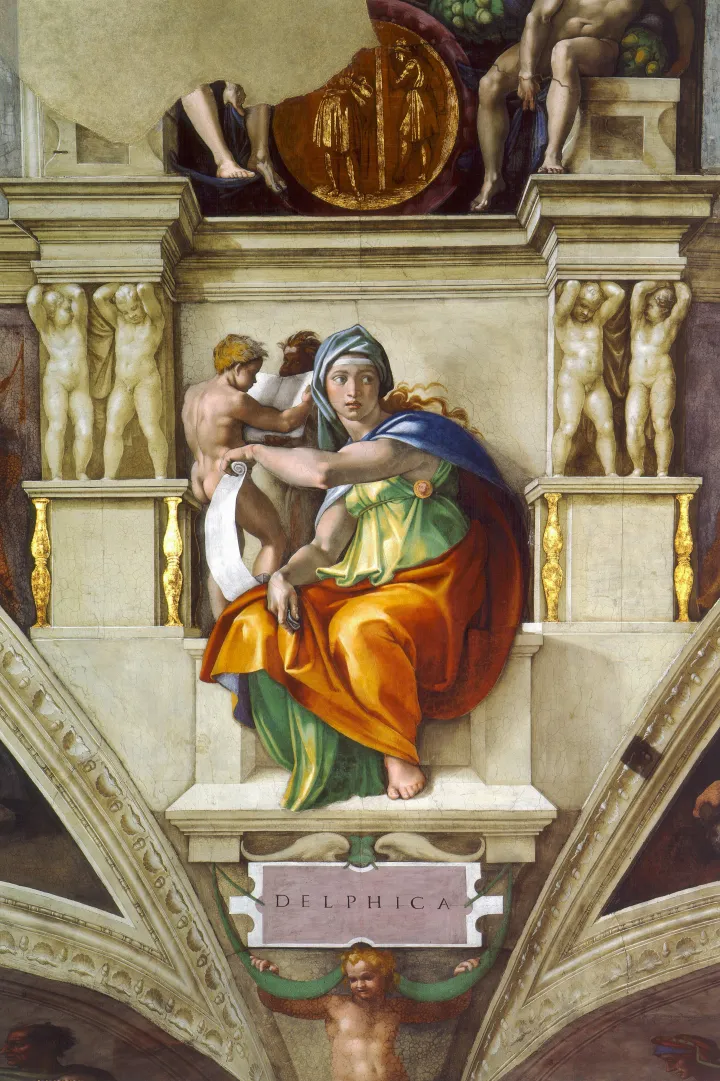
Around the narrative panels sit prophets and sibyls. The pairing joins the Hebrew scriptural tradition with figures from the ancient pagan world whom Christian interpretation treated as foretelling Christ. Their books, scrolls and turning bodies create different kinds of attention: reading, listening, remembering, waiting. Painted architectural members organize these people into a structure more elaborate than the actual vault.
The room after 1512
By the end of October, the new work was ready for Julius’s solemn Mass. That ceremony returned the completed ceiling to the religious life of the chapel. It was a setting for worship and papal ritual, however famous it would become as an achievement of an individual artist.
Michelangelo would change the room again. The Last Judgment on the altar wall was painted from 1536 to 1541, under a different pope and in a different period of his life. It was absent on November 1, 1512. The congregation that day looked upward at the new ceiling above an older cycle of wall paintings, seeing a chapel whose artistic history was still being written.
Cover photograph: Michelangelo / Sistine Chapel / public-domain reproduction via Wikimedia Commons