At secret meetings in Sèvres, outside Paris, representatives of Israel, Britain and France had agreed on a plan. Israel would invade Sinai. Britain and France would then demand that both sides pull away from the canal, presenting themselves as powers intervening to protect an international waterway. Egypt's expected refusal would provide the occasion for their attack.
The canal before the invasion
The dispute had sharpened in July, when President Gamal Abdel Nasser nationalized the Suez Canal Company. Egypt intended to use the revenue to help finance the Aswan High Dam after the United States withdrew its offer of assistance. Britain and France saw the decision as a threat to their interests and to the influence they still claimed in the region.
The canal's ownership was only part of the conflict. France opposed Nasser's support for the Algerian independence struggle. Israel faced cross-border violence, Egyptian restrictions on its shipping and a regional arms race. Egyptian-sponsored fedayeen attacks and Israeli reprisals had already made the armistice lines dangerous. These overlapping conflicts brought the three attackers together without giving them identical objectives.
A military timetable and a diplomatic one
Israeli forces moved into Sinai on October 29. The next day Britain and France delivered their ultimatum. Demanding an Egyptian withdrawal from territory beside an Egyptian canal placed Nasser in a position he would not accept. Anglo-French air attacks followed on October 31.
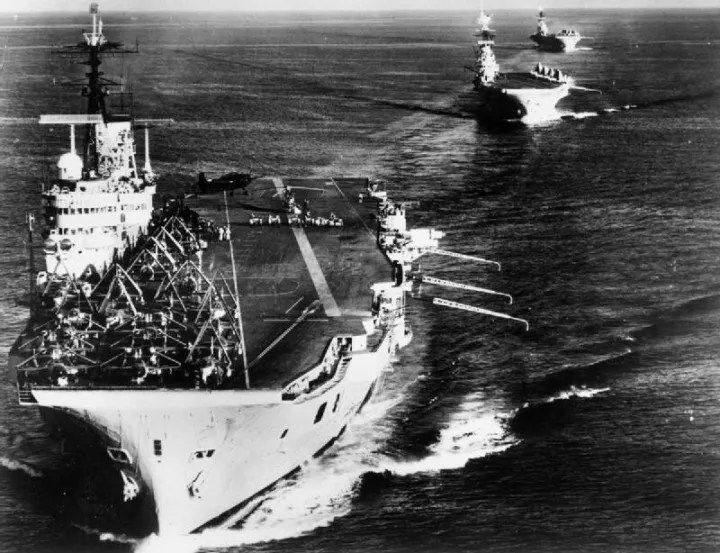
Paratroopers landed on November 5, with seaborne forces following. Photographs of aircraft carriers, assault vehicles and smoke over Port Said record this later phase. They should not be labeled as scenes from the opening Israeli attack. The fighting damaged an inhabited city, while the canal that the operation supposedly intended to secure became obstructed.
Military progress did not settle the political contest. The Eisenhower administration opposed the invasion. Washington's position mattered because Britain depended on American support in a financial emergency. Soviet threats added another source of pressure. Britain and France could take ground, but they could not make the international consequences disappear by advancing farther.
The withdrawal took months
British and French vetoes blocked action in the Security Council, so the issue went to an emergency session of the United Nations General Assembly. Its resolutions demanded a ceasefire and withdrawal. Secretary-General Dag Hammarskjöld and Canada's Lester Pearson helped develop an armed emergency force to supervise that process.
UNEF was a peacekeeping force, operating with Egyptian consent, rather than an army sent to impose a settlement by conquest. Its arrival created a practical way to separate forces and oversee departures. British and French troops completed their withdrawal in December 1956. Israel's withdrawal continued into March 1957. The dates explain why photographs of departing vehicles and prisoner exchanges belong in the story months after the fighting began.
Nasser remained in power. For Britain and France, the outcome exposed the distance between possessing armed forces and being able to use them independently of their allies. For Egypt, the diplomatic victory came with casualties and destruction. The invasion's failure did not erase that cost, nor did the peacekeeping arrangement resolve the wider Arab-Israeli conflict.
Cover photograph: Fleet Air Arm official photographer / Imperial War Museums, MH 23509. Public domain; expired Crown copyright.