A staircase beneath the huts
Howard Carter had returned to Luxor at the end of October. Excavation began on November 1 near the tomb of Ramesses VI. Three days later, his team reached the stair. On November 5, clearing revealed a plastered doorway carrying the royal necropolis seal. Carter stopped, protected the opening and sent word to his financial backer, Lord Carnarvon. A promising entrance had been located. Its contents still lay out of sight.
Carnarvon arrived in Luxor on November 23. The following work exposed the full stairway and impressions of Tutankhamun’s name. A first doorway gave way to a passage filled with rubble; beyond it stood another sealed entrance. Carter looked through a small opening on November 26 and saw the antechamber. The distinction matters when reading anniversary accounts: November 4 marks the discovery of the entrance, not the first view of the treasures or the opening of the burial chamber.
The camera became part of the excavation
Removing the objects was a separate undertaking. Their position, condition and relationship to one another had to be recorded before they could be moved. The Metropolitan Museum of Art lent specialists from its Egyptian Expedition, including photographer Harry Burton. Burton had worked for the museum since 1914 and knew the practical problems of photographing tomb interiors.
His pictures preserve arrangements that excavation itself would dismantle. A photograph of objects in place can show the space between a shrine and a wall, the route available to a worker, or the awkward angle at which a large object had to be lifted. Later studio views served another purpose: they made the individual object legible after its removal. The two kinds of image answer different questions.
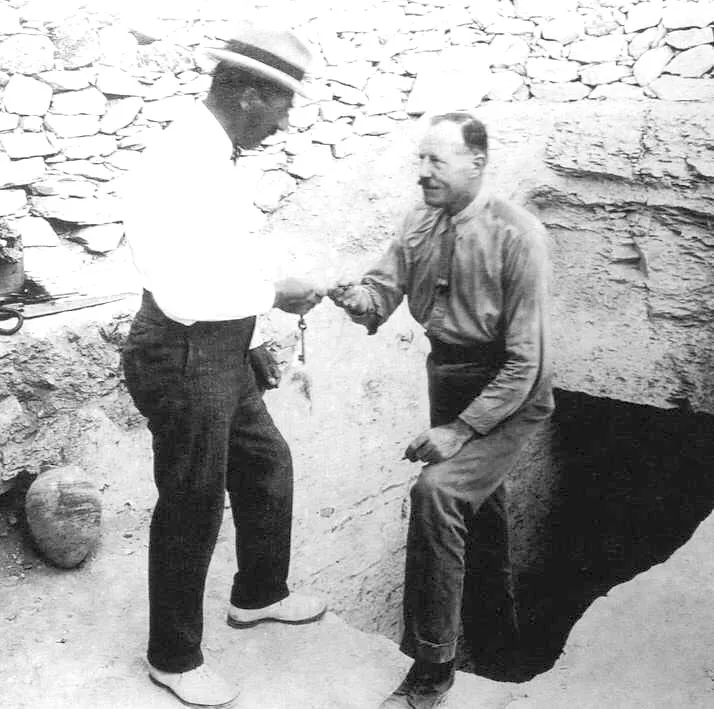
They also require careful dates. A famous view of Carter beside the burial shrines belongs to January 1924, well over a year after the first step appeared. Photographs of the coffins and the examination of the king’s body belong to still later work. Using them to illustrate the whole excavation is reasonable. Calling them photographs of November 4 is not.
The people who moved the stone
The surviving written record gives Carter and his European and American colleagues far more space than the Egyptian workforce. The Griffith Institute’s recent presentation of the archive makes that imbalance explicit. Local workers cleared debris, carried baskets, moved objects and helped lift the roofs of the burial shrines. Their labor was present at every stage, even when their names were absent from captions.
Burton’s photographs sometimes recover that presence. In his December 1923 view of a shrine roof being lifted, two Egyptian foremen work beside Carter and Arthur Callender. It is a scene of shared, physically exacting work. Identifying a foreman merely as an assistant would flatten what the photograph shows; assigning him a name without evidence would create a different error.
The tomb’s discovery survives through notebooks, object cards, drawings and photographs, not through a single triumphant moment. Read together, those records turn a famous date into the beginning of a long investigation. On November 4 the team had reached a stair. The work needed to understand what lay below it had barely begun.
Cover photograph: Harry Burton, January 3–4, 1924. Public domain. Wikimedia Commons; New York Times photo archive / Medelhavsmuseet HB06. Archive record linked under Sources.