

For generations, the flying car has represented a particular vision of the future: drive away from home, reach an open stretch of sky, unfold a pair of wings and simply take off.
Long before modern electric aircraft and computer-controlled air taxis, however, one engineer came remarkably close to turning that fantasy into an ordinary means of transportation.
His name was Moulton “Molt” Taylor, and his machine was the Aerocar.
Completed in 1949, the Aerocar was not a movie prop, an exhibition mock-up or an optimistic drawing in a science magazine. It was a working vehicle. It could be driven on roads. It could fly. Its wings could be folded and towed behind the car. And after years of testing, it received federal certification as an aircraft.
For a brief moment, Taylor believed the automobile and the airplane were about to become one.
They never did.
But nearly eight decades later, surviving footage of the Aerocar remains an extraordinary record of how seriously people once pursued a future that still has not fully arrived.
The Idea Was Born After the Second World War
Molt Taylor was already deeply involved with aviation before he began thinking about flying cars.
Born in 1912, Taylor learned to fly while still young and later studied engineering at the University of Washington. During the Second World War he served in the United States Navy and worked on early pilotless aircraft and guided-missile projects. After the war, he turned his attention toward civilian aviation.
The immediate inspiration for the Aerocar came in 1946.
While traveling in Delaware, Taylor met inventor Robert Edison Fulton Jr., who had developed another roadable aircraft called the Airphibian.
Fulton's machine was already a remarkable achievement. Its aircraft components could be removed so that the remaining vehicle could be driven on the road. The Airphibian would eventually become the first such vehicle to receive certification from the U.S. Civil Aeronautics Administration.
Taylor was fascinated by the idea but believed he could improve it.
One of the problems was what happened to the aircraft components after the vehicle became a car. A flying vehicle was far less useful if its owner had to leave the wings behind at an airport and later return to retrieve them.
Taylor devised a different solution.
The aircraft's wings and tail would fold into a compact unit that could be towed behind the car like a trailer.
The driver could therefore land at one airport, convert the aircraft into a road vehicle, drive somewhere else with the flight components attached behind it, and later reassemble the aircraft at another suitable airfield.
It sounds remarkably modern.
Taylor began developing the concept, assembled a small engineering team in Longview, Washington, tested scale models and eventually produced a working prototype.
On December 8, 1949, the first Aerocar prototype made its first flight.
How the Aerocar Actually Worked
The Aerocar was essentially designed around one principle: neither the automobile nor the aircraft portion should have to be abandoned when changing modes.
In road configuration, the vehicle looked like an unusually small postwar automobile. Behind it, the folded wings and tail could travel on their own wheels as a trailer.
At an airport, the transformation could be performed without specialized machinery.
The wing assembly was unfolded and connected to the vehicle. The tail section was attached behind the car, and the aircraft's drivetrain was connected through a coupling concealed behind the rear license plate.
The wings were then swung into flying position and secured.
The design even incorporated safety mechanisms intended to prevent the engine from operating for flight unless the necessary connections had been properly made. The Museum of Flight describes the complete transformation as taking less than 15 minutes.
Inside, the Aerocar blended the controls of two completely different machines.
It had an automobile-style steering wheel, gearshift, horn and turn signals. At the same time, aircraft instruments occupied part of the dashboard, while the control system changed function once the vehicle was prepared for flight.
The engine also served both worlds.
In flight configuration, power was transmitted to a propeller mounted at the rear of the aircraft. The high tail boom gave the propeller sufficient clearance from the ground.
The result was not merely a car that could briefly lift itself into the air.
It was a genuine light aircraft.
A Car on the Ground, an Airplane in the Sky
Specifications varied between Aerocar versions and during the prototype's development, but the surviving Aerocar I preserved by the Experimental Aircraft Association illustrates what Taylor achieved.
The two-seat machine had a wingspan of approximately 30 feet (9.1 meters) and a gross weight of around 2,100 pounds (953 kilograms). The EAA's restored example uses a Lycoming O-320 engine producing 150 horsepower.
Its listed cruising speed is approximately 100 mph (161 km/h), with a maximum speed of about 110 mph (177 km/h) and a range of roughly 300 miles (483 kilometers).
Those numbers are modest compared with modern aircraft.
But speed was not really the Aerocar's revolutionary feature.
Its advantage was flexibility.
A conventional private aircraft could fly rapidly between airports but left its occupants searching for transportation after landing. A car offered freedom on the ground but was limited by roads and distance.
Taylor imagined one machine solving both problems.
Fly between cities.
Land.
Fold the wings.
Drive to your final destination.
No rental car. No taxi. No need to return to the same airport simply because the aircraft had been left there.
This was not simply an attempt to make a car fly.
It was an attempt to redesign personal transportation.
The Hard Part Was Not Making It Fly
Taylor spent much of the 1950s testing, refining and promoting his invention.
The Aerocar appeared at aviation and automobile shows and attracted extensive media attention. Taylor demonstrated it publicly and appeared on television. One Aerocar later appeared in connection with actor and pilot Bob Cummings, who personally owned one of the aircraft. Another was used by Portland radio station KISN for airborne traffic reporting.
Most importantly, the machine survived the certification process.
In December 1956, the U.S. Civil Aeronautics Administration approved the Aerocar design.
That achievement distinguished it from countless flying-car concepts that never advanced beyond experimental prototypes.
Taylor had demonstrated that the basic engineering could work.
Now he needed to demonstrate that people would buy it.
That proved far more difficult.
The 500-Order Problem
The Aerocar eventually attracted the attention of Ling-Temco-Vought, a major American industrial and aerospace company.
A potential production agreement offered Taylor the opportunity he had spent years pursuing.
But there was a condition.
Before large-scale manufacturing would begin, Taylor needed to secure 500 firm orders.
According to an account published by Smithsonian's Air & Space Magazine, Taylor managed to collect 278 deposits of $1,000 each in a remarkably short period. It was significant evidence of public interest — but it was still 222 orders short of the requirement.
Without the necessary commitments, the manufacturing deal collapsed.
The Aerocar had crossed one of the greatest barriers faced by experimental aircraft: it worked.
What it could not cross was the economic barrier between a fascinating invention and a mass-market product.
Why Didn't Everyone Buy a Flying Car?
The Aerocar exposed a problem that has continued to challenge flying-car designers ever since.
A machine optimized for driving is not necessarily a good airplane.
A machine optimized for flying is not necessarily a good car.
Combining both inevitably creates compromises.
The vehicle had to carry structures and systems that were useless during part of every journey. Wings, flight controls and aircraft equipment added complexity to an automobile. Wheels, road equipment and automotive requirements added weight and aerodynamic drag to an aircraft.
And owning one did not eliminate aviation's other requirements.
The person behind the controls still needed the skills and qualifications required to fly an airplane. The vehicle still needed suitable places to take off and land. Weather remained a limitation. Maintenance was more complicated than that of an ordinary automobile.
Then there was price.
The very qualities that made the Aerocar extraordinary also made it difficult to manufacture cheaply enough for ordinary motorists.
Taylor had solved much of the engineering problem.
He had not solved the economics.
Even Ford Took a Look
Taylor did not immediately abandon the idea.
He continued refining the concept and eventually developed the Aerocar III, which featured a more streamlined body and improved aerodynamic performance.
The project even attracted interest from Ford Motor Company around 1970.
Ford executives Donald Petersen and Dick Place traveled to meet Taylor, and Place flew the Aerocar III. According to his later recollection, the vehicle performed well enough that he believed the company should at least continue investigating the idea.
Ford ultimately went no further.
Once again, the Aerocar came close enough to serious industrial attention to demonstrate that it was not merely an eccentric inventor's fantasy.
But close was never enough.
Only a handful of Aerocars were ultimately built.
The Museum of Flight records six examples associated with the project rather than the thousands Taylor once hoped might fill American roads and skies.
An Invention That Arrived Before Its Market
It is tempting to describe the Aerocar simply as a failed flying car.
That misses what makes it historically important.
Many futuristic vehicles look impressive in drawings and promotional films because they never have to confront reality.
The Aerocar did.
It was built.
It drove on public roads.
It flew.
It underwent years of testing.
It received government certification.
Owners actually used Aerocars, and surviving film shows them being converted, driven and flown.
Taylor's problem was therefore not that his flying car was imaginary.
His problem was that the society around it was not ready to make such a machine practical on a large scale.
Infrastructure remained centered on conventional automobiles and conventional aircraft. Pilot training presented a major barrier to ordinary consumers. Manufacturing costs remained high. And the combination of two vehicles in one inevitably demanded compromises.
Those challenges remain familiar today.
The Flying Car Dream Never Disappeared
Modern versions of the flying-car idea often look very different from Taylor's machine.
Some developers are pursuing electric vertical-takeoff aircraft that resemble oversized drones. Others continue working on road vehicles with deployable wings. Advances in lightweight composites, batteries, electric motors, navigation systems and automated flight controls have opened possibilities Taylor could not have imagined.
Yet the central problem remains surprisingly similar.
Creating a vehicle capable of moving through both the road network and the sky is possible.
Creating one that is safe, affordable, convenient, legally practical and desirable to millions of ordinary people is much harder.
That distinction is exactly what the Aerocar demonstrated more than seventy years ago.
A Surviving Artifact of an Optimistic Future
Today, surviving Aerocars are historical artifacts rather than everyday transportation.
Taylor's original prototype has been restored and is preserved by the EAA Aviation Museum, while the unique Aerocar III is part of The Museum of Flight collection in Seattle.
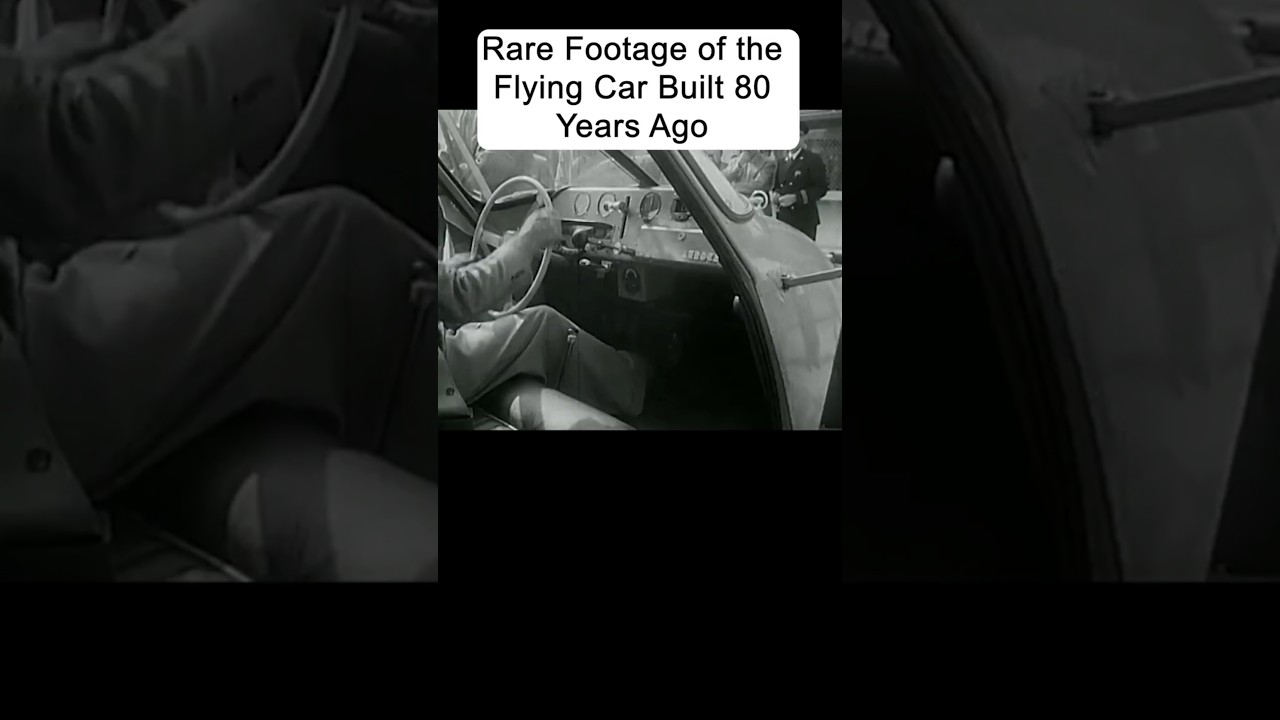
Archival film preserved by The Museum of Flight provides an especially valuable glimpse of the machine in operation. Footage from 1968 shows Taylor with the Aerocar III in road configuration, towing its folded aircraft components before converting it for flight and taking to the air.
Seen today, the footage has an almost surreal quality.
A tiny postwar automobile arrives at an airfield.
Its wings unfold.
Its tail is attached.
A few minutes later, the same machine is flying.
There are no computer graphics and no speculative animation.
The future people imagined actually existed — at least in prototype form.
Molt Taylor never saw skies crowded with Aerocars as he once hoped. His invention did not replace the family automobile or transform private aviation.
But he demonstrated something far more significant than a futuristic styling exercise.
He proved that a practical roadable airplane could be built, driven, flown and certified.
The Aerocar therefore occupies a peculiar place in technological history: a vision of the future that worked, but never became the future.