

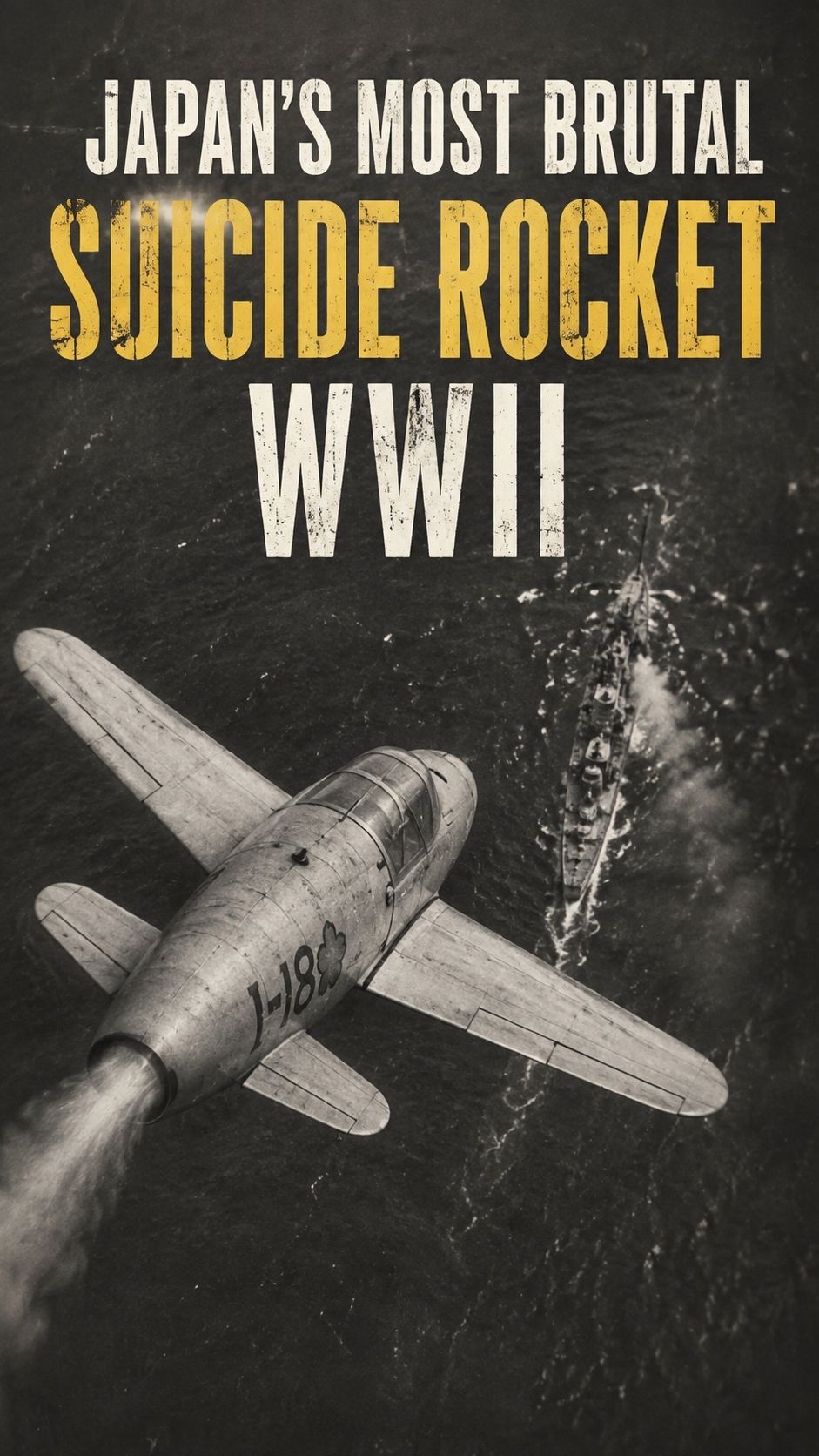
In the spring of 1945, Allied sailors fighting around Okinawa faced a weapon that blurred the line between aircraft, bomb and missile.
The Yokosuka MXY-7 Ohka was carried beneath a bomber, released near an enemy formation and guided by a pilot toward a warship. During its final approach, three rocket motors accelerated the weapon into a high-speed dive. Its nose contained a 2,646-pound — approximately 1,200-kilogram — warhead. Behind that warhead sat the guidance system: a human being.
Calling the Ohka Japan’s “most brutal” suicide rocket is not a claim that it caused more deaths than every other Japanese weapon. In operational terms, it was far less successful than conventional kamikaze aircraft. The description instead refers to the logic built into the machine. Its pilot was not merely expected to risk his life while operating a weapon. His death was part of the weapon’s intended function.
A Weapon Born From Strategic Collapse
By late 1944, Japan’s position in the Pacific had become increasingly desperate. Its navy had lost carriers, experienced aviators, aircraft and access to vital supplies. Allied forces were advancing toward the Japanese home islands behind an enormous naval and air-power advantage. Radar-directed fighter patrols made conventional attacks against American carrier groups increasingly difficult.
Japan’s response included the expansion of the tokkōtai, or special-attack forces, usually described in English under the broader term “kamikaze.” These operations were based on the belief that a deliberately sacrificed aircraft and pilot might achieve what a conventional attack could no longer accomplish.
The Ohka was created for this environment. It was not designed to fight enemy aircraft, conduct reconnaissance or return to its base. Its sole purpose was to carry a large explosive charge into an Allied ship at a speed intended to make interception during the final seconds extremely difficult. By March 1945, 755 Model 11 Ohkas had reportedly been constructed, demonstrating that it was more than an isolated experiment. It had become a production weapon intended for large-scale use.
The Meaning Behind the Name
The Japanese name Ōka, commonly written as Ohka in English, means “cherry blossom.”
That name was not accidental. Cherry blossoms had long carried complex meanings in Japanese culture, including beauty, impermanence and the brevity of life. During the militarization of Japanese society, the state transformed this older cultural symbol into an image of patriotic sacrifice: the idealized young man falling for the emperor like a cherry petal at the height of its beauty.
Anthropologist Emiko Ohnuki-Tierney has shown that many special-attack pilots did not interpret this symbolism as simply or enthusiastically as military propaganda suggested. Their surviving diaries reveal grief, uncertainty, anger and resistance alongside duty and loyalty. Nevertheless, the state’s use of the cherry blossom helped turn death into an aesthetic and political message.
Allied personnel gave the weapon a far less poetic name: the Baka bomb. “Baka” is a Japanese word commonly translated as “fool” or “idiot.” The nickname expressed both contempt for the weapon and disbelief that a human pilot would be deliberately placed inside it.
Aircraft, Bomb or Missile?
The Ohka was technically a piloted aircraft, but it was built around the characteristics of a bomb.
The combat Model 11 carried a 2,646-pound warhead and used three Type 4 rocket motors producing a combined 1,764 pounds of thrust. The rockets burned for only about eight to ten seconds, which meant they were reserved for the final approach rather than used throughout the flight. According to the National Museum of the United States Air Force, the Ohka could reach approximately 615 miles per hour — about 990 kilometers per hour — in a powered dive.
It had no ability to take off independently. A modified Mitsubishi G4M2e bomber, known to the Allies as the “Betty,” carried the Ohka beneath its fuselage. The bomber crew had to transport both the weapon and its pilot close enough to the enemy fleet for the attack to begin.
After release, the Ohka pilot would initially glide toward the target. When the remaining distance was short enough, he ignited the rocket motors and committed the aircraft to its terminal dive. The high closing speed dramatically reduced the time available to a ship’s anti-aircraft gunners. Once the Ohka entered this final phase on the correct trajectory, stopping it could be extraordinarily difficult.
This is why the Smithsonian describes the Ohka as a human-guided missile. Its warhead, terminal propulsion and control system were all concentrated into one compact attack vehicle. The crucial difference was that the functions later performed by electronic sensors and guidance computers were performed by a pilot.
The Fatal Weakness Was the Mothership
The Ohka’s great speed concealed a fundamental design problem.
The weapon was dangerous only after it had been released. Before that moment, it depended entirely on the G4M bomber carrying it. The loaded bomber was a large, vulnerable target that had to approach an Allied fleet protected by radar, combat air patrols and layers of anti-aircraft fire.
In effect, the Ohka solved the final few miles of the attack while making the entire journey to those final miles more difficult.
The G4M already had a reputation for vulnerability. Carrying the Ohka added weight and reduced the bomber’s performance further. Allied fighters did not need to wait for the rocket aircraft to begin its dive. They could destroy the carrier aircraft long before it reached a suitable release point.
This became the defining weakness of the entire system. The Ohka could be nearly impossible to stop during a successful terminal attack, but most weapons never reached that stage.
The First Mission: Destroyed Before Release
The first operational Ohka attack began on March 21, 1945.
A formation of eighteen G4M2e bombers departed Kanoya Naval Air Base to attack an American carrier group. Fifteen of the bombers carried Ohkas. They were accompanied by Japanese Zero fighters, but mechanical problems forced a significant part of the escort to turn back.
American radar detected the formation before it could reach the carrier force. Hellcats and Corsairs were directed toward the incoming aircraft, creating an interception force of more than 150 fighters.
The battle was brief and catastrophic for the Japanese formation. Within approximately twenty minutes, all eighteen G4M bombers had been shot down. Some attempted to escape at low altitude, while others jettisoned their Ohkas. Not one of the rocket aircraft was launched against the American carriers.
The detailed operational chronology records the loss of 137 bomber crew members and all fifteen Ohka pilots — 152 men — without a single attack reaching its intended target.
The first mission revealed the central contradiction of the weapon. Japanese engineers had created an attack vehicle designed to be almost unstoppable in its final dive, but they had attached it to an aircraft that the enemy could destroy long before that dive began.
The Day an Ohka Reached Its Target
The weapon nevertheless proved that it could be devastating when it broke through.
On April 12, 1945, the destroyer USS Mannert L. Abele was operating approximately 75 miles off northern Okinawa as part of the radar picket screen. These isolated destroyers provided early warning of incoming Japanese attacks and were therefore exposed to some of the most concentrated kamikaze assaults of the campaign.
A conventional Japanese aircraft first struck the destroyer near its after-engine room. Approximately one minute later, an Ohka hit the ship at the waterline. The explosion caused the bow and stern to buckle rapidly, and the destroyer broke apart.
The Mannert L. Abele became the first United States warship sunk by a Japanese rocket-powered, human-guided bomb. Eighty-four American sailors were lost with the ship.
Other Ohkas struck or damaged American vessels during the Okinawa campaign, but the weapon’s overall results remained limited. A U.S. Navy historical analysis concluded that only four Ohkas succeeded in hitting ships and that the Mannert L. Abele was the only vessel sunk by one.
The attack therefore demonstrated both sides of the Ohka. At the tactical level, a successful hit could destroy a warship and kill dozens of sailors. At the strategic level, such rare successes could not compensate for the bombers, crews, escorts, pilots and weapons lost before reaching their targets.
The Human Being Inside the Guidance System
The Ohka’s brutality cannot be understood only through its speed, explosive power or engineering.
Its defining component was the person inside it.
The combat aircraft was not equipped for a conventional landing or recovery. The separate MXY7-K1 trainer had flaps, a landing skid and water ballast in place of the warhead and rocket motors. These additions allowed it to be used repeatedly for training. The operational Ohka did not have those recovery features because it was never intended to return.
It would also be misleading to depict every pilot as an unquestioning fanatic who eagerly chose death.
Evidence from the broader Japanese special-attack system reveals a far more complicated reality. Some men were motivated by patriotism, loyalty to their comrades or the belief that their sacrifice might protect their families. Others were drafted, pressured or effectively “volunteered” through military authority and social coercion. Diaries and letters written by student soldiers describe fear, resignation, intellectual resistance and attempts to find meaning in a death they believed had already been decided for them.
The pilot of an Ohka was therefore both an operator and an expendable part of the machine. His eyesight identified the target. His judgment corrected the approach. His hands replaced the guidance computer. The aircraft converted a human life into a control mechanism that would be destroyed at the moment the weapon functioned as intended.
Was the Canopy Bolted Shut?
A dramatic claim frequently repeated online says that the Ohka’s canopy was bolted shut from the outside, preventing the pilot from escaping even before the weapon was released.
The major museum descriptions and U.S. naval records consulted for this article do not document an externally bolted canopy as a standard feature of the operational Ohka. The absence of such a detail from these records does not conclusively prove that it never happened in an individual case, but it means the claim should not be presented as an established design fact.
The verified reality is already severe enough. The combat aircraft lacked the trainer’s landing equipment, carried a large warhead in its nose and was built specifically for a non-returning attack. Japanese special-attack weapons generally included no practical means of returning after the final mission had begun. Once an Ohka was released on a committed attack run, survival was not part of its operational design.
Was the Ohka an Ancestor of the Modern Missile?
The Ohka is sometimes described as an ancestor of the modern guided missile. That comparison is useful, but only if it is expressed carefully.
It was not a direct technological ancestor from which modern anti-ship missiles evolved. Other nations were already developing guided bombs, pilotless aircraft and automatic control systems during World War II. The Ohka did not create the electronic guidance technologies that later defined modern missiles.
It was, however, a disturbing conceptual parallel.
Like a later air-launched anti-ship missile, the Ohka combined a warhead, an aerodynamic body, terminal propulsion and a guidance method in a single expendable vehicle. But instead of radar, infrared sensors or an onboard computer, it relied on a pilot to detect, select and steer toward the target.
Japanese engineers understood the weapon’s short range to be its greatest practical weakness. A later design, the Ohka Model 22, was intended to increase the range to approximately 130 kilometers while using a smaller warhead and a motorjet power plant. Production difficulties prevented the design from becoming operational, and the war ended before any Model 22 flew in combat.
A Terrifying Weapon That Could Not Change the War
The Ohka was frightening, but fear should not be confused with effectiveness.
Japan built hundreds of them. Their final speed could make them extremely difficult to stop. At least one broke a destroyer apart, while others inflicted serious damage. Yet the weapon did nothing to halt the invasion of Okinawa, weaken American naval superiority or change the outcome of the Pacific War.
Its failure was not caused by a lack of destructive power. It failed because the entire attack system depended on vulnerable bombers entering an airspace dominated by Allied radar and fighters. The weapon’s tactical strength arrived too late in the sequence to overcome its operational weakness.
The Ohka’s deeper legacy is therefore not that Japan created an unbeatable missile. It is that a collapsing military strategy produced a weapon in which a person was deliberately substituted for technology.
The name promised the beauty of a falling cherry blossom. The machinery revealed something much darker: a government had begun to treat the lives of its own young men as components that could be consumed, like fuel, explosives or metal, in the hope of delaying a defeat it could no longer prevent.