France did not lose control of Algeria that morning. The opening attacks were limited beside the violence that followed. Their lasting importance lay in the decision they announced: a group of militants had chosen armed struggle and claimed the authority to lead it. November 1 became the starting date of the Algerian War.
The road to November
Algeria's status made the dispute especially difficult to resolve. Much of the territory was administered as departments of France, and a large European settler population regarded it as home. For the Muslim majority, formal connections to France coexisted with political inequality, rural poverty and restricted access to power. Reforms repeatedly fell short of nationalist expectations.
The repression that followed the violence around Sétif and other towns in May 1945 left thousands of Algerians dead. That experience damaged hopes of a peaceful settlement. In the following years, electoral manipulation and the weakness of reform strengthened those who believed that the colonial system would yield only under force.
Nationalists nevertheless disagreed about leadership and methods. The militants who launched the FLN emerged amid divisions within the existing movement associated with Messali Hadj. France's defeat in Indochina in 1954 and unrest elsewhere in North Africa made the moment seem more promising to advocates of an uprising. They were acting on a judgment about opportunity, not following an outcome already assured.
What the proclamation offered
The November 1 document deserves attention alongside the attacks. It proposed a sovereign Algerian state, described in democratic and social terms within an Islamic framework, and promised fundamental freedoms without religious or racial distinction. It also sought international recognition and cooperation with other North African movements.
Its language addressed French residents as well as Algerian nationalists. The FLN offered respect for persons, families and legitimately acquired economic interests. French people who remained would be able to retain their nationality or become Algerian. Negotiations with France were envisaged, but only on the basis of Algerian sovereignty.
These were the movement's declared intentions. They should not be mistaken for a neutral description of everything the FLN subsequently did. The proclamation was an argument for support, and its claim to speak for the nation would be contested by rival nationalists as well as by France.
A war that widened
The French government rejected the independence demand and reinforced its military presence. Emergency legislation and expanded operations followed. A conflict initially described by French officials as an internal security problem grew into a war fought in rural districts, cities and metropolitan France.
The consequences reached far beyond the first organizers. Civilians suffered attacks, displacement and repression. The FLN's urban campaign and the French military's methods in Algiers became central to the conflict's memory. In 2024, the French presidency formally acknowledged that French soldiers had murdered Larbi Ben M'hidi, one of the six leaders associated with the uprising, after his arrest in 1957.
The Évian agreements were signed on March 18, 1962, with a ceasefire taking effect the next day. An independence referendum followed on July 1; France recognized Algerian independence on July 3, and Algeria commemorates it on July 5. Violence and bitter displacement did not simply stop with a signature.
November 1 marks the beginning of that long passage, not its conclusion. The proclamation's demand became a state eight years later. Between the two stood a war that changed Algeria, brought down France's Fourth Republic and left families on both shores of the Mediterranean carrying losses that no anniversary can neatly contain.
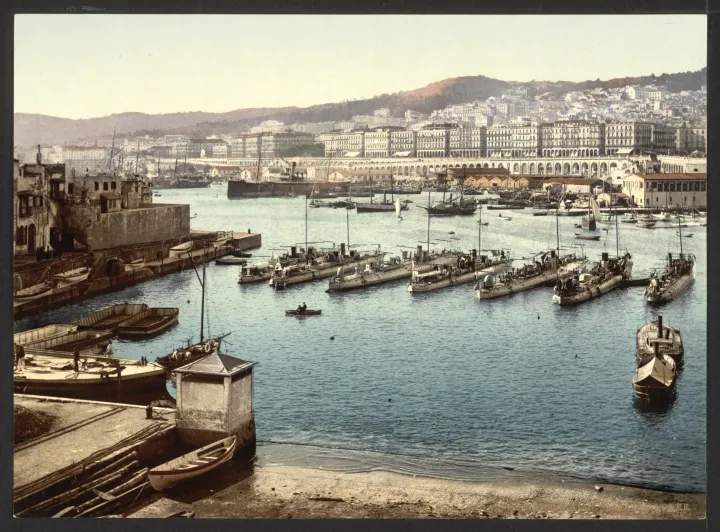
Cover image: Unknown photographer; photochrom by Photoglob Zürich / Library of Congress, Photochrom Print Collection, ppmsc.05513. Public domain; Library of Congress reports no known restrictions on reproduction. View circa 1899, used as historical context.