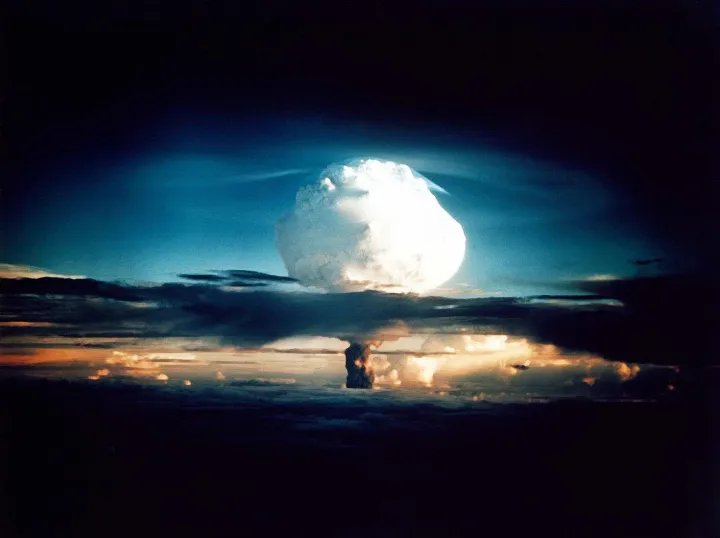
Some American records date the explosion October 31. Both dates refer to the same event: it was still October 31 in the continental United States when the test took place at about 7:15 a.m. on November 1 in the Marshall Islands. Here, the anniversary follows the date at the test site.
A presidential decision becomes a Pacific operation
Harry Truman had publicly directed the Atomic Energy Commission to continue work on hydrogen weapons on January 31, 1950. The Soviet Union's first atomic test the previous year had ended the American nuclear monopoly. Inside the United States, scientists and officials disagreed over whether a far more powerful weapon would improve security or make an already dangerous competition worse.
Truman presented the decision as a responsibility of national defense, while leaving open the prospect of international control of atomic energy. Research and military preparations proceeded. By 1952, the question had become whether the new thermonuclear concept could be demonstrated at full scale.
Mike was an experiment of extraordinary size, not a compact bomb ready to be loaded into an operational aircraft. Its liquid fuel required extensive cooling equipment. Photographs of the installation show something closer to an industrial facility than the familiar outline of a bomb. Making the idea work was one problem; producing a practical weapon was another.
The machinery behind a few seconds
Joint Task Force 132 brought military units, scientists, ships and aircraft to Enewetak. Preparations began months before the detonation. Instrument stations spread across the atoll, while aircraft and ships supported observation, communication and the collection of scientific evidence.
The test was fired remotely from the command ship USS Estes. Personnel withdrew from the atoll for the explosion. Cameras recorded the fireball and the enormous cloud that followed, images that would become shorthand for the thermonuclear age. The photographic record is dramatic, but it compresses months of logistical work into a view that lasts only a moment.
The result demonstrated a new scale of destructive power. Elugelab was gone, replaced by a large underwater crater. The name of the island survived on pre-test maps and photographs; the land itself did not. A before-and-after pair makes that change easier to grasp than a comparison between explosive yields.
The people outside the frame
Enewetak was not an empty laboratory. Its inhabitants had been moved to Ujelang Atoll in 1947, before the American testing program began there. Their displacement is part of the test's history even when official photographs show only equipment, ships and sky.
A film held by the Truman Library adds another detail. Navy doctor Rufus Kruse recorded residents of Ujelang being taken aboard a landing ship during the Mike test period. The library's description places his film between October 27 and November 2, 1952. Even the island to which Enewetak's people had been relocated was drawn into the precautions surrounding the experiment.
What remained after the cloud
Mike was one event in a much longer program. Forty-three atmospheric nuclear tests were conducted at Enewetak between 1948 and 1958. The damage included altered islands, contaminated soil and lagoon sediments, and abandoned military and scientific equipment. Later cleanup had to deal with that cumulative legacy, not merely the remains of a single explosion.
Resettlement on Enewetak Island began in 1980, decades after removal. The anniversary therefore has two very different clocks: the seconds in which an experiment proved its power, and the years in which people waited to return. The mushroom cloud documents the first. The missing island and the history of displacement keep the second in view.
Cover image: United States government photographer; individual unidentified / National Nuclear Security Administration, Nevada Site Office Photo Library, XX-11; public domain.