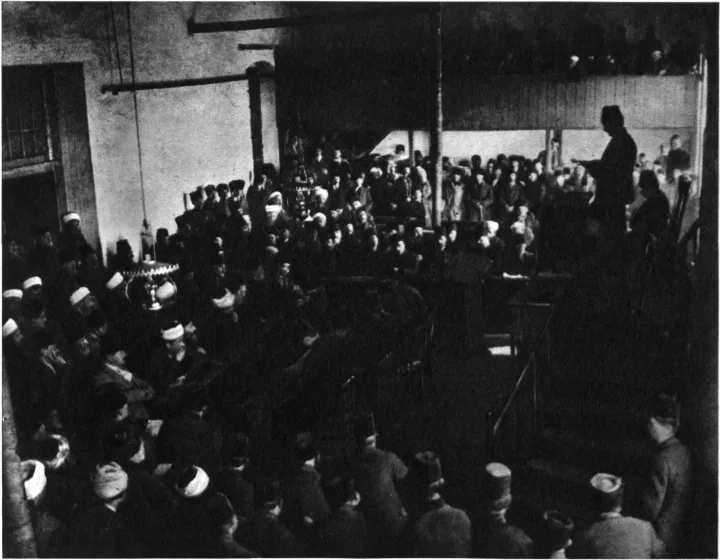
On November 1, the Grand National Assembly abolished the Ottoman sultanate. A dynasty that had ruled for centuries lost its claim to govern. The decision also settled a very immediate diplomatic problem: the sultan's government could no longer present itself as a second Turkish authority at the forthcoming negotiations.
Two governments, one claim to sovereignty
The division had developed during the struggle that followed the Ottoman defeat in the First World War. Sultan Mehmed VI remained in occupied Istanbul. Mustafa Kemal and his colleagues built a rival center of government in Ankara, where the assembly opened in April 1920. Its constitution placed sovereignty in the nation. By autumn 1922, its armies had won the decisive campaign against Greek forces in Anatolia.
Grand Vizier Tevfik Pasha still sought cooperation between the two governments over the peace delegation. His approaches to Ankara met a different answer: there was only one legitimate representative of the country. What looked from Istanbul like a proposal for unity looked from Ankara like an attempt to revive an authority the national movement had already displaced.
The assembly debated the issue on October 30 and November 1. Its decision separated the sultanate from the caliphate, allowing deputies to end dynastic government without abolishing the religious office at the same moment. That distinction mattered. The events of November 1922 are often compressed into a single ending, although the institutions did not disappear together.
A vote in Ankara, a government dissolving in Istanbul
The resolution treated the Istanbul government as having ceased to exist from March 16, 1920, the date of the Allied occupation of the capital. This was a retrospective legal claim, not a statement that the palace's administration had physically vanished that day. The vote of November 1, 1922, made the break explicit and enforceable.
In Istanbul, newspapers carried the decision on November 2. Historian Betül Aslan's study of the local reaction records ministers complaining that they had learned it from the press rather than an official notification. The awkwardness tells us something about the transfer of power: Ankara was refusing to treat the old government as a partner even in the business of ending it.
Officials and departments began declaring their allegiance to the assembly. Tevfik Pasha's cabinet resigned on November 4. The change was therefore more than the disappearance of a title. Courts, administrators and communications services had to establish whose instructions they would follow.
The sultan leaves; the caliphate remains
Mehmed VI requested British protection and left Istanbul aboard HMS Malaya on November 17. The following day, the assembly chose Abdülmecid II as caliph. He inherited no sultanate. The political authority that had once accompanied the dynasty's religious position now belonged to Ankara.
İsmet Pasha led the Turkish delegation at Lausanne. The diplomatic dispute that had helped force the decision was resolved: there would be no parallel delegation speaking for the Ottoman cabinet.
Turkey was proclaimed a republic on October 29, 1923. The caliphate survived until March 3, 1924. Keeping those dates separate makes the sequence easier to understand. November 1 was the end of hereditary Ottoman government; the republic's formal declaration and the abolition of the caliphate followed in further decisions. The old order came apart through votes, resignations and departures, each removing a different part of its authority.
Cover image: Frédéric Gadmer / Département des Hauts-de-Seine, musée Albert-Kahn, A36958. CC BY-SA 4.0.