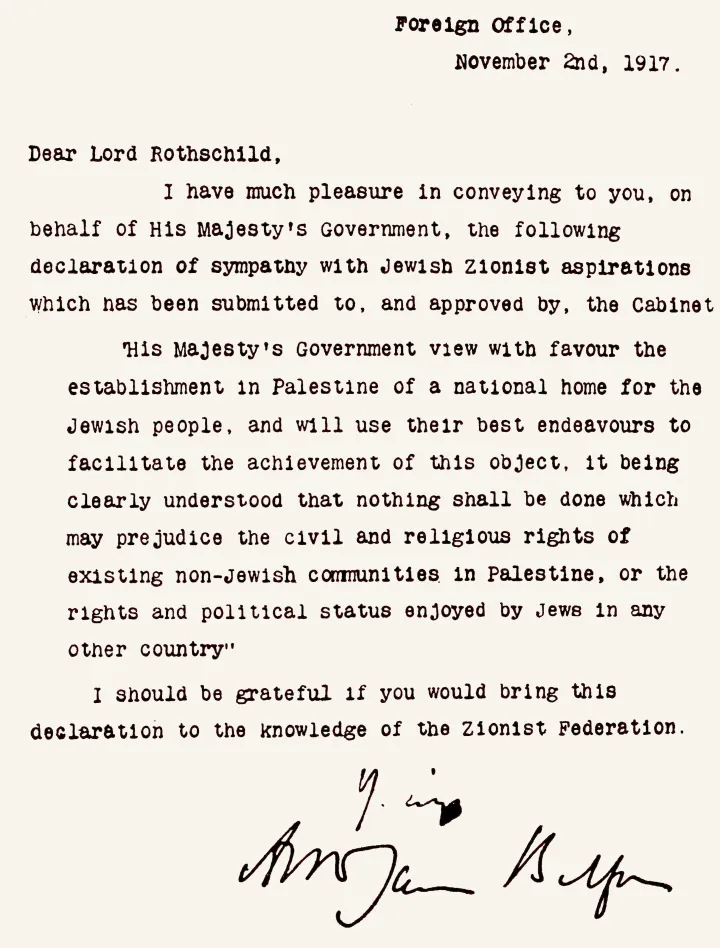
The declaration became a foundation of British policy. It supplied neither borders nor a constitution. Its promise and its safeguards occupied the same paragraph, with no explanation of how competing claims would be reconciled.
A wartime commitment
Palestine was still part of the Ottoman Empire, and British forces were advancing into the region. General Edmund Allenby’s ceremonial entry into Jerusalem came on December 11, more than a month after Balfour signed the declaration. British policy was being shaped before British troops had completed their occupation of the territory.
Nor did the policy appear fully formed on November 2. The British Library preserves an October 6 letter from War Cabinet secretary Maurice Hankey asking Rothschild for his opinion on the proposed text. Surviving drafts and cabinet papers record a process of discussion. The War Cabinet approved release on October 31, and Balfour’s letter followed two days later. The Times printed it on November 9.
What the letter promised
The decisive expression was “national home.” It was a substantial endorsement of Zionist aspirations, but it was not a precise definition of a future state. The government also undertook to help bring that home into being. These were commitments by a major wartime power, rather than a private expression of sympathy.
The declaration said that the civil and religious rights of Palestine’s existing non-Jewish communities must not be harmed. It separately protected the rights and political standing of Jews elsewhere. Those two clauses addressed different concerns: the position of people already living in Palestine, and the position of Jewish citizens in other countries.
The wording nevertheless treated the two populations differently. It named the Jewish people as the beneficiary of a national project, while describing the other inhabitants through a religious distinction. It did not explicitly recognize their national political rights. That imbalance is visible in the document’s own terms.
Dissent inside the cabinet
Britain’s Jewish population did not speak with one voice on Zionism. Edwin Montagu’s memorandum of August 23, 1917, carried the blunt title The Anti-Semitism of the Present Government. His objection came from inside the government that would issue the declaration. Support for Zionism, opposition to it, and concern about Jewish citizenship were separate political positions; Jewish identity alone does not tell us which position someone held.
From letter to administration
The declaration acquired a different practical weight when it was incorporated into the League of Nations Mandate for Palestine, approved in July 1922. The mandate charged Britain with creating conditions for the Jewish national home and with safeguarding the civil and religious rights of all inhabitants. It also recognized a Jewish agency to advise and cooperate with the administration. The mandate formally entered into force on September 29, 1923.
A letter, a military occupation and an international mandate were distinct steps, taken over almost six years. Balfour’s letter was brief enough to fit on a single sheet. The responsibilities it placed on Britain—and the competing expectations it encouraged—extended far beyond that page.
Cover: Balfour’s letter to Lord Rothschild, November 2, 1917. United Kingdom Government / British Library, via Wikimedia Commons. Public domain; expired Crown copyright. Full image record is listed in Sources.