
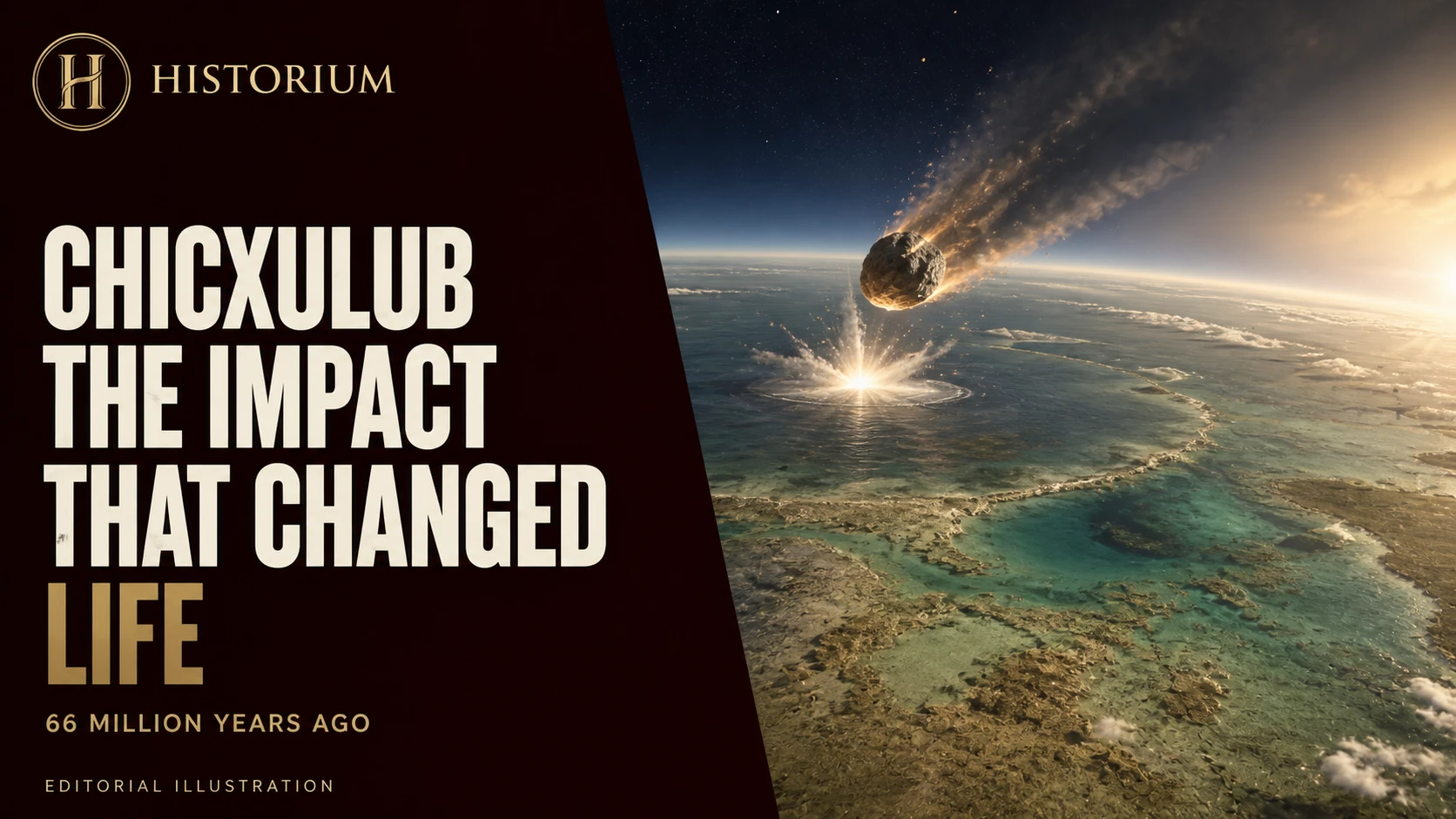

About 66 million years ago, a large asteroid struck the region now occupied by Mexico’s Yucatán Peninsula. The resulting Chicxulub impact is associated with the loss of roughly 75 percent of Earth’s species. That figure describes biological diversity, not a count of every individual organism and not the disappearance of three quarters of the planet’s living material. NASA’s account of major impacts provides the broad scale of the event.
Chicxulub is often pictured as a single flash ending an entire world. Its scientific history is more demanding: researchers must connect a collision, a disturbed atmosphere, failing ecosystems and uneven recovery. Each connection requires different evidence. A crater can establish an extraordinary impact; it cannot, by itself, explain the fate of an animal on another continent.
Reading the first day in rock
A drilling expedition in 2016 recovered cores from the crater. A study published in 2019 identified a thick sequence of material deposited during the immediate aftermath, including broken and melted rocks, charcoal and deposits associated with water returning into the basin. The researchers reconstructed approximately 130 metres of accumulation within the first day. These observations help connect impact processes with fire and powerful water movements. The University of Texas describes the core evidence.
The distinction between a deposit and its interpretation matters. Charcoal is physical evidence; an account of how it reached a particular layer is a reconstruction tested against surrounding material. These are not competing kinds of knowledge. Together they turn a dramatic possibility into an explanation that other researchers can examine. A core preserves a sequence, allowing scientists to ask which processes preceded others rather than treating every effect as simultaneous.
Why the atmosphere matters
The immediate destruction near an impact does not explain a worldwide extinction on its own. A 2020 study combined climate simulations with information about conditions suitable for dinosaurs. It compared the consequences of the impact with those of the Deccan volcanic eruptions in present-day India. In those models, impact-driven cooling removed suitable habitat much more broadly than volcanism alone. The authors also proposed that longer-term volcanic warming could have helped subsequent recovery. UCL explains the study and its modelling approach.
This is a reason to separate the trigger from the mechanisms through which it acted. A rock from space can initiate a catastrophe whose consequences are mediated by sunlight, temperature and food. It also explains why a strong case for the impact does not make every question about volcanism irrelevant. Different processes can operate over different intervals, and explaining the principal cause does not require imagining an otherwise motionless Earth.
Small fossils reveal a food crisis
Evidence from microscopic marine organisms offers another perspective. Research published in 2020 examined fossil nannoplankton alongside ecological modelling. Organisms that persisted after the extinction included forms able to consume food as well as obtain energy through photosynthesis. Features in their fossil skeletons helped researchers infer those feeding capabilities. The team interpreted the pattern as evidence that loss of sunlight was central to the crisis. UCL’s account explains the fossils and feeding strategies.
These tiny organisms make the story larger, not smaller. A history centred only on spectacular animals misses the conditions supporting them. Food systems can fail from their foundations, and survival depends on how an organism obtains resources when familiar ones disappear. That does not turn extinction into a contest with deserving winners. It asks a more useful question: which ways of living remained possible under abruptly altered conditions?
Birds complicate the familiar ending
The phrase “all the dinosaurs died” leaves out an essential survivor: birds. A 2018 study combined bird evolutionary relationships with evidence of vegetation change to investigate which ancestors survived. Its authors inferred that surviving ancestors of modern birds were ground dwellers, while forest loss was especially destructive for tree-dependent forms. This is a reconstruction of ecological selectivity, not a claim that every detail of avian survival has been settled. Cornell’s report explains the evidence behind the hypothesis.
Calling the lost dinosaurs “non-avian dinosaurs” preserves that distinction. It also changes the emotional shape of the story. The past is not wholly sealed away at the extinction boundary: one dinosaur lineage continues around us. Survival, however, should not be confused with an unchanged world. A surviving branch can persist through a profound reduction in the diversity and ecological arrangements that previously surrounded it.
Recovery had more than one clock
Research led by Christopher Lowery examined microfossils, traces of animal activity and chemical evidence within the crater. The published study reported signs of life returning within years and a highly productive ecosystem established within about 30,000 years. This contrasted with slower recovery in some other marine regions and challenged a simple relationship between distance from the impact and the speed of recovery. The Nature paper’s abstract sets out these findings.
An inhabited seafloor, a productive ecosystem and the replacement of lost diversity are different milestones. Treating them as one date makes either destruction or recovery misleadingly simple. A few organisms returning do not restore every lost species; a functioning community does not recreate the old one.
Chicxulub therefore tells two connected histories. One concerns a sudden physical event that transformed conditions across Earth. The other concerns living communities responding over very different timescales. Keeping those scales separate allows the catastrophe to remain extraordinary without turning it into a moment when all life ended.