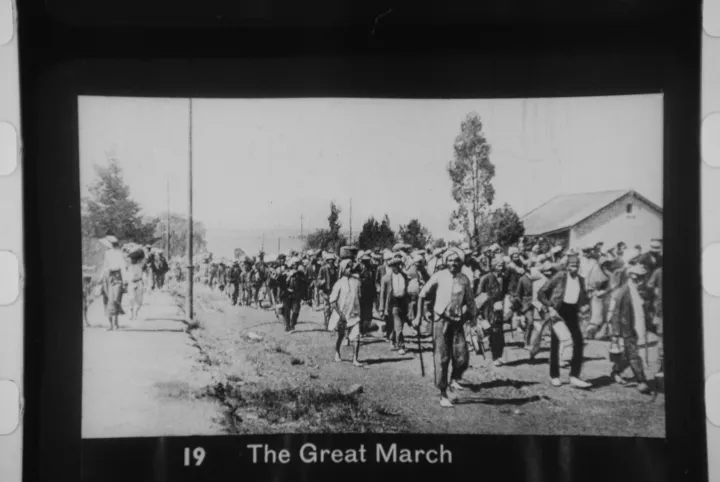
This was Gandhi's Great March in South Africa, seventeen years before the Salt March in India. The familiar story of one man walking at the head of a crowd can conceal the people who made this earlier campaign possible: striking miners, women who had already gone to prison, merchants providing supplies and organizers keeping families together on the road.
A tax that followed workers out of indenture
One grievance was the annual three-pound tax imposed on Indians who stayed in Natal after completing indentured service. Workers who had fulfilled their contracts still faced a financial penalty for remaining as free residents. Repeal had become a central demand, and the failure to obtain it brought the campaign directly into the coalfields around Newcastle.
A court judgment in March 1913 added another source of anger. Marriages conducted under Indian religious customs were denied legal recognition in circumstances that threatened the status of wives and children. Women joined the resistance, crossed provincial boundaries without the required permits and accepted imprisonment. Kasturba Gandhi was among them. Their intervention helped turn a dispute conducted through petitions and negotiations into a wider confrontation.
Newcastle, Charlestown, Volksrust
The miners' strike developed during October. Gandhi and other organizers traveled through the district, while supporters arranged food and places to sleep. November 6 marks the major border-crossing stage from Charlestown, rather than the first movement of every participant out of Newcastle. That distinction explains why accounts of the march also contain dates in late October.
Mani Bhavan's chronology records 2,037 men, 127 women and 57 children leaving at 6:30 in the morning. Numbers this precise came from the movement's own record keeping; they should not be read as a count of everyone who eventually joined the broader strike. At the border, officials confronted a deliberate breach of immigration restrictions carried out in public.
Gandhi was arrested that evening. He appeared in court at Volksrust the next day, obtained bail and rejoined the march. Another arrest followed at Standerton, and a third on November 9 removed him from the column. The marchers continued. A protest dependent entirely on its most recognizable leader would have ended much earlier.
The mines became part of the prison system
Repression reached beyond the men carrying warrants for Gandhi. Workers were forced back toward the mines, and the strike spread through other parts of Natal. Police violence, imprisonment and the treatment of laborers brought attention from India and Britain. South African History Online describes produce markets stalling, sugar mills closing and domestic workers leaving their jobs. The confrontation had become an economic crisis as well as a dispute over permits.
Negotiations and an official inquiry followed. The settlement of 1914 abolished the three-pound tax and provided legal recognition for Indian marriages within specified limits. Gandhi's own account of the legislation is careful about those limits: where a man had more than one wife, the act recognized only one marriage at a time.
A victory with a boundary of its own
The settlement did not establish racial equality in South Africa. It addressed particular Indian grievances inside a state that continued to enforce racial hierarchy. Nor did the workers' suffering disappear into the legal text. The march had demonstrated something practical: officials could remove leaders, but doing so would not automatically restore work in the mines or quiet the roads. That lesson traveled with Gandhi when he left South Africa in 1914.
Cover image: Mahatma Gandhi image archive, via Wikimedia Commons