
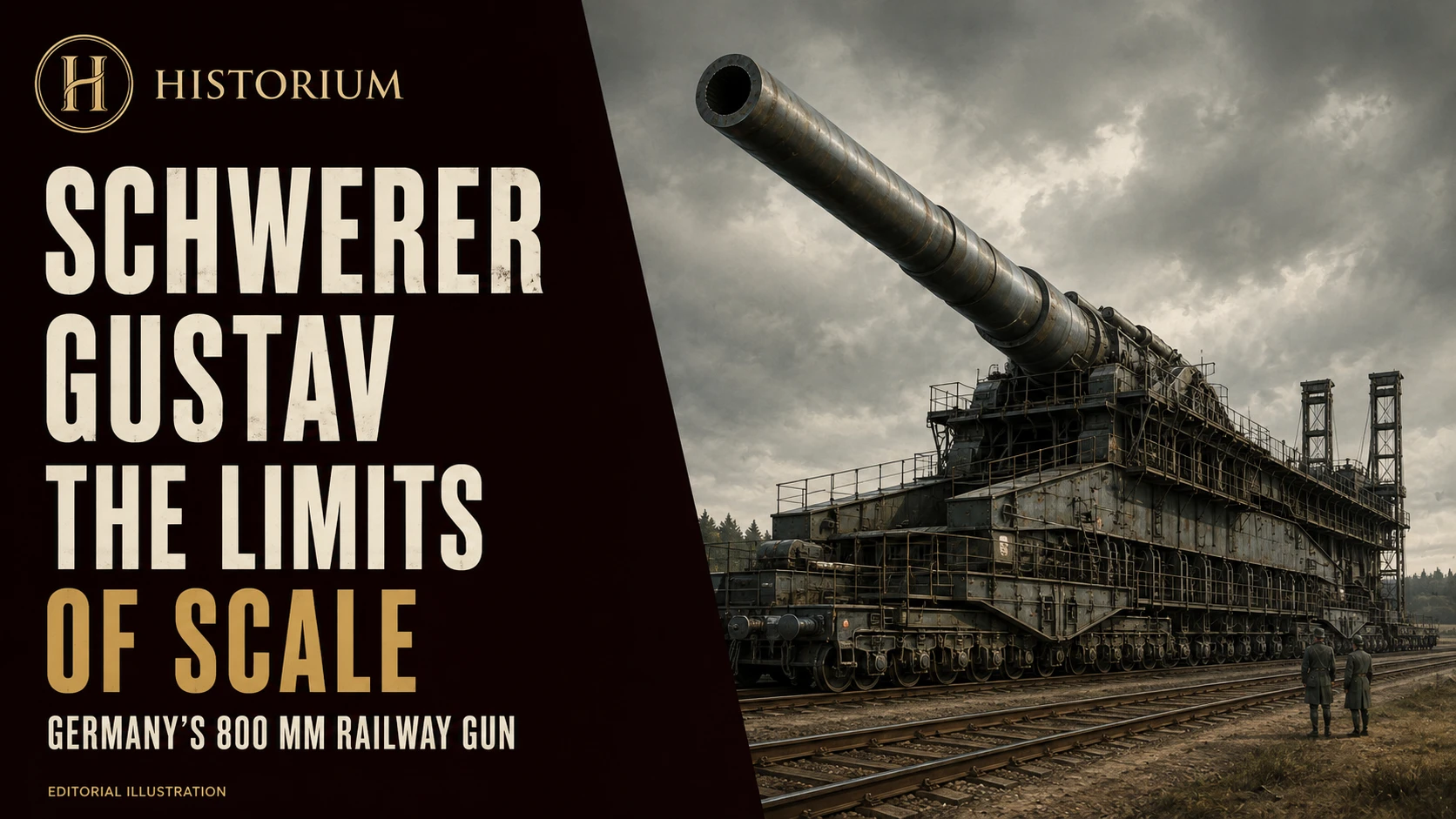

Schwerer Gustav invites a simple response: astonishment at the size of a gun. Yet size is only the beginning of its history. Understanding the weapon requires separate questions about what its designers wanted, how an army moved and operated it, and what happened when it finally entered battle. Those questions lead beyond a familiar photograph of a barrel towering over people.
Calling it the largest weapon ever made obscures those distinctions. A weapon can be compared by calibre, overall mass, range or destructive effect; those measurements do not describe the same achievement. Gustav is more usefully examined as an extraordinary attempt to solve a specific siege problem, with consequences for everyone required to support it.
Gustav and Dora in the records
Imperial War Museums catalogues a Krupp film containing the 80-centimetre Schwerer Gustav railway gun and identifies Dora as its German Army nickname. The catalogue describes a preparation scene with a mobile crane and an incompletely joined barrel, associated with proof firing in 1941. The IWM record identifies the weapon and the assembly context.
That description is a catalogue of film material, not evidence that every sequence shows combat. This matters when historical footage is edited into a modern documentary. A manufacturing or testing scene can explain a machine’s construction, but it should not silently become an image of that machine firing at a named city. The original caption is part of the evidence.
A fortress problem overtaken by events
The Bundeswehr’s artillery history places very heavy railway guns within attempts to attack strong fortifications, including the Maginot Line. It dates the order for Dora to 1937 and records an 800-millimetre calibre and a total weight of approximately 1,350 tonnes. Its historical overview describes that development and scale.
The French campaign followed a different course from the scenario imagined for a giant fortress-breaking gun. German forces crossed the Meuse at Sedan on 13 May 1940 and outflanked the Maginot Line. France’s defeat followed that summer. The National Army Museum explains the campaign’s movements. Gustav did not blast a route through the Maginot Line during that campaign.
The chronology is the important point. A military requirement belongs to the circumstances in which a project begins; a completed weapon arrives in circumstances that may have changed. It is therefore possible to build an impressive answer to a problem that the war has already approached by another route. Confusing design intention with actual service makes the weapon appear more decisive than the chronology supports.
The railway was part of the weapon
The Polish Army Museum explains that the gun travelled after being dismantled. At its firing position, it used two parallel railway tracks with a curved section: changing its horizontal direction involved moving the whole mounting along the curve. The museum gives an operating complement of 500 people. Its technical history separates transport, emplacement and operation.
These details explain why a railway gun cannot be understood simply as a large cannon placed on an ordinary train. The ground and track arrangement constrained where it could operate and where it could point. Preparation was part of achieving the firing position, not an incidental activity completed somewhere outside the weapon’s story.
Personnel figures need the same care. An operating complement is not interchangeable with everyone involved in construction, transport, supply, maintenance or security. A claim that thousands of men were needed “just to fire” compresses different kinds of work into one misleading image. The useful question is what a particular total includes, over what period, and for which stage of deployment.
Sevastopol: an identifiable combat setting
An original photograph in the Schleswig-Holstein State Archives is catalogued as showing German 11th Army soldiers loading the 80-centimetre Dora during the bombardment of Sevastopol, with an additional date of June 1942. Its reference is LASH, Abt. 2003.2, Nr. 3302. The archive record connects the loading scene to Operation Störfang.
This is a more precise foundation than an unlabelled image circulating under several names. It connects a particular activity, unit, place and campaign. It still does not establish what any individual shell struck, or how much that shot contributed to the outcome. Those are separate claims requiring separate evidence.
Sevastopol’s fall was a combined military operation. The Deutsches Historisches Museum describes German and Romanian formations attacking a heavily defended Soviet position after extensive air and artillery bombardment. It identifies the assault across Severnaya Bay on 29 June as a decisive development before the city’s capture. The museum’s campaign account places the siege artillery within the larger battle.
The same account records mass Soviet captivity and heavy losses among the attacking forces. A story concerned only with the gun’s dimensions leaves those people outside the frame. Sevastopol was not an empty proving ground. It was a defended city and naval base subjected to siege, and its capture cannot responsibly be assigned to a single spectacular machine.
What would count as success?
The Bundeswehr identifies Sevastopol in 1942 as Dora’s only combat deployment and questions the tactical return from such an extreme development. That judgment directs attention toward the relationship between resources and results, rather than the ability to manufacture something exceptionally large.
A useful assessment would compare verified target damage, preparation time, transport demands and the alternatives available to commanders. A photograph cannot supply that comparison. Nor does the eventual capture of a fortress prove that every weapon used against it was necessary to the result.
Gustav remains compelling because its visible scale makes normally hidden requirements easier to recognise. The tracks, cranes, workers, ammunition and time belong in the same history as the barrel. Looking at that whole system preserves the engineering achievement while making a more demanding historical judgment possible: what did this particular machine enable, at what cost, and how securely can we know?