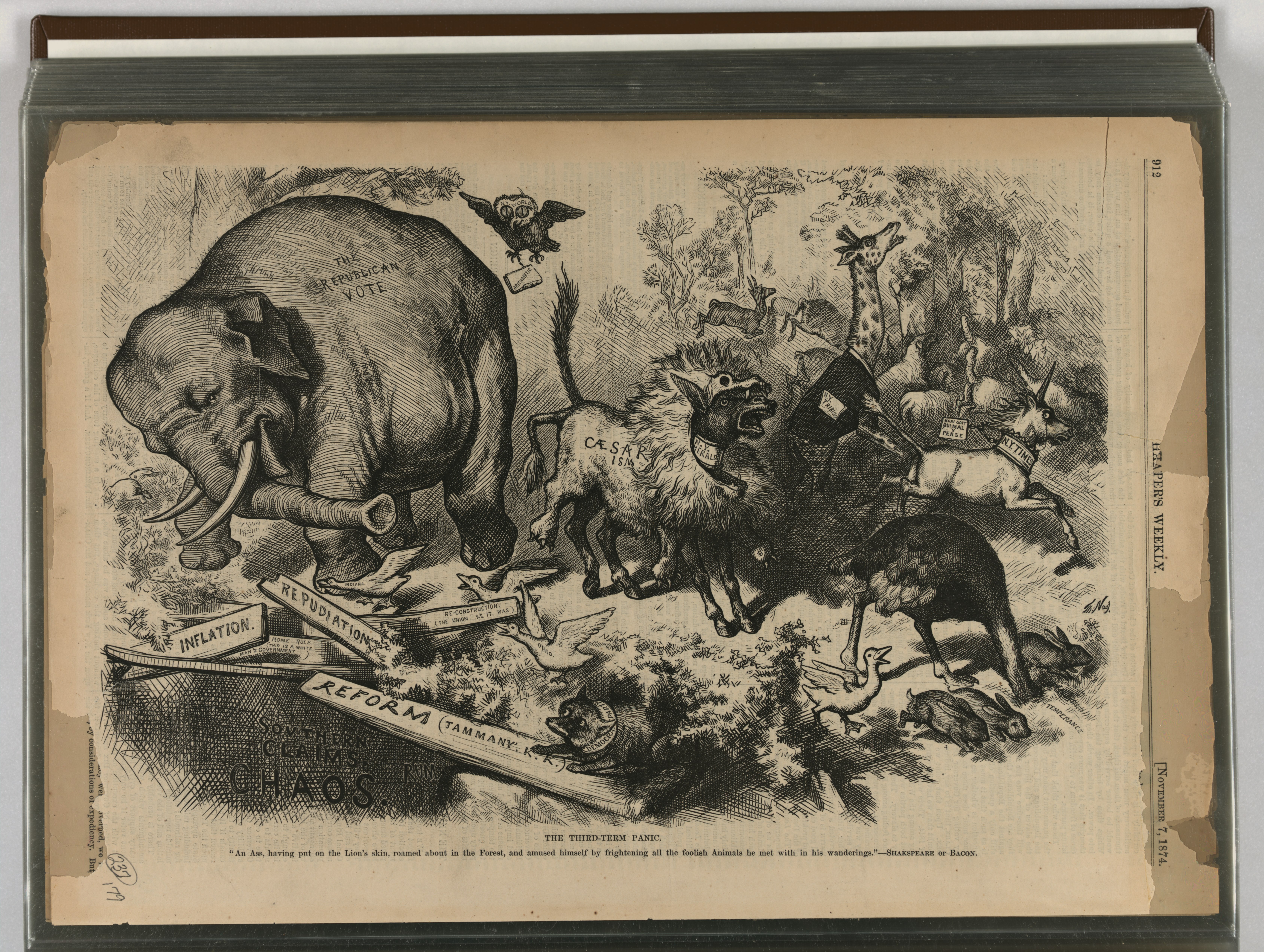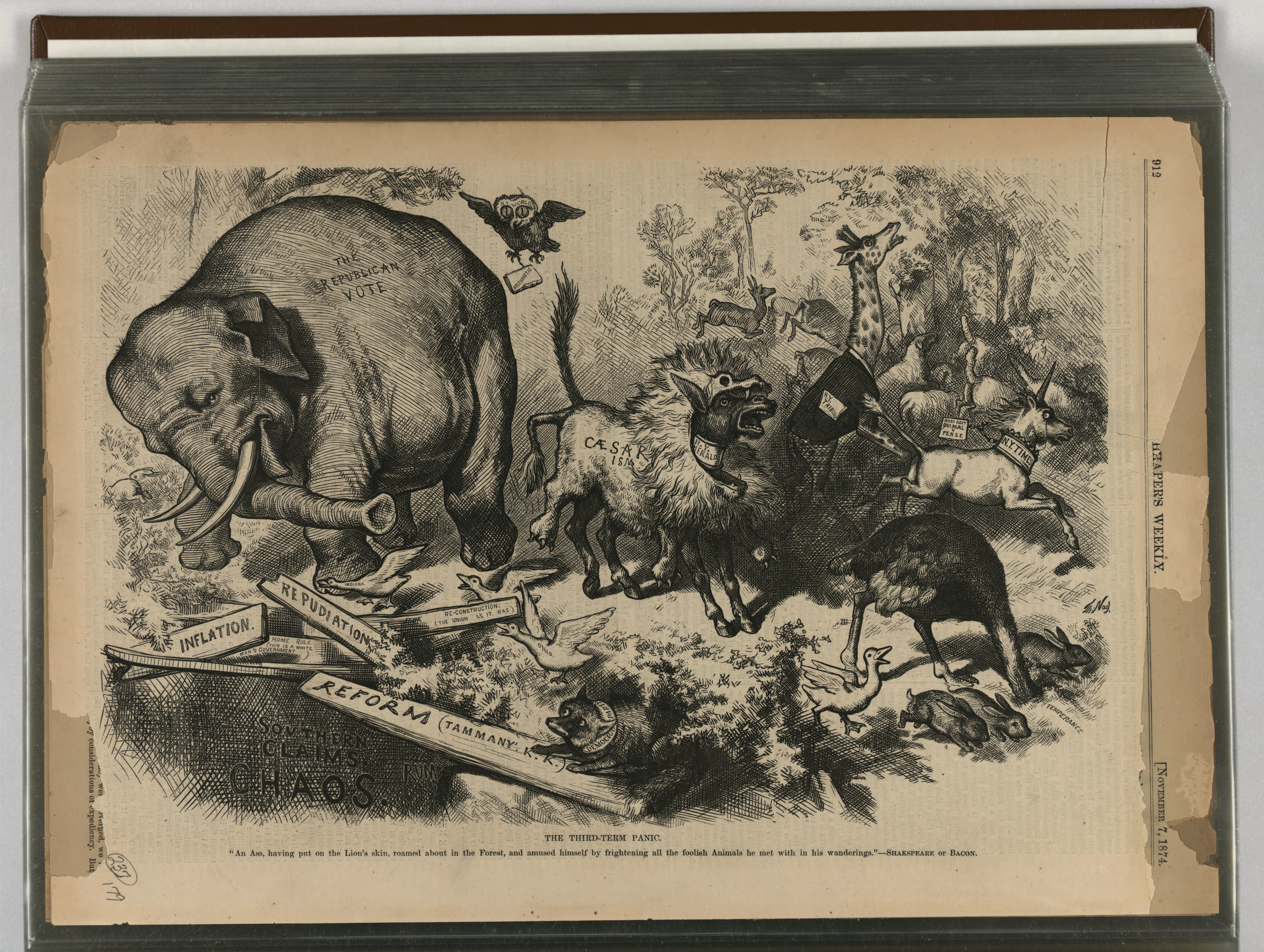
“The Third-Term Panic” appeared in the November 7, 1874 issue of Harper’s Weekly. Its elephant represented the Republican vote. The disguised donkey represented the New York Herald, a newspaper warning against the possibility of President Ulysses S. Grant seeking another term. The Democratic Party appeared elsewhere in the scene, as a fox.
A newspaper quarrel in animal form
Grant was serving his second presidential term. Discussion of a third raised fears that a successful military commander might cling to office. The Herald’s campaign against this prospect supplied Nast with his immediate subject. He turned an argument about presidential ambition into a scene of spreading alarm.
The animal labels make the press part of the joke. A giraffe stands for the New York Tribune, a unicorn for the New York Times and an owl for the New York World. These are competing voices, each given a body and a temperament. The lion’s skin exaggerates the Herald’s apparent strength; the donkey beneath it exposes what Nast thought of that performance.
The broken planks carry political words, including inflation and repudiation. They turn the familiar phrase “party platform” into something an elephant might actually fall through. The joke is visual, but reading the inscriptions changes its meaning. Remove them and the scene becomes a collection of frightened animals. Keep them and it becomes an argument about voters, newspapers and unreliable political footing.
Nast made the elephant memorable
November 7 is often described as the birthday of the Republican elephant. That is convenient shorthand, but too absolute. Ohio State University’s cartoon archive points to an elephant used by an Illinois newspaper during Abraham Lincoln’s 1860 campaign. Nast’s 1874 drawing was decisive in popularizing an association that had earlier precedents.
He continued to draw the animal, and other cartoonists adopted it. Repetition mattered. Readers learned to recognize a party before reaching the caption. The elephant could appear powerful, dignified, clumsy or frightened, depending on the situation. A useful political symbol had to carry criticism as well as praise.
Nast himself was a Republican, rather than an observer standing outside the contest. His elephant was not simply a compliment to his own side. In this drawing its size cannot protect it from panic or bad footing. A supporter could still mock the people and policies he wanted to succeed.
A larger menagerie
The donkey also had a political history before Nast. Ohio State traces Democratic uses back to Andrew Jackson’s presidency. Nast helped strengthen that association with his January 15, 1870 cartoon “A Live Jackass Kicking a Dead Lion.” There, the donkey was labeled for the Copperhead press; the dead lion represented former war secretary Edwin Stanton.
His animals did not always have fixed identities. The 1874 donkey was a particular newspaper, while the fox carried the Democratic label. Five years later, “Stranger Things Have Happened” placed a Democratic donkey and Republican elephant together in another uncertain political landscape. That later image is closer to the pairing audiences recognize today.
These cartoons were arguments before they became historical illustrations. Their exaggerations, labels and loyalties belong to the evidence. The elephant that survived was no neutral logo devised at a party office. It grew out of partisan drawing, newspaper rivalry and an artist’s ability to make a complicated quarrel readable at a glance.
Cover image: Thomas Nast / Library of Congress, ppmsca.15785. Public domain; copyright expired