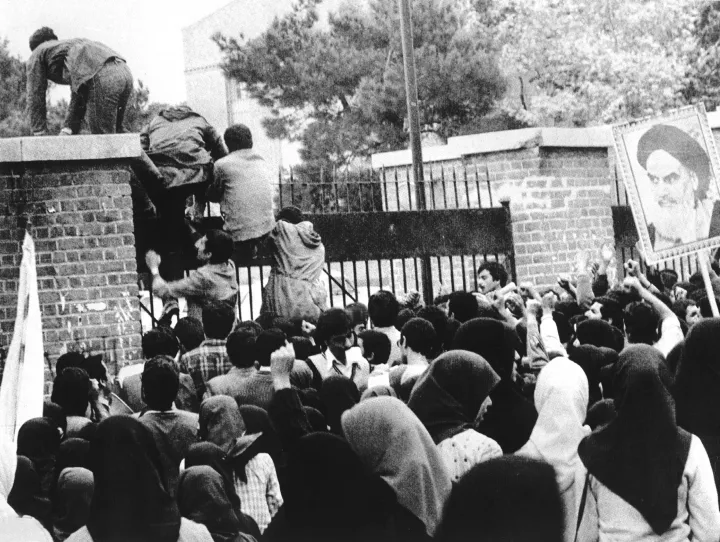
The shah’s shadow
Iran’s monarchy had collapsed earlier that year. Mohammad Reza Shah Pahlavi left the country in January, and Ayatollah Ruhollah Khomeini returned from exile in February. The shah’s departure did not settle who would control the new political order. Rival groups competed to define the revolution and its relationship with the outside world.
For many opponents of the monarchy, Washington was inseparable from the shah’s rule. American and British involvement in the 1953 overthrow of Prime Minister Mohammad Mosaddeq remained an especially potent memory. That history helped make accusations of another American intervention persuasive, even though evidence assembled by the National Security Archive shows a much weaker American position in Iran in 1979.
On October 22, the Carter administration admitted the ailing shah to the United States for medical treatment. The decision became the immediate justification for the embassy seizure. Khomeini endorsed the hostage-taking. His support transformed the students’ occupation into a crisis that could not be resolved simply by asking the Iranian government to clear the building.
Diplomacy under captivity
President Jimmy Carter’s November 6 letter to Khomeini asked for the Americans’ release and proposed discussions through two emissaries. The letter’s language stressed safety, international law and relations based on mutual respect. It gives a close view of the administration’s first problem: how to open a channel to an authority that was benefiting politically from the confrontation.
The captives included diplomats, other embassy personnel and Marine guards. Their circumstances were not identical, and the number held changed. Thirteen were released in November 1979. Richard Queen, who became seriously ill, was freed in July 1980. Fifty-two remained until the crisis ended. Six other Americans who had escaped capture left Iran in January 1980 with Canadian assistance; their escape did not free those still imprisoned.
At home, the captives’ families lived with repeated uncertainty while news coverage counted the days. For the administration, every proposed response had to take their safety into account. Diplomatic pressure and economic measures offered no quick way to compel the captors.
A rescue attempt ends in the desert
On April 7, 1980, Carter announced new sanctions and the break in diplomatic relations. Later that month he authorized a military rescue operation, Eagle Claw. The plan required helicopters and transport aircraft to meet at a remote desert staging point before the rescue force could move toward Tehran.
Mechanical problems and difficult flying conditions left too few usable helicopters. Commanders canceled the mission. During withdrawal, a helicopter collided with a transport aircraft, killing eight American servicemen. No hostages were rescued. Secretary of State Cyrus Vance, who had opposed the operation, resigned. The failure exposed both operational weaknesses and the administration’s deep disagreement over how force could be used.
Freedom after 444 days
Negotiations continued. Algerian intermediaries helped secure the agreement signed on January 19, 1981. The following day, the remaining 52 hostages were released, shortly after Ronald Reagan took the presidential oath. Their captivity had lasted 444 days.
Medical care in West Germany preceded the journey home. Families gathered at Stewart Field, New York, on January 25; a White House reception followed two days later. The photographs changed from confinement to reunion, but the rupture was enduring. The embassy seizure had helped consolidate Iran’s revolutionary leadership while leaving American officials and the public with a defining memory of the new Islamic Republic.
Cover image: Photographer unrecorded; Shiraz University historical collection, via Wikimedia Commons. Public domain in Iran under the photographic-work term.