
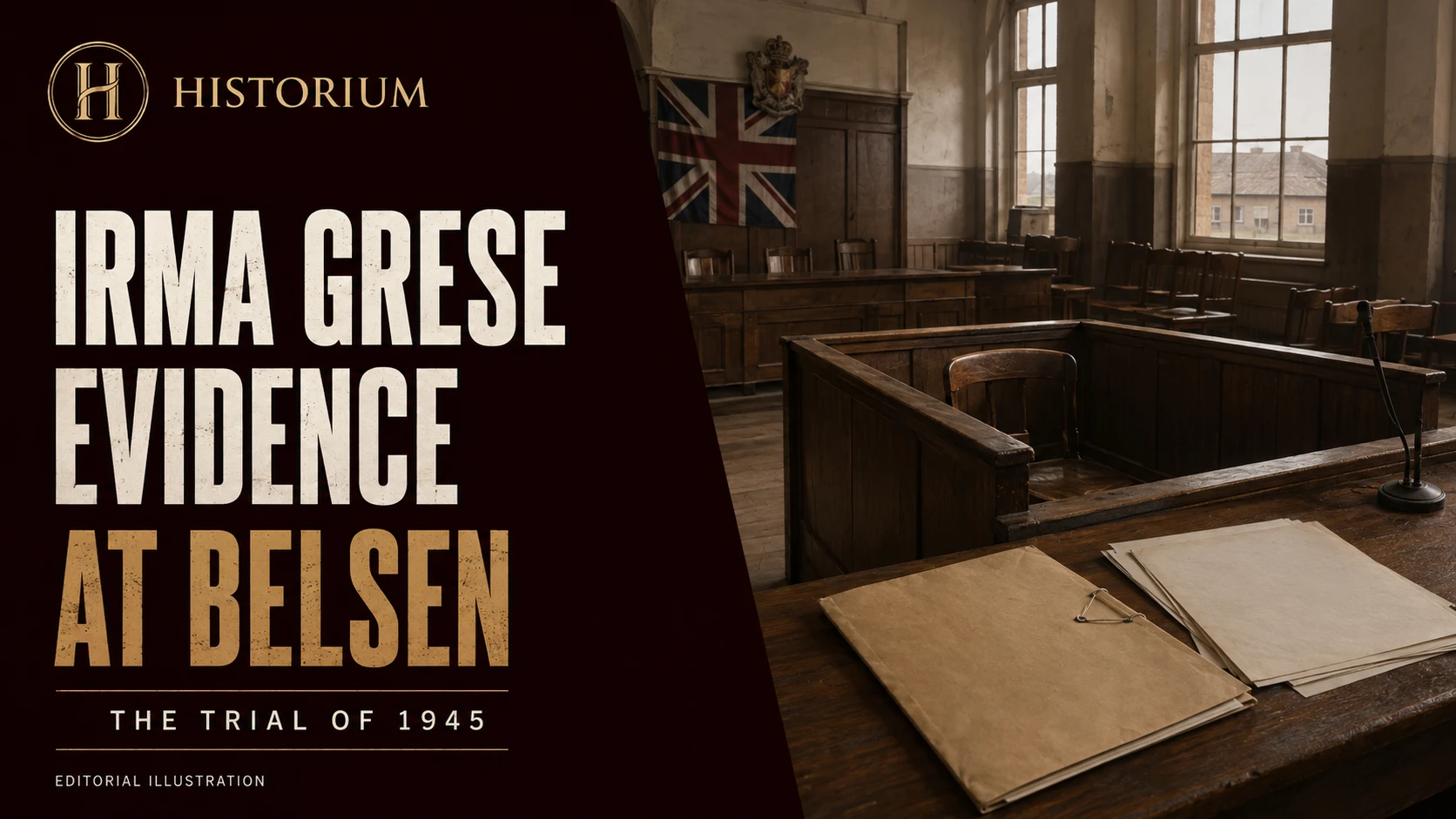

Irma Grese became one of the most widely publicized defendants in the first Belsen trial of 1945. She was a female concentration camp guard whose responsibility for crimes at Auschwitz and Bergen-Belsen was examined by a British military court. The historical importance of her case lies in that evidence and its outcome, rather than in the dramatic nicknames attached to her.
An account centered on appearance, supposed private desires or a sensational personal death toll can obscure the questions the records allow us to answer: what authority did a guard exercise over prisoners, what did witnesses describe, and what did the court find proved?
Why One Trial Examined Two Camps
The proceedings began in Lüneburg on 17 September 1945. They were conducted by the British Army under the Royal Warrant governing war crimes trials. They were separate from the International Military Tribunal at Nuremberg. The USHMM account of the Belsen trial explains that the defendants included camp personnel and prisoner functionaries, and that some faced charges concerning Auschwitz as well as Bergen-Belsen.
The overlap reflected the movement of both prisoners and personnel between camps. Many survivors liberated at Belsen had arrived relatively recently after enduring imprisonment elsewhere. Their experiences could not be contained within the history of a single location. A trial bearing Belsen’s name therefore also brought evidence about Auschwitz before the public.
The Catastrophe at Bergen-Belsen
The Bergen-Belsen Memorial’s history describes a camp whose functions changed. The SS established an exchange camp for Jewish prisoners in 1943; additional sections later held sick prisoners and women transferred from other camps. Evacuation transports from camps near advancing fronts brought enormous numbers of people to Belsen in the last months of the war.
British troops liberated the camp on 15 April 1945 and found tens of thousands of critically ill prisoners. Hunger, disease and the effects of imprisonment continued to kill after liberation. The Memorial estimates that at least 52,000 concentration camp prisoners died in the camp or from the immediate consequences of their confinement.
That is a figure for the camp and its aftermath. It is not a count of people personally killed by Grese. The suffering resulted from a system involving many officials, guards and decisions; establishing one person’s responsibility requires evidence about that person.
What the Record Says About Grese
The United Nations War Crimes Commission’s published trial report preserves prosecution evidence, defense arguments and the verdict. Survivor Ilona Stein described Grese’s participation in selections at Auschwitz, repeated beatings and prolonged roll calls at Belsen. Stein also distinguished what she saw from what she inferred: in one shooting incident, she saw Grese speak to a guard but did not hear the words.
The defense challenged identifications, particular allegations and the extent of Grese’s authority. The judge advocate explained that mere presence on a camp staff did not automatically establish guilt; the court had to consider knowing participation in criminal conduct. The court found Grese guilty on both the Auschwitz and Belsen charges.
These distinctions matter. A conviction establishes the outcome of the charges considered. It does not convert every allegation repeated afterward into a separately proven fact, and it does not supply an exact total of victims attributable to an individual guard.
How Witnesses Became Evidence
The National Archives preserves a different survivor’s sworn statement by Dora Almaleh, dated 13 June 1945. Almaleh identified another female guard using a numbered photograph and described a particular incident involving a working party carrying vegetables. Her statement is not evidence about Grese, and should not be presented as though it were.
Its value here is showing the work behind a prosecution: identifying a person, naming a place, describing an action and recording the statement formally. Moving from a general picture of camp brutality to a case against a named defendant required those connections. Keeping witnesses and accused people correctly paired also respects the specificity of survivors’ experiences.
A National Archives trial photograph of women guards, catalogued under WO 235/19, is another kind of record. It documents the defendants’ presence in a courtroom setting. A photograph alone cannot tell us what each person did inside a camp. Its caption and relationship to the case files are essential.
The Courtroom and the Public Image
The Bergen-Belsen Memorial’s account of the prosecutions describes extensive German and international reporting. After two months of proceedings, the court issued eleven death sentences, prison terms and fourteen acquittals. Those different outcomes show why the trial needs to be read as a set of individual cases within a shared history.
A contemporary newsreel report preserved by the Bundesarchiv and presented by the German Historical Institute shows how the proceedings reached audiences outside the courtroom. Such films were edited accounts, with commentary directing viewers’ attention toward particular defendants. They preserve the public presentation of justice as well as images of the trial itself.
In an Imperial War Museums discussion of liberation and its representation, historian James Bulgin identifies the gendered language used in British coverage of female perpetrators. Repeating that framing can make a guard seem historically significant because she violated expectations about women. Attention to her conduct, power and victims gives a firmer explanation of why her case matters.
Sentence and Historical Responsibility
Grese was sentenced to death and executed at Hamelin prison on 13 December 1945. Her execution should not become a spectacle that displaces the people whose suffering the trial investigated. Nor does the seriousness of her conviction need an unsupported claim that she personally killed thousands.
The surviving records allow a direct account of responsibility: a guard wielded power over prisoners; witnesses described how that power was used; a court heard competing arguments and convicted her. Reading those records carefully preserves the force of that conclusion while keeping sensational additions out of the history.