

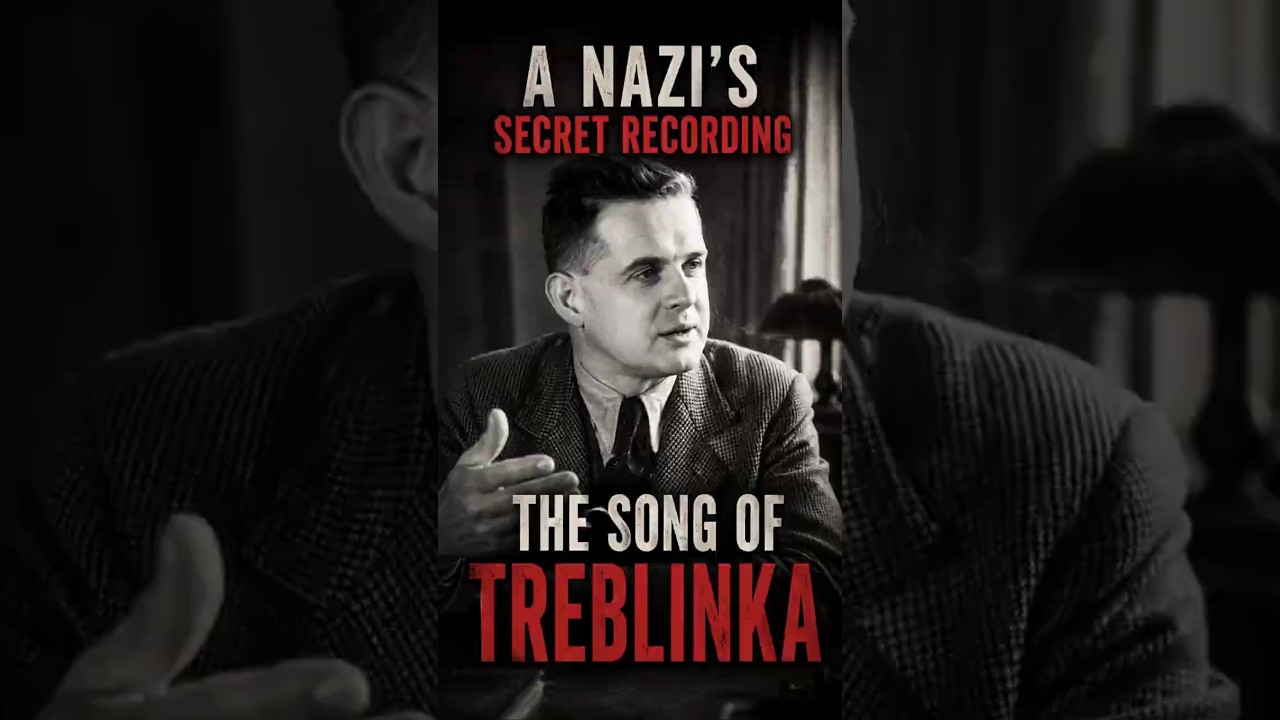
A man sits in front of an interviewer and speaks about his former workplace.
His voice is calm. His language is practical. At one point, he even begins to sing.
Yet the place he is describing was Treblinka—one of Nazi Germany’s most lethal extermination centers—and the song had been forced upon Jewish prisoners living under the constant threat of death.
The man was Franz Suchomel, a former SS noncommissioned officer who served at Treblinka. He did not realize that filmmaker Claude Lanzmann and his crew were secretly capturing his face and words.
The result became one of the most unsettling sequences in Shoah, Lanzmann’s monumental documentary about the Holocaust.
Who Was Franz Suchomel?
Franz Suchomel was not one of the most famous figures in the Nazi leadership. He was not a camp commandant, senior general, or architect of national policy.
He was an SS-Unterscharführer—a junior noncommissioned officer—and that relative ordinariness is part of what makes his story so disturbing.
Suchomel served at Treblinka II, the extermination center constructed in occupied Poland as part of Operation Reinhard. Unlike Treblinka I, which operated as a forced-labor camp, Treblinka II was created primarily for the mass murder of human beings.
The SS established Treblinka alongside Bełżec and Sobibór as part of the plan to murder the Jewish population of German-occupied Poland. According to the United States Holocaust Memorial Museum, personnel at Treblinka murdered an estimated 925,000 Jews, as well as an unknown number of Roma, Poles, and Soviet prisoners of war.
Suchomel worked around arriving transports and later supervised prisoners assigned to collect and sort money, gold, jewelry, and other property stolen from victims. The prisoners forced to perform this work were sometimes referred to by the SS as the “Gold Jews.” The label did not grant them status or protection; it identified the task they had been compelled to carry out inside the machinery of extermination.
Claude Lanzmann and the Making of Shoah
French filmmaker Claude Lanzmann began developing what would become Shoah during the 1970s. Rather than constructing a conventional historical documentary from wartime newsreels, photographs, and narrated summaries, he built the film around testimony.
He interviewed survivors, local witnesses, railway workers, historians, government officials, and former Nazi perpetrators. The finished film, released in 1985, runs for more than nine hours and deliberately contains no historical archive footage. Instead, it confronts the past through living voices and contemporary images of the places where the crimes occurred.
The complete project generated far more material than could appear in the finished film. The digitized outtakes preserved in the Claude Lanzmann Shoah Collection include approximately 185 hours of interviews and 35 hours of location footage.
Convincing former perpetrators to speak openly, however, presented a serious problem. Some refused to appear on camera. Others agreed to talk only if they believed their identities would remain concealed.
Lanzmann responded by using hidden-camera technology.
How Suchomel Was Secretly Filmed
Lanzmann secretly recorded Franz Suchomel in Austria in March 1976. The interview lasted approximately four and a half hours.
According to the official collection catalogue, this was Lanzmann’s first interview filmed with a newly developed miniature camera known as the Paluche. Lanzmann used an alias and paid Suchomel 500 German marks for the conversation.
The Paluche could be concealed while transmitting images to recording equipment located elsewhere. Only a small number of these cameras existed at the time, and Lanzmann later used similar methods to record other former Nazi perpetrators who would not knowingly appear on film.
Suchomel believed that he could speak without being publicly identified. In the finished sequence, the imperfections of the hidden recording remain visible. The image is degraded and unstable, but that visual quality strengthens the scene rather than weakening it.
The viewer is not watching a carefully staged confession. The camera captures a man who believes he controls the conditions of the conversation.
“An Assembly Line of Death”
During the interview, Suchomel described Treblinka as primitive when compared with the larger complex at Auschwitz.
But he added that it was a “well-functioning assembly line of death.”
The phrase is horrifying because it transforms murder into a question of organization and efficiency. Human beings disappear behind the language of transport schedules, labor assignments, processing areas, stolen property, and capacity.
Suchomel did not describe Treblinka with the language of grief. He spoke with the vocabulary of someone recalling how a workplace functioned.
That does not make his testimony neutral or fully reliable. Perpetrator testimony must always be read critically. Former participants could minimize their own responsibility, deny specific acts, shift blame to superiors, or portray themselves as unwilling parts of the system.
Yet Suchomel’s attempts to explain himself are historically valuable for precisely that reason. They reveal not only what he remembered but how a former perpetrator attempted to place himself within the memory of the crime.
The Property Stolen From Treblinka’s Victims
The killing process at Treblinka was accompanied by systematic robbery.
Victims arriving at the camp were deprived of money, jewelry, clothing, documents, and personal possessions. These items were collected, inspected, sorted, and transferred under SS supervision.
Suchomel described his position as the German responsible for the prisoners forced to handle valuables. He was therefore not merely observing the system from a distance. His work was connected to the conversion of murdered people’s belongings into property of the Nazi state.
This detail is important because the theft was not incidental to the killing process. Dehumanization, murder, and economic exploitation were interconnected.
Objects that had carried private meaning—a wedding ring, a family keepsake, a small amount of savings—were stripped of their histories and reduced to categories of material value.
The Song of Treblinka
One of the most unforgettable moments in the interview occurs when Lanzmann asks Suchomel about the song imposed upon prisoners at Treblinka.
According to the USHMM archive description, prisoners were required to sing it in the morning and evening. At Lanzmann’s urging, Suchomel performs the song twice.
Its melody sounds almost cheerful, like a simple military or workers’ march. Its words center on the commandant, obedience, duty, labor, and continuing to work.
Placed outside its historical setting, it might sound merely regimented.
Inside Treblinka, it meant something entirely different.
The people ordered to sing were prisoners trapped inside an extermination center. Many had been selected from arriving transports to carry out forced labor connected to the killing process. Their continued survival was temporary and could end at any moment.
The song therefore functioned as more than camp discipline. It imposed a performance of order and enthusiasm upon people surrounded by terror. They were required to sing about duty and labor inside a place created to destroy them.
Decades later, Suchomel reproduced that melody in front of Lanzmann’s concealed camera.
The moment is disturbing not because he shouts, threatens, or openly celebrates the crime. It is disturbing because the song appears to remain accessible in his memory as part of the camp’s ordinary routine.
What the Recording Does—and Does Not—Show
The Suchomel footage is sometimes described as a confession. That word should be used carefully.
A confession normally suggests direct acceptance of guilt, responsibility, and moral recognition. Suchomel provides information, admits his presence, and describes elements of Treblinka’s operation. But the recording does not present a simple moment of remorse.
Instead, it preserves something more complicated.
Suchomel shifts between description, self-justification, recollection, and emotional distance. He speaks as both a source of evidence and a man attempting to manage how his own role will be understood.
The camera records not only the history he describes but the language through which he tries to survive that history.
Why the Hidden Recording Still Matters
Much of Treblinka was dismantled by the Germans in 1943 as they attempted to erase evidence of the extermination center. Buildings were destroyed, the ground was altered, and the site was disguised.
As a result, the surviving historical record depends heavily on documents, postwar investigations, testimony from survivors, witnesses, and perpetrators, and the physical traces that remained.
Lanzmann’s recording does not replace the voices of Treblinka’s victims or survivors. Nor should a perpetrator’s account be allowed to dominate the history of the camp.
Its importance lies elsewhere.
The footage shows how an individual who participated in a system of mass murder could remember its procedures decades later with remarkable calm. Suchomel’s language exposes the administrative mentality that allowed people to treat extermination as a set of tasks to be completed.
The terror of the recording is not the presence of an obviously theatrical monster.
It is the presence of an apparently ordinary man discussing an extraordinary crime in ordinary language.
A Voice Preserved Against Oblivion
Claude Lanzmann’s hidden camera captured more than the face of a former SS guard.
It preserved the tone of his voice, his gestures, his pauses, his vocabulary, and the song that prisoners at Treblinka had once been forced to perform.
The recording offers no comforting conclusion. It does not show justice fully achieved or guilt honestly confronted.
Instead, it leaves the viewer with a more difficult historical truth: systems of mass murder were maintained not only by famous leaders, but by individuals who converted cruelty into procedure, theft into administration, and death into routine.
Suchomel spoke because he believed the camera could not see him.
History remembers him because it could.