


Correction — 6 September 2026: The prisoner-ship list has been corrected to Cap Arcona, Thielbek and Athen. Athen ferried prisoners to Cap Arcona, later took some back and avoided the main raid while in port. The RAF attack targeted suspected German military movements; it was not a rescue flight. Approximately 7,000 prisoner deaths is an estimate for the catastrophe involving Cap Arcona and Thielbek, not a verified total for Cap Arcona alone. The SS's ultimate intentions remain unresolved. (ship documents; attack and estimate; historical uncertainty)
In the chaotic twilight of World War II, as the Third Reich crumbled and Allied forces advanced deep into Germany, the Baltic Sea became the stage for one of the most devastating—and overlooked—maritime tragedies in human history.
On 3 May 1945, British aircraft attacked ships in Lübeck Bay, killing thousands of concentration-camp prisoners. The operation aimed to prevent German military units from withdrawing across the Baltic. The approaching defeat of Nazi Germany did not make this air strike a rescue mission. (Neuengamme Memorial)
The Final Days of Neuengamme
As Allied troops approached in April 1945, the SS evacuated Neuengamme and its satellite camps. Thousands of prisoners were forced towards Lübeck and confined aboard ships. Their removal from the camps is documented; what the SS ultimately intended to do with those held on the ships remains unresolved. (Memorialmuseums)
Thousands of emaciated, sick, and exhausted prisoners from over two dozen nations were forced onto death marches or packed into freight trains heading toward the coastal town of Lübeck. Their ultimate destination was not freedom, but a fleet of requisitioned ships anchored in the Bay of Lübeck.
Floating Prisons in the Baltic
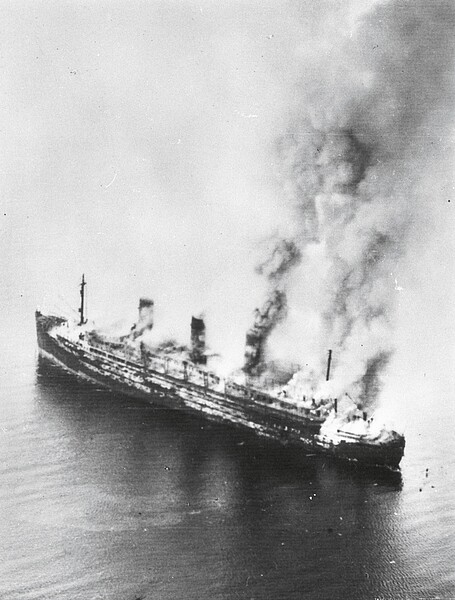
Among the vessels seized by the SS was the Cap Arcona, a once-glamorous 27,500-ton ocean liner that had been the pride of the German merchant fleet. Once known as the "Queen of the South Atlantic," the ship was stripped of its luxury and transformed into a floating concentration camp.
The prisoner transports involved Cap Arcona and the freighters Thielbek and Athen. Athen carried prisoners out to Cap Arcona and later took some back from the overcrowded liner. More than 9,000 prisoners were held across these ships before the attack, with little food or water. On 3 May, Athen was in Neustadt harbour and escaped the main raid. It must not be confused with Deutschland in the account of these prisoner transfers. (Neuengamme archival documents; memorial overview)
The Fatal Miscalculation
British operations in the Baltic were intended to block the movement of German military forces. The attack on the ships in Lübeck Bay took place within that campaign. (Neuengamme Memorial)
The Neuengamme Memorial records that British aircraft attacked the ships after mistaking them for German troop transports. Cap Arcona and Thielbek were instead carrying thousands of concentration-camp prisoners. Their destruction must be distinguished from the subsequent liberation and rescue of survivors. (Neuengamme Memorial)
The Attack of May 3, 1945
In the early afternoon of May 3, squadrons of British Hawker Typhoon fighter-bombers descended upon the Bay of Lübeck. Armed with 60-pound high-explosive rockets and 20mm cannons, they unleashed a devastating barrage on the unflagged ships.
The Thielbek, struck multiple times, sank in a mere 20 minutes. The massive Cap Arcona was engulfed in flames and eventually capsized in the shallow waters. For the prisoners locked below deck, escape was nearly impossible. Those who miraculously managed to reach the burning decks and jump into the freezing waters faced another horror: SS guards on the shore, and in some cases, the strafing aircraft themselves, fired upon the survivors struggling in the water.
A Tragic Legacy
Approximately 7,000 prisoners died in the catastrophe involving Cap Arcona and Thielbek; only a few hundred survived. This is an estimate, not a verified total for Cap Arcona alone. Published memorial accounts differ: Neuengamme's 2023 exhibition uses a figure close to 7,000, while Memorialmuseums describes more than 6,000 deaths. (Neuengamme Memorial; Memorialmuseums)
The profound irony of the Cap Arcona tragedy makes it one of the most heartbreaking footnotes of the Second World War. These individuals had survived years of unimaginable cruelty, starvation, and forced labor in the worst camps on Earth. They had held onto hope, only to be killed by a tragic mistake of their liberators, practically on the eve of peace.
Germany officially surrendered on May 8, 1945—just five days later.
For decades, the tragedy of the Cap Arcona remained shrouded in the shadows of the broader war narrative. At Historium, we believe that true history is found not just in the triumphs of victory, but in the devastating realities of war. The thousands of lives lost in the Bay of Lübeck serve as a haunting reminder of the chaotic, indiscriminate, and tragic nature of human conflict.