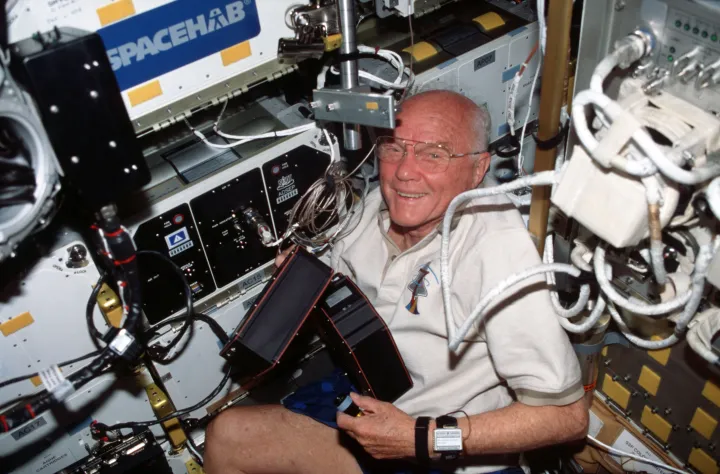
Television cameras naturally followed the oldest person then to fly in space. Inside the shuttle, his job was more specific: serve as a payload specialist, carry out experiments and allow researchers to measure how his body responded to weightlessness. The flight brought a familiar face back into orbit, but the spacecraft around him showed how much human spaceflight had changed.
Thirty-six years between launches
On February 20, 1962, Glenn had circled Earth three times in Friendship 7, becoming the first American to reach orbit. Alan Shepard and Virgil Grissom had flown earlier suborbital missions; the Soviet Union's Yuri Gagarin had completed the first human orbital flight the previous year. Those distinctions mattered in a competition in which every milestone carried political weight.
Friendship 7's return was tense. A signal raised doubts about whether its heat shield was secure, and controllers told Glenn to keep the retrorocket package attached during reentry. He splashed down safely. The mission made him a national figure, and NASA's later history describes an institution reluctant to risk losing him on another flight.
Glenn left the astronaut corps in 1964 and eventually represented Ohio in the U.S. Senate for four terms. Spaceflight stayed unfinished business. He pressed NASA Administrator Daniel Goldin to consider a return, proposing that an older astronaut could contribute to research on physiological changes.
A laboratory with seven people aboard
NASA announced Glenn's assignment in January 1998. The agency required him to meet the medical standards for the flight and included research developed with the National Institute on Aging. Months of preparation followed. Photographs of countdown rehearsals and suit training belong to that preparation; they should not be mistaken for launch-day scenes.
Discovery lifted off from Kennedy Space Center's Pad 39B on October 29. Curtis Brown commanded the mission and Steven Lindsey served as pilot. Scott Parazynski, Stephen Robinson and Spain's Pedro Duque were mission specialists. Japan's Chiaki Mukai joined Glenn as a payload specialist. Their work included life sciences, materials research and astronomy.
The crew released and later recovered the Spartan solar-observing spacecraft. Other equipment tested hardware associated with the Hubble Space Telescope. The Spacehab laboratory gave the astronauts additional working room, reached through a tunnel from the shuttle's middeck. Glenn's presence drew attention to the mission, but its schedule belonged to the whole crew.
What one older astronaut could show
Researchers were interested in changes involving sleep, balance, muscles, bones and immune function. Some effects of weightlessness resemble changes associated with aging. That resemblance offered questions worth testing; it did not make a spaceflight equivalent to aging on Earth.
There was another obvious limit. Glenn was one carefully screened participant, with an unusual medical and professional history. His results could add observations and help researchers formulate questions. They could not, on their own, describe how every person in their seventies would respond to orbit.
Discovery landed in Florida on November 7. Medical measurements continued after the astronauts returned to gravity, because recovery was part of what the investigators wanted to understand. Glenn's second flight ended on a runway, more than 36 years after his first had ended in the Atlantic. Between those two landings lay the distance from a single-seat Cold War demonstration to an international research crew at work.
Cover photograph: NASA, STS095-325-013 / KSC-JohnGlenn-0016. Public domain. Source: NASA archive record, linked below.