The explanation was painfully ordinary. The controls that moved the tail had remained locked for takeoff. A device meant to protect the aircraft while it sat on the ground had helped destroy it in the air.
A much larger bet
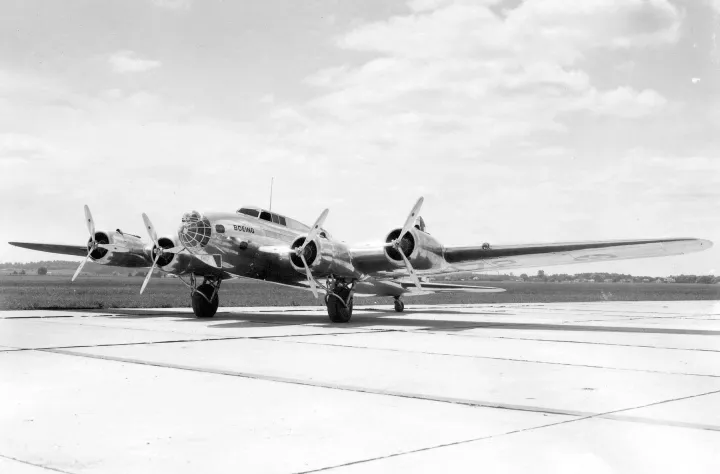
Boeing had built Model 299 as its contender for a new Army Air Corps bomber. It first flew at Seattle on July 28, 1935. Four engines, a substantial bomb load and multiple defensive gun positions gave it an imposing appearance. The name Flying Fortress attached itself to the design before the familiar wartime B-17 existed.
The aircraft then flew across the country to Wright Field. Army officers interested in long-range bombardment saw considerable promise in it. The competition mattered to Boeing as a business, but it also mattered to airmen arguing that bombers should reach farther and carry more than the machines already in service.
The people inside
Major Ployer P. Hill, chief of Wright Field’s Flying Branch, was at the controls on October 30. Lieutenant Donald L. Putt was copilot. Boeing test pilot Leslie Tower, who had flown the prototype from Seattle, was also aboard, along with observer John Cutting and mechanic Mark Koogler.
An Air Corps account written soon after the accident describes rescuers struggling to free Hill and Tower from the burning cockpit. Cutting and Koogler escaped from the cabin; Putt also got out. Hill died within hours. Tower initially survived and gave evidence about the flight, but later died from his burns. The eventual death toll was two, not an entire crew.
What the investigators found
The inquiry’s findings, dated November 15, ruled out failure of the structure, engines, flight-control surfaces or automatic pilot. Instead, investigators identified locked rudder and elevator controls, with the elevator especially decisive. The position of the locks in the wreckage, survivor testimony and observations from the ground supported that conclusion.
A gust lock prevents control surfaces from moving in the wind while an aircraft is parked. Before flight, it has to be released. Model 299 allowed that operation from the cockpit. On this takeoff, several experienced men failed to catch the omission. Skill and familiarity with aviation were not the same as a dependable routine for this particular aircraft.
A bomber program survives
The crash cost Boeing the competition, but it did not end the design. The Army later acquired a small group of improved aircraft for service testing, leading toward the B-17 that would fight in World War II. That later bomber was repeatedly modified; the prototype in the wreck photographs should not be mistaken for the heavily armed B-17G of the wartime production line.
The accident also became a landmark in the adoption of cockpit checklists. Written checks gave crews an agreed sequence and made essential actions less dependent on one person remembering everything. The lesson was neither that pilots lacked ability nor that complexity had to stop increasing. Procedures had to develop with the machines.
Model 299 left two legacies: a family of bombers and a lasting argument for checking the obvious. At Wright Field, the overlooked step had been small. Its consequences were not.
Cover photograph: U.S. Air Force / National Museum of the U.S. Air Force; public domain.