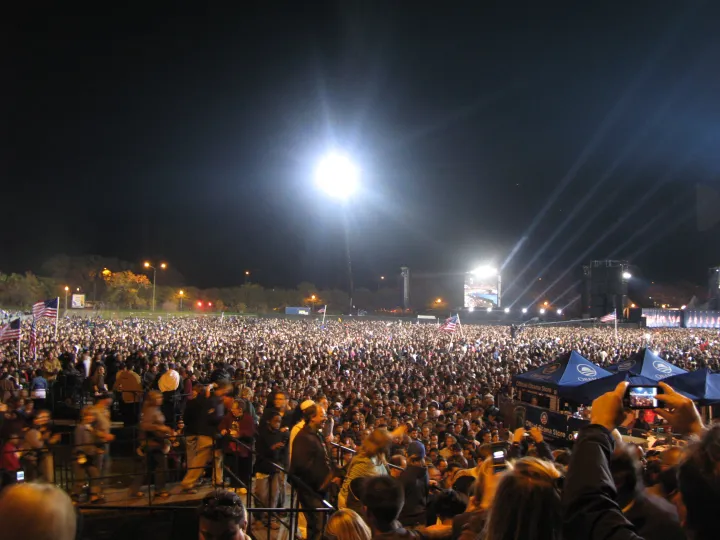
The photographs from that night have an unusual intimacy, even when they are blurred or badly lit. They were made by people standing inside the celebration. Beyond Chicago, other gatherings formed around television screens. At a Washington gas station, a photographer caught spectators applauding beneath the canopy.
A result with room to spare
The certified figures were decisive. Obama received 69,498,516 popular votes, or 52.93 percent; Republican John McCain received 59,948,323, or 45.65 percent, according to the Federal Election Commission. The eventual electoral vote was 365 for Obama and 173 for McCain. Joe Biden and Sarah Palin received the corresponding vice-presidential votes.
That result reached well beyond Obama's home state. He carried Florida, Virginia, North Carolina, Indiana and Colorado, among others. Nebraska supplied a smaller curiosity: Obama won its Second Congressional District and one electoral vote, while McCain took the other four. It was the first split since Nebraska had adopted its district-based allocation system.
The victory completed a rapid ascent. Obama had been elected to the U.S. Senate only four years earlier, after serving in the Illinois legislature. He announced his presidential candidacy in February 2007 and accepted the Democratic nomination in Denver in August 2008. By November, the campaign had reached its finish under conditions very different from those at its beginning.
The crisis behind the celebration
September had brought the collapse of Lehman Brothers, extraordinary intervention to support AIG, and widening alarm across the financial system. The Federal Reserve's account of the year describes a sharp deterioration in credit markets and economic activity during the autumn. Whoever won would inherit a country already confronting a severe emergency.
Obama acknowledged that burden in Chicago. Alongside thanks to organizers and voters, his speech turned to the wars in Iraq and Afghanistan, families struggling with mortgages and medical bills, and the difficulty of the work ahead. He cautioned that progress would take time. Then, in a small domestic interruption to the grand occasion, he told his daughters they had earned a puppy for the White House.
There were disappointed voters elsewhere. In Phoenix, McCain conceded and urged his supporters to help the next president. He explicitly recognized the election's significance for African Americans. He also acknowledged that the two candidates' differences remained. Accepting the result did not require pretending that the campaign's arguments had disappeared.
The night and the office
Obama's election broke a barrier whose meaning extended beyond a party victory. It did not settle the country's disputes over race, government or the economy. McCain's concession and Obama's acceptance speech both addressed the work of governing people who had voted the other way.
That distinction matters when looking back at the cheering faces and flags. Election night gave the crowd a result to celebrate; it could not supply the record of a presidency that had yet to begin. Obama resigned his Senate seat on November 16. On January 20, 2009, he took office as the forty-fourth president.
For a few hours on November 4, the public ceremony belonged to the voters. Some watched a distant platform in Grant Park. Others stood around a television at a gas station. Both became part of the photographic record of the same night.
Cover image: janeyhenning / Flickr via Wikimedia Commons · CC BY 2.0