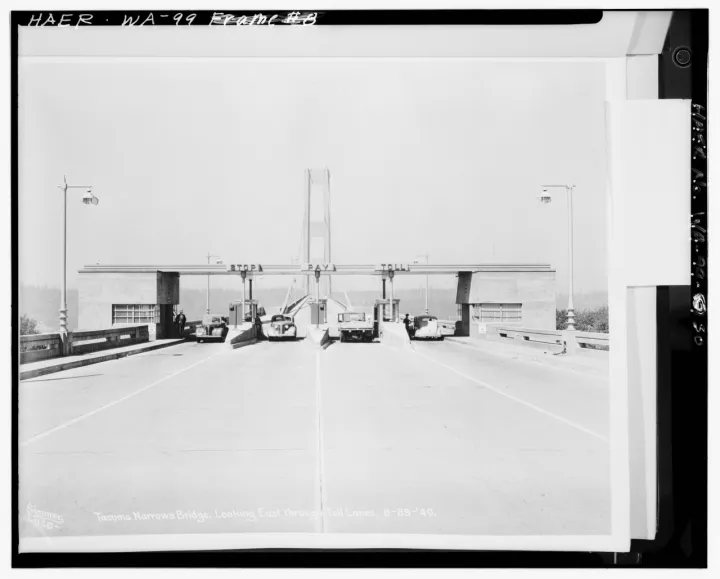
The bridge had opened on July 1. Photographs from that summer show crowds, cars and an elegant suspension span linking Tacoma with the Kitsap Peninsula. Only four months separated the celebration from the wreck. The surviving opening program, with its illustration of a graceful bridge, belongs beside the collapse footage: it records what the crossing was supposed to become.
A slender bridge with a visible problem
The design used shallow, solid steel plate girders along the roadway. They gave the deck its clean profile but provided much less resistance to twisting than deeper, open trusses. The central span stretched 2,800 feet. Its eight-foot-deep girders were exceptionally slender in relation to that distance.
Movement was evident before opening day. As workers finished the floor in May, the deck developed vertical waves. Hydraulic buffers did little to quiet them. Engineers brought in University of Washington professor F. Bert Farquharson, who studied scale models and watched the full-size bridge. Tie-down cables were added during the autumn, with limited success.
Farquharson’s models also revealed a more alarming movement: twisting. His study, completed on November 2, recommended changing how air passed around the solid girders, either by opening them up or fitting curved deflectors. Preparations for the deflectors were under way when the bridge failed five days later. The warning had arrived. The remedy had not.
The morning the movement changed
Strong winds blew across the Narrows on November 7. At first, the roadway performed its familiar vertical wave. Shortly after ten, that motion changed into violent twisting. Officials closed the crossing. Newspaper editor Leonard Coatsworth abandoned his car and struggled toward the Tacoma end; his daughter’s dog, Tubby, remained inside.
Farquharson and several photographers stayed long enough to record what was happening. Attempts to recover Tubby failed. Around eleven, large sections of deck began breaking away. Within minutes, the center span had fallen into the water, taking the car and dog with it.
The film made the failure unusually visible. It also encouraged a misleadingly simple explanation: wind had pushed the bridge at just the right rhythm, as someone pushes a child on a swing. That familiar classroom account confuses the mechanism.
What the wind was doing
The destructive motion is understood as torsional flutter. As the deck twisted, it changed the airflow around itself. The resulting aerodynamic forces fed energy back into the twisting movement. Once that feedback overcame the structure’s ability to dissipate energy, the oscillation grew. A steady wind could sustain the process; it did not need to deliver a sequence of timed gusts.
This distinction matters beyond a physics lesson. Calculating how much weight a bridge could carry did not settle how its particular shape would behave in moving air. The interaction between structure and airflow had to become part of the design problem.
A federal investigation followed. Its March 1941 report identified the bridge’s excessive flexibility and called for better understanding of aerodynamic behavior. The failure helped establish wind-tunnel testing as a standard part of suspension-bridge development. The replacement, opened in 1950, reused the surviving piers and anchorages but embodied a different approach to the deck.
The first Tacoma bridge is remembered for its last hour. The quieter records are revealing too: workers spinning a cable, cars arriving on opening day, the toll lanes standing ready in August. They show an ordinary working crossing before its motion became one of engineering’s most studied failures.
Cover image: Unknown original photographer; HAER archival reproduction / Library of Congress, HAER WA-99, image 30. Public domain in the United States; NPS/HAER record