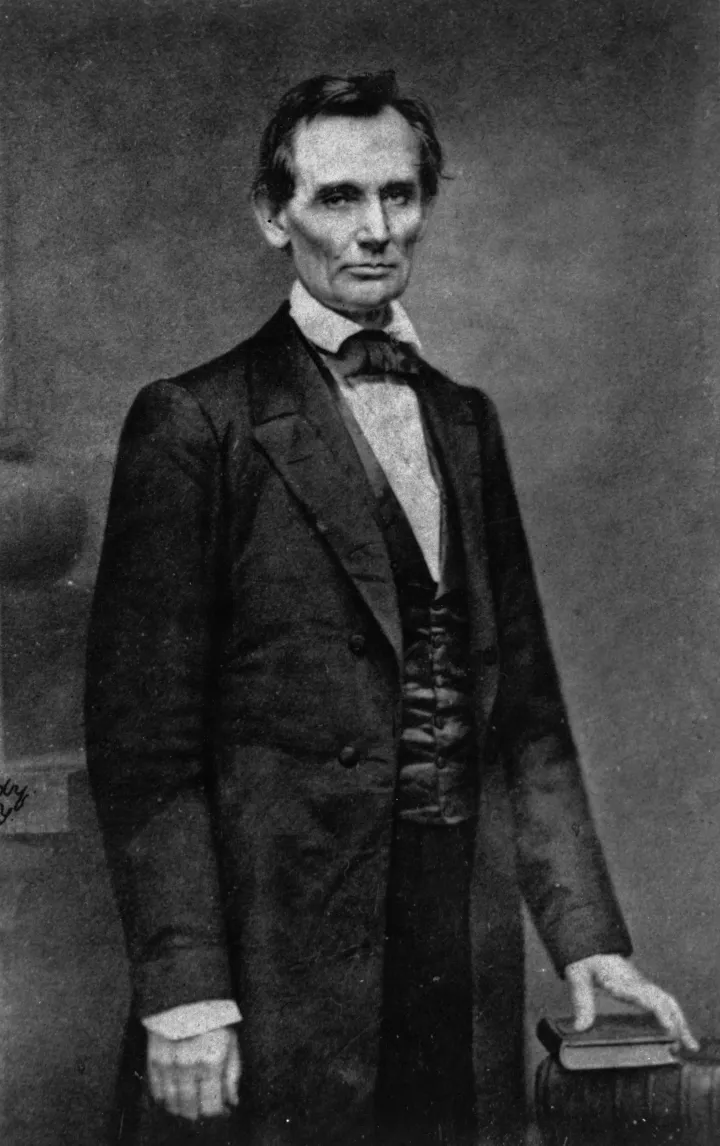
The contest had four principal candidates. Stephen A. Douglas represented one wing of a divided Democratic Party; Vice President John C. Breckinridge represented the other. John Bell stood for the Constitutional Union Party. Lincoln and his running mate, Hannibal Hamlin, offered a Republican alternative. The returns exposed divisions that campaign art had tried to package into reassuring flags, familiar faces and patriotic emblems.
The dispute was slavery
The division concerned the future of slavery. The Republican platform opposed its expansion into federal territories. Lincoln was not running on a promise to abolish slavery immediately in the states where it already existed. Northern Democrats backed popular sovereignty, allowing settlers to decide the question, while Southern Democrats demanded federal protection for slaveholding in the territories. Those differences helped break the Democratic Party apart.
Lincoln’s assurances about existing slave states did not satisfy Southern secessionists. They feared that containing slavery geographically would undermine its political power and threaten its long-term survival. The election therefore carried more than a change of officeholders: it placed the federal executive in the hands of a party organized against slavery’s further spread.
A campaign carried through print
One surviving Lincoln–Hamlin banner is little more than a small flag with two names printed across it. Another surrounds their portraits with an eagle, a rail fence, books and the White House. These were practical objects of persuasion. They made a comparatively new party recognizable, connected its candidates with national institutions and gave supporters something to display.
The rail fence mattered because Lincoln's public image emphasized work and modest origins. Yet the elaborate printed banner also advertised order and respectability. The Constitution, laws and Bible appear beneath the candidates. Its makers presented Republican victory as a legitimate inheritance of the nation, not a break with it. That is an interpretation of the image's design; the print itself cannot tell us how every viewer responded.
Political cartoons were less restrained. In Storming the Castle, Lincoln guards the White House while rival candidates try to get inside. He wears the cap and cape associated with the Wide Awakes, Republican marching clubs. The joke turns a complicated election into a contest over a building. It also shows how closely street organizing and printed propaganda could reinforce one another.
The map behind the totals
According to the National Archives, Lincoln carried New York's 35 electoral votes and Pennsylvania's 27, as well as the other major building blocks of his Northern coalition. Douglas received only 12 electoral votes. Breckinridge won 72 and Bell 39. Popular support and electoral strength did not line up neatly: Douglas's substantial national vote translated into few state victories.
A telegram sent by B. J. F. Hanna to Lincoln on election day survives in the Library of Congress. It belongs to the working paperwork of a campaign waiting for returns. Unlike a later commemorative painting, this document was part of the event itself. Its date anchors the larger collection of portraits, banners and cartoons to November 6.
Victory before the rupture
The election did not begin the shooting war that night. It opened an immediate political crisis. South Carolina Senator James Chesnut resigned on November 10 and returned home to help prepare secession; James Hammond followed him out of the Senate. By the time Congress assembled in December, the election's consequences were already reshaping national government.
Confederate guns fired on Fort Sumter on April 12, 1861. Keeping that date separate from November 6 matters. Election, secession and war were connected, but each involved further decisions. Lincoln's victory showed that a sectional coalition could control the presidency. The response of Southern secessionists turned that constitutional result into a struggle over whether the Union would survive.
Cover photograph: Mathew Brady, February 27, 1860. Library of Congress, cph.3a09102; via Wikimedia Commons. Public domain. Archive record linked under Sources.